
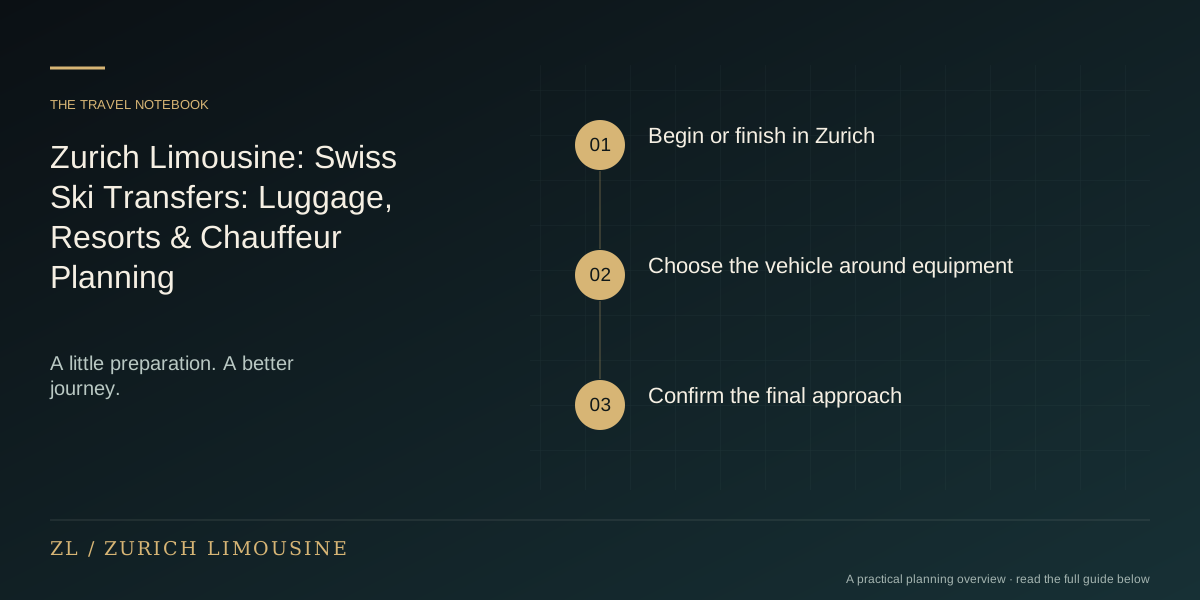
Begin or finish in Zurich
This guide is for a private limousine itinerary with Zurich as its starting point or final destination. Choose a Zurich city address or Zurich Airport and describe the destination, any stops and the return arrangement. Share your actual schedule so the team can review the full journey and offer the right chauffeur service.
Choose the vehicle around equipment
Skis, snowboards, boots and winter luggage take space in different ways. Give the team the number of equipment bags and their approximate size, then list suitcases and cabin bags separately. Do not treat the maximum passenger number as a guarantee of luggage capacity. If you are uncertain, describe the load and ask for a vehicle recommendation before booking.
Confirm the final approach
Ask the hotel or chalet host for current road-arrival instructions. Some properties have a separate driveway, a designated luggage point or a final approach that needs a local arrangement. Send those instructions with your request. If the destination is car-free, establish where the conventional vehicle transfer ends and who will arrange the onward connection.
Plan the handover for car-free places
Zermatt illustrates why the final connection matters. For a typical road transfer, Täsch is the handover point for onward travel to the village. Confirm the exact meeting place and the separate onward arrangements with the relevant provider or your accommodation. Luggage assistance and local transport are included only when expressly agreed.
Give winter journeys some breathing room
Weather, road conditions and holiday traffic can affect mountain travel. Share your flight schedule and any important arrival deadline so the dispatcher can assess the plan. Do not rely on the shortest route estimate as a promise. If the return journey follows a morning on the slopes, make the timing realistic before you commit to it.
Prepare for family travel
Include children in the passenger count and state their ages when requesting child seats. Add pushchairs and any special luggage. If a comfort stop would help the group, discuss it when the route is planned. The right combination of seats, bags and pauses is easier to arrange before departure than at the airport kerb.
Agree what happens during the stay
A one-way arrival transfer does not provide a chauffeur throughout a ski holiday. If you need trips to restaurants, shopping or another resort, send a separate programme or request retained chauffeur time. Include collection times, destinations and the expected finish. The written offer should distinguish these services from the airport transfer.
Measure the awkward item first
A long ski bag can be the deciding factor even when there are empty seats. Measure its packed length and note whether it is rigid or flexible. Count a double ski bag as one physical bag but explain what is inside and how large it becomes. A useful load description might be four passengers, three suitcases, two long ski bags and four boot bags. Those figures are an example for communicating a load, not a capacity promise for any vehicle. Photographing your packed bags for the dispatcher can help when dimensions are difficult to describe.
Make the return morning a separate plan
Work backwards from the flight or train connection with the transport team. Include checkout, packing equipment, collecting stored luggage and reaching the accessible pickup point. Do not schedule a final ski lesson and an airport collection for the same moment. If the chalet requires a local shuttle to the main road, confirm who runs that shuttle and where the luggage changes vehicles. Keep essential documents and any items you need during the journey in a small bag you can reach without unloading skis.
Compare the resort name with the property location
A resort name can cover accommodation across a large valley or on a restricted final approach. Find the actual property address and ask the host how a road vehicle should reach it in the travel season. A summer instruction may not describe the winter entrance. If the property has several buildings, identify the one containing reception or your apartment. Do not infer vehicle access from the shortest line shown on a map. Forward the host’s current instructions to the transport team and ask for the arrival endpoint to be included in the offer.
Distinguish hired equipment from equipment travelling with you
If equipment will be hired at the resort, explain whether you want to stop at the rental shop on arrival or travel directly to the accommodation. The shop address and planned stop duration belong in the itinerary. If you bring equipment from home, include its packed dimensions in the luggage inventory. Do not list ski boots only as footwear if they are travelling in separate bags; those bags still use storage. On departure, allow time to return hired equipment before the agreed pickup. The driver’s presence does not extend a rental shop’s opening hours or guarantee that a collection can happen immediately.
Use one inventory for a multi-family party
Ask each household for its luggage and equipment count, then combine them into one current list. Keep passenger ages and child-seat requests with the appropriate family so the organiser can check the arrangement. If one family arrives on a later flight, do not assume the whole group can wait without changing the quote. Agree which adult handles communication and how changes reach the other travellers. A useful planning document distinguishes what is loaded at the airport from equipment collected later. It also avoids counting the same pushchair twice because two people included it in separate messages.
Treat weather as a planning input, not a promise
Mountain travel can involve conditions that differ between the departure city and the final valley. Ask the team to review the itinerary for the actual date and follow current destination guidance. A comfortable vehicle does not remove road closures or weather-related disruption. If you have a fixed dinner reservation, lesson or onward connection, state that constraint before accepting an itinerary. Keep flexibility around activities that depend on the arrival journey. When conditions change, ask for the revised plan and its implications rather than demanding a driving time taken from a normal-weather estimate.
Prepare for the journey as well as the destination
Keep small essentials accessible while the larger luggage is packed away. For families, discuss whether a planned comfort stop is useful and include it in the request. Ask about the practical arrangement for getting in and out with children or anyone needing assistance, especially if the final pickup is outdoors. Carry the accommodation contact and address where you can retrieve them quickly. After unloading, count equipment bags before the vehicle departs and check that no boot bag or small case remains behind. This is particularly helpful when identical-looking ski bags belong to different households.
Keep the resort handover practical
Ask your accommodation where unloading is permitted and whether reception can receive equipment before room check-in. A ski bag left with the hotel is a different arrangement from a vehicle waiting while the party collects rental equipment. Clarify that distinction when requesting stops. On departure day, allow your group to return rented items and dry or pack equipment before the agreed collection; those tasks should not be discovered while the chauffeur is waiting.
Your travel checklist
- Count ski and snowboard bags, with approximate lengths
- Include boot bags, pushchairs and ordinary suitcases
- Ask the property for winter road-arrival instructions
- Agree any final rail or authorised local transfer
- Share the return flight and the time you can actually leave
Questions about this journey
Will a seven-passenger van carry seven people and all their skis?+
Not necessarily. Seats and storage are separate constraints. Send the packed equipment dimensions and complete luggage count for a load assessment.
Does a Zermatt transfer always finish at the hotel door?+
No. Conventional road travel normally requires a handover at Täsch, followed by rail or an authorised local arrangement. Confirm the final leg with your accommodation and transport providers.
Can the itinerary include another resort?+
Yes, request it as an additional leg with the date, addresses, equipment and expected stop duration. Availability and the complete itinerary must be agreed.
Useful official sources
Check current information for your travel date.