
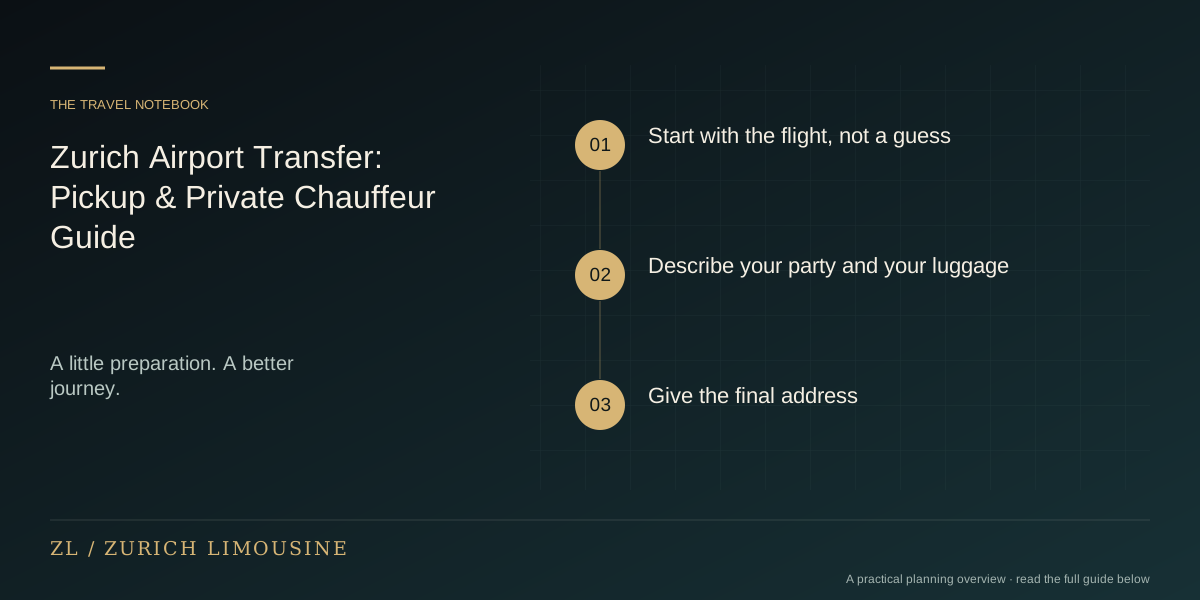
Start with the flight, not a guess
Send the flight number and the arrival date shown on your itinerary. The flight number identifies the arrival more clearly than an approximate time. If a connection changes or a replacement flight is issued, tell the dispatcher and ask for the revised arrangement to be confirmed. A previous confirmation should not be assumed to cover a different arrival automatically.
Describe your party and your luggage
Count adults and children, then describe the luggage separately. Several passengers travelling with small bags may fit a different vehicle from the same group with large suitcases, a pushchair and sports equipment. Mention the ages of children who need seats and any particular seating request. The team can confirm the appropriate vehicle only when it knows what needs to travel.
Give the final address
A destination such as Zurich city or a hotel brand does not identify the exact endpoint. Provide the full address, property name and any vehicle-entrance instructions. If your journey has an additional stop, include that address before accepting the quote. A planned stop should appear in the itinerary and price, rather than being introduced after the chauffeur has started driving.
Know how you will meet
Read the meeting instructions sent with the confirmation and keep a phone available after arrival. Tell the team if you expect difficulty receiving calls or messages. If luggage delivery or another airport process delays you, communicate as soon as you can. Waiting arrangements are governed by the confirmed booking; they should be understood before travel.
Separate an enquiry from a reservation
Completing the journey form prepares a request. It does not allocate a vehicle, charge a card or produce an automatic booking confirmation. The team confirms availability, the total price, payment arrangements and pickup details. Keep that written confirmation accessible during travel, especially if another person made the booking on your behalf.
Keep the return journey clear
If you also need a transfer back to the airport, provide its date, pickup address and flight departure time. Return travel deserves its own schedule. Mention changes in passenger numbers, luggage or additional stops rather than assuming the outward arrangement applies unchanged. A well-defined return journey avoids uncertainty at the end of your stay.
An arrival message that the team can act on
A useful message separates the flight from the pickup arrangement. For example: “Two adults arriving on flight [number] on [date]. Two large cases and two small bags. Destination: [hotel and street address]. Lead passenger: [name and reachable number]. Please confirm the meeting point and waiting allowance.” Replace the brackets with real details. This is a planning example, not an instruction to send personal information in a public comment. If your booking assistant is travelling separately, make sure the passenger also has the final confirmation.
If a bag is missing or your phone will not connect
Do not leave the agreed meeting area to search for the chauffeur without making contact. If baggage is delayed, notify the team with a short update and agree the next step. Keep the telephone number written down as well as stored in your phone. Before flying, discuss a backup contact or meeting arrangement if you will not have mobile service. Airport flight status is useful for tracking the aircraft, but it does not tell the chauffeur that you have finished baggage collection or are ready to leave.
Book for the traveller who will actually arrive
An assistant can prepare a request, but the pickup needs the traveller’s operational details. Give the name the passenger will recognise and a telephone number they can use after landing. Tell the team whether the assistant or passenger should receive decisions about itinerary changes. If the passenger does not speak the language used in the original enquiry, request a suitable communication arrangement before confirmation. Forward the final meeting instructions to the traveller, not just the payment or price information. For a family, identify the adult who will coordinate the group. For a business visitor, avoid putting confidential meeting information into a public-facing name sign.
Handle connecting flights and arrival dates carefully
A long-haul itinerary may begin on one calendar date and arrive in Zurich on another. Use the arrival date at Zurich, then check the local time shown on the flight itinerary. For a connection, send the flight that actually lands at the pickup airport. If several members of the party arrive on different services, list each arrival separately. Ask the team whether one shared pickup is practical before promising it to the group. A flight number without its travel date is incomplete information, and a date without the destination airport may become ambiguous when an itinerary is revised.
Agree the boundaries of meet and greet
Before accepting an offer, ask what the meeting arrangement includes: where the passenger is met, how the traveller identifies the chauffeur, and how delays after landing are handled. Airport access varies, so do not assume that a private chauffeur can enter a restricted area or collect a guest at the aircraft. If assistance with bags or a special escort is important, describe the need explicitly. Keep the confirmed meeting point separate from the address of the airport itself. A map pin can help orient you, but it should supplement written instructions that work inside an airport building.
Use the first destination as a complete address
Hotels with similar names, multiple branches and separate guest entrances can create avoidable uncertainty. Copy the street address from the actual reservation and add the property name. For an apartment, explain whether the car should stop at the street entrance, reception or an accessible loading point. If you need to collect keys elsewhere, make that a planned stop. For a private home, give any useful entrance instructions without sharing access codes unnecessarily. A journey ending at a train station should identify the station, onward departure and any luggage-handling arrangement you need the team to review.
Close the loop before departure day
Review the written offer against the details you sent: flight, local arrival date, destination, party, luggage, vehicle preference and meeting instructions. Ask about any mismatch before travel. Save a copy you can open without a data connection and make sure the contact number is easy to find. On the day, report meaningful changes rather than sending repeated messages with no new information. If you have only a website request reference and no separate acceptance, contact the team to establish the status. The final practical question is simple: does the passenger know who to contact and where to go after leaving the arrival process?
Your travel checklist
- Arrival date and flight number copied from the ticket
- One reachable lead passenger and a backup contact
- Checked bags, cabin bags and oversized items listed separately
- Final street address and hotel vehicle entrance
- Written meeting instructions saved for offline access
Questions about this journey
Should I enter landing time as pickup time?+
Provide the scheduled landing time and flight number, and ask the team to confirm the collection arrangement. The time needed after landing varies; do not invent a fixed baggage allowance.
What changes if my inbound flight is replaced?+
Send the new flight number and arrival date, then ask for the pickup plan to be reconfirmed. A saved request does not automatically track or update your flight.
Where can I check Zurich Airport arrivals?+
Use Zurich Airport’s official arrivals page linked in this guide. The agreed chauffeur meeting point is provided separately with your travel confirmation.
Useful official sources
Check current information for your travel date.