Early Morning Transfer Zurich Airport: The Complete 2026 Guide
56 min read · 12,854 words
Catching a 6 a.m. flight from Zurich or landing before the city wakes up demands a completely different strategy from a midday journey. This guide covers every variable — from road conditions at 3 a.m. to the quietest terminal entrances — so your early start goes exactly to plan.
Why Early Morning Transfers at Zurich Airport Are a Different Beast
Getting a midday transfer to Zurich Airport right is relatively straightforward. You build in a comfortable buffer, check the SBB app, flag a taxi if you need to, and stroll through one of Europe's most efficiently organised terminal buildings with a flat white in hand. The rhythm of the airport at noon is predictable: check-in counters are staffed, the shopping concourse hums, information screens refresh constantly and there are dozens of transport options feeding the forecourt every few minutes.
Between midnight and roughly seven in the morning, every single one of those certainties dissolves.
Early morning transfers to Zurich Airport inhabit a completely different operational universe — one governed by curfew-restricted runway schedules, skeleton ground crews, suspended rail services and roads that behave in ways that would surprise even experienced Zurich commuters. Understanding that universe is not a luxury for fastidious planners; it is the minimum required to avoid genuinely missing a flight, arriving at a closed check-in desk or spending an anxious hour on an empty platform wondering whether the train will show up at all.
This section sets out exactly why the pre-dawn window is its own category of travel challenge, and why the tactics that work perfectly at midday can fail comprehensively before sunrise.
The Airport That Sleeps — But Never Fully Switches Off
Zurich Airport (ZRH) is one of the busiest hubs in continental Europe, handling roughly 30 million passengers in a normal year across three main piers. Airside, it is technically a 24-hour facility in the sense that the terminal building remains physically open throughout the night. Landside and operationally, however, the airport between midnight and 05:30 is a profoundly different institution.
The clearest indicator is staffing. Most long-haul carriers and European network airlines close their check-in counters after their last evening departure and do not reopen them until the first bank of early flights requires it — typically between 04:00 and 05:30, depending on the carrier and route. That means passengers who arrive at the terminal at 03:00 for a 06:00 departure can face a nearly empty check-in hall. Self-service kiosks may be available, but bag-drop queues only open when ground-handling crews arrive to process them. Security lanes are staffed in reduced configuration for the very first wave of departures, often consolidating into a single open lane rather than the full array available at peak hours.
None of this is a problem if you plan around it. It becomes a serious problem if you base your planning on the assumption that the airport operates the same way it does at 11:00.
Curfew Mathematics and the Pressure It Creates
Zurich Airport operates under a night-flight curfew. Commercial aircraft movements are restricted during specific overnight hours (broadly, departures and arrivals are curtailed between approximately 23:30 and 06:00 local time, with precise slot rules managed by Flughafen Zürich AG and regulated by Swiss federal ordinance). The exact boundaries and exceptions are managed at the slot level and can vary slightly by season and aircraft category, but the practical effect for passengers is straightforward: the first wave of departures clusters tightly into a short window after the curfew lifts.
That clustering creates a paradox. The curfew reduces the total number of very early flights, but it concentrates those that do exist into a compressed 90-minute window. A passenger on a 06:10 Zurich–London service and a passenger on a 06:40 Zurich–Frankfurt service are both targeting a narrow slice of infrastructure: the same reopening security lanes, the same first staffed check-in desks, the same first trains and buses to the airport. When everything goes smoothly, the system copes. When one element slips — a delayed chauffeur, a closed platform, roadworks on the A1 — the consequences cascade quickly because there is almost no slack in the system.
This is fundamentally unlike a midday transfer, where a 20-minute delay to your car is irritating but recoverable. At 04:30, a 20-minute delay can be the difference between catching the flight and watching the gate close on the departure board.
Road Conditions: The Counterintuitive Reality
Most travellers assume that the roads to Zurich Airport are easiest before dawn simply because there is less traffic. That assumption is roughly correct but incomplete in ways that matter.
What is genuinely better before dawn:
- The motorway network (A1 from the city, A3 from Zug and the south) runs freely. Journey times from Zurich city centre to ZRH via the A1 are typically 18–28 minutes rather than the 35–55 minutes you might face during morning rush hour between 07:30 and 09:00.
- The airport forecourt and drop-off zones are uncongested. You will not circle the terminal looking for a gap in a taxi queue.
- The Milchbuck tunnel and other urban choke points are clear.
What is not better, or is actively worse:
- Road maintenance and roadworks. The Swiss Federal Roads Office (ASTRA) and cantonal road authorities concentrate scheduled maintenance in low-traffic overnight windows precisely because they can. Overnight lane closures, contraflows and surface works on the A1 and on the airport approach roads (particularly the Kloten ring road sections) are significantly more common between 22:00 and 06:00 than during the day. A driver who has not checked the ASTRA traffic portal or the canton's overnight works schedule may encounter a diversion that adds 15–25 minutes to a route that otherwise takes 20.
- Reduced visibility and winter conditions. Between November and March, early morning ground-level fog (Hochnebel) is extremely common across the Mittelland, including the Glattal basin where Zurich Airport sits. Black ice is a real hazard on ungritted secondary roads between roughly 02:00 and 06:00, before municipal gritting schedules reach their peak. A professional chauffeur with winter-equipped vehicles and local knowledge of alternative routing is not a luxury in these conditions; it is measurably safer.
- Psychological impact on amateur drivers. The combination of darkness, unfamiliarity with overnight road configurations and personal sleep deprivation makes self-driving before dawn statistically more hazardous. Swiss accident data consistently shows elevated rates of single-vehicle incidents in the early morning hours, particularly on motorway sections.
The Psychological Dimension: Travelling While Sleep-Deprived
This element is almost never discussed in airport transfer guides, yet it shapes the entire early morning experience.
A passenger taking a 06:00 flight from Zurich has, in most realistic scenarios, slept between two and five hours — if they slept at all. They set an alarm for 03:30 or 04:00, moved through a dark, quiet home with a suitcase, and arrived at a car or a station platform in a state of cognitive impairment that researchers consistently compare to mild intoxication in terms of its effect on reaction time, decision-making and stress tolerance.
In that state, small logistical problems are magnified. An empty taxi rank that would be a minor annoyance at noon triggers disproportionate anxiety at 04:15. A confusing announcement about platform changes at Zurich HB — delivered in rapid Swiss German over a crackling PA — becomes genuinely difficult to parse. A check-in agent who asks a routine question about connecting flights in a brisk tone lands differently when you have had three hours of broken sleep.
The relevance for transfer planning is this: the system you build around an early morning departure should require as few real-time decisions from you as possible. Every variable you can eliminate in advance — vehicle availability, routing, meeting point, waiting time — is cognitive load you do not have to carry at 04:30 when your brain is operating at a fraction of its daytime capacity.
Why the Midday Playbook Fails
To crystallise why early morning transfers need a dedicated approach, consider the table below, which compares the same basic transfer task — getting from Zurich city centre to ZRH for a 06:10 departure — as it would unfold at midday versus before dawn.
| Factor | Midday transfer (11:00 departure) | Pre-dawn transfer (06:10 departure) |
|---|---|---|
| Recommended arrival at airport | 90 minutes before (09:30) | 90–120 minutes before (04:10–04:40) |
| S-Bahn frequency | Every 10–15 minutes | Every 30 minutes or suspended |
| Taxi availability at pickup | Abundant | Sparse to none in outer districts |
| Road journey time (city–ZRH) | 35–55 min (rush risk) | 18–28 min (maintenance risk) |
| Check-in desks open on arrival | Yes, fully staffed | Possibly not yet open |
| Security lane configuration | Multiple lanes | One or two lanes, possible queue |
| Fog / ice risk | Low (seasonal) | High (Nov–Mar) |
| Driver pool availability (rideshare) | Very high | Very low; surge pricing likely |
| Cognitive state of traveller | Normal | Significantly impaired |
| Recovery time if transfer fails | Usually recoverable | Often not recoverable |
The midday column is forgiving. Almost every cell in it contains a buffer, an alternative or a fallback. The pre-dawn column is unforgiving. Failures in that column tend to be terminal — for the journey, if not for the flight.
That asymmetry is the core reason why early morning transfers to Zurich Airport deserve to be planned with a level of precision and reliability that no midday trip would ever require.
Decoding Zurich Airport's Early Morning Schedule: Curfews, First Flights and Arrivals
Zurich Airport runs on a tighter clock than many travellers realise. Unlike hub airports in the Gulf or Southeast Asia that operate around the clock as a matter of commercial identity, Zürich Flughafen (IATA: ZRH) is embedded in one of Europe's most noise-sensitive urban environments. The result is a carefully legislated operating window that compresses an enormous amount of passenger movement into a very short period at each end of the day — and nowhere is that compression more acute than in the first ninety minutes after the airport wakes up.
The Night Flight Restriction: What the Curfew Actually Means
Switzerland's Federal Office of Civil Aviation (BAZL/OFAC) enforces operating regulations that effectively impose a commercial night-flight restriction at Zurich Airport. The published quiet period runs from approximately 23:30 to 06:00, during which scheduled commercial movements — both arrivals and departures — are prohibited or very heavily restricted. The precise rules distinguish between aircraft noise categories, and there are limited exceptions for cargo operations, technical diversions and emergency flights, but for the purposes of a passenger planning an early morning transfer, the practical takeaway is straightforward: almost nothing moves before six in the morning.
This is not a soft guideline. It is a condition of the airport's operating licence, and it is monitored and enforced with Swiss rigour. Airlines that repeatedly violate curfew timings face fines and, in serious cases, slot penalties. The consequence for passengers is that the first wave of departures does not trickle out gently across an extended pre-dawn window — it erupts all at once, shortly after 06:00, with a concentration of aircraft pushbacks that can make the first hour of the morning operationally intense for ground staff and ground transport alike.
When the First Flights Actually Depart
The earliest scheduled commercial departures at ZRH typically bank around the 06:05–06:15 window, depending on the season and that year's slot allocation. Swiss International Air Lines, which operates the largest schedule from Zurich, typically slots its earliest European departures — to London, Paris, Frankfurt, Amsterdam and the major Scandinavian cities — into this opening window. These are genuinely popular flights: they serve business travellers who need to be at a meeting in another European city by mid-morning, and they sell well.
What this means in practice is that passengers on those flights need to be airside, through security, by no later than 05:30, and many airlines recommend check-in closure at 05:45 for short-haul routes. For long-haul departures — of which there are fewer in the very early morning — check-in requirements are more demanding still. Working backwards from a 06:10 departure, a passenger checking in luggage should be at the check-in desk by 04:30 at the latest, which places their arrival at the airport somewhere between 04:15 and 04:30. That is the window that drives the demand for true pre-dawn transfers, and it is earlier than most casual travellers anticipate when they first look at their boarding pass.
The First Arrivals: A Thinner but Significant Flow
The arrival picture in the early morning is somewhat different. Because of the curfew, no commercial passenger flights land before roughly 06:00. The earliest arrivals tend to be overnight services from long-haul destinations — transatlantic routes from North America, connections routed through Middle Eastern hubs — that time their arrival windows to coincide with the curfew's end. In practice, the first handful of arrivals at Zurich typically touch down between 06:00 and 06:30, with the flow building meaningfully through 07:00 to 08:30 as intra-European morning services arrive from London, Paris, Amsterdam, Vienna and the major German cities.
For anyone booking a chauffeur car to meet an arriving passenger, the important point is that the first arrivals clear immigration and baggage reclaim at a moment when the airport is still at relatively low staffing levels. Passport control for non-Schengen arrivals can move quickly at 06:15 simply because there are fewer passengers, or it can be unexpectedly slow if several intercontinental aircraft land within minutes of one another and queues form before all booths are fully staffed. A buffer of at least thirty to forty-five minutes beyond the scheduled landing time should be factored into any pickup calculation.
Terminal 1 and Terminal 2: How They Open and What Differs
Zurich Airport's passenger terminal is physically divided into what is colloquially referred to as Terminal A/B/D on the airside (the gate areas) and Terminal E (the satellite, accessed by an underground transit train) — but for landside purposes the distinction that matters most to early morning travellers is between the main terminal building and the various check-in zones within it, which the airport labels by check-in rows.
For simplicity, the airport commonly refers to its main structure and the satellite as Terminal 1 and Terminal 2 in public-facing communications, where Terminal 2 denotes the satellite building (Terminal E) reached via the Skymetro automated people-mover running every ninety seconds in normal operations.
The critical point for early morning travellers is that Terminal 2 / the E-gates satellite does not open for passengers simultaneously with the main terminal. In the early morning period, the Skymetro typically begins passenger service around 05:00, aligned with the first check-in processes beginning for the 06:xx departure wave. Before that time, the satellite is inaccessible to landside passengers. If your gate is in the E concourse — which handles many of the Schengen-area flights operated by Swiss and its partners — and you arrive at the airport at 04:30, you should expect to wait landside in the main terminal until the satellite access point opens.
The main terminal check-in zones (rows A through P roughly, handling Swiss, Lufthansa, Star Alliance carriers and others) are accessible somewhat earlier, but the retail, food and beverage offer will be extremely limited before 05:30. Do not plan to have a sit-down breakfast before your flight if you are departing in the 06:xx window — you will be fortunate to find a vending machine and a staffed coffee counter.
Airside Walking Distances That Matter at 05:30
Once through security, airside Zurich is more expansive than its landside footprint suggests. The following distances and transit times are worth understanding before you arrive:
| From security exit | To gate area | Approximate walking time | Notes |
|---|---|---|---|
| Main security (A-side) | Gates A (non-Schengen, upper level) | 5–8 minutes | Straightforward, mostly flat |
| Main security (B-side) | Gates B (Schengen, incl. Swiss hub) | 4–6 minutes | Short walk, busy at 06:xx |
| Main security (B-side) | Terminal E satellite (via Skymetro) | 12–16 minutes door-to-door | Includes walk + automated train |
| Main security (A-side) | Gates D (non-Schengen, lower level) | 6–10 minutes | Can feel long with carry-on |
The Skymetro leg to Terminal E is the one that catches passengers off guard most often. The train itself takes under two minutes once boarded, but the total journey from the security checkpoint — including the walk to the departure level, the boarding queue and the walk at the other end — reliably takes twelve to sixteen minutes when the airport is operating normally. At 05:30, with minimal staff and sporadic Skymetro frequency as the system spools up, it can take longer.
If you know your gate is in the E concourse and you are on a 06:05 departure, the arithmetic is unforgiving. Security at ZRH at 05:00–05:15 is typically fast — one or two lanes open, very short queues — but this advantage evaporates instantly if there is any delay at any point. Swiss's app and the airport's own FIDS (flight information display system) will show your gate as soon as it is allocated, and E-gates are shown as such. Check before you leave for the airport if possible.
How the Curfew Shapes the Entire Morning Passenger Flow
The compression effect of the curfew is worth understanding in full because it cascades through every system the airport operates. When the curfew lifts at approximately 06:00, Zurich does not ease gently into its operating day. It starts at close to full capacity within minutes. Ground handlers, baggage staff, security lanes and check-in agents all ramp up simultaneously for the morning wave, which typically peaks between 06:30 and 08:30 in terms of departing passenger volume.
This means:
- Security queues, which are negligible at 04:45, can grow to ten to fifteen minutes or more by 06:00 as the next cohort of passengers — those on 07:xx and 08:xx departures — begins arriving.
- The drop-off zone and car park access roads around the terminal become noticeably busier after 05:30 as taxis, private cars and transfer vehicles all converge for the first wave.
- Baggage reclaim for early arrivals, by contrast, can be surprisingly efficient at 06:15 precisely because the system has not yet reached its daytime throughput.
Understanding this rhythm is what separates a relaxed early morning at Zurich Airport from a stressful one. The airport rewards passengers who arrive a few minutes ahead of the crowd — and penalises, with unusual efficiency, those who miscalculate and arrive just as the compression peaks.
Road Conditions and Journey Times: Zurich Before and After Dawn
The stretch of tarmac between Zurich's city centre and Kloten is one of the most scrutinised corridors in Swiss mobility — and for good reason. Hundreds of early departures stack up before 07:00, and the road network that carries them behaves in ways that bear almost no resemblance to a midday drive. Understanding exactly what happens on those roads at 03:00, 04:30 and 05:30 versus the onset of rush hour is the single most useful piece of planning knowledge a frequent early-morning traveller can have.
The Motorway Anatomy: A1, Stadtautobahn and Butzenbüel
To set the scene properly, it helps to know the specific road segments involved. Most airport-bound journeys from central Zurich use one of two primary corridors:
- The A1 via Dietlikon — the canonical motorway route from the city's northern edge, passing through the Oerlikon interchange and then east towards Kloten. This is the route most professional chauffeurs default to for city-centre pickups, carrying traffic from Wiedikon, Altstetten and the Hardbrücke quarter.
- The Stadtautobahn (A1/A3 urban expressway) — the elevated and semi-tunnelled section running through the city itself, connecting the south-western neighbourhoods and the Uetlibergtunnel corridor with the northern ring road. Its narrow lanes and tight curves make it sensitive to even minor incidents at any hour.
- The Butzenbüel tunnel — a shorter but tactically important segment used on the Winterthur-side approach and occasionally as a bypass option when the main A1 interchange near Seebach backs up.
Each of these segments has its own behavioural rhythm in the small hours, and a driver who knows that rhythm can shave ten to fifteen minutes off a journey without breaking any speed limits.
03:00 — The Cleanest Window
At 03:00, Zurich's roads are as close to empty as they ever get on a working day. Night buses are running their last circuits, a handful of logistics lorries are repositioning, and the airport's cargo operations generate some heavy-vehicle movement on the A1's outer lanes near Kloten — but passenger car traffic is negligible.
Realistic journey times at 03:00:
| Origin | Distance to ZRH | 03:00 journey time | Midday comparison |
|---|---|---|---|
| Zurich city centre (Hauptbahnhof) | ~13 km | 14–18 min | 22–35 min |
| Zurich Enge / Seefeld | ~16 km | 18–22 min | 28–42 min |
| Zug | ~40 km | 30–36 min | 45–65 min |
| Lucerne | ~63 km | 44–52 min | 65–90 min |
| Küsnacht / Küssnacht am Rigi area (lake communities) | ~25 km | 22–28 min | 35–55 min |
| Meilen / Stäfa (eastern lake shore) | ~33 km | 28–34 min | 48–65 min |
All figures assume normal weather, no incidents and a professional driver following standard routing. Treat these as realistic planning benchmarks, not guarantees.
The Stadtautobahn through the city is particularly well-behaved at this hour. The traffic signal coordination that normally staggers flow along Seebahnstrasse and Escher-Wyss-Platz is irrelevant — a driver can move at a smooth, unbroken pace from the Sihlhölzli area all the way to the Schipfe without touching a queue. The Butzenbüel tunnel is open and clear, with no lane restrictions from overnight maintenance except during pre-planned closures (which ASTRA publishes in advance).
04:00 — The First Stirring
By 04:00, the character of the roads starts to shift almost imperceptibly. Airport staff shifts begin. Cargo handlers, ground crew and early check-in agents are driving in from the Zurich agglomeration — Bülach, Embrach, Bassersdorf and the northern communes that sit within fifteen minutes of the terminal. The A1's Kloten exit and the Hochbord interchange see a small but measurable increase in volume.
This is rarely enough to cause queues, but it does introduce the first element of variability. A driver familiar with the airport's staffing rhythms will know, for example, that the access road to Terminal 1's departures level can slow briefly around 04:15–04:45 as shift workers arrive by car and the first dedicated airport buses are loading.
From city-centre origins, 04:00 adds roughly two to four minutes to the 03:00 benchmarks. From further-out origins — Zug, Lucerne, the southern lake shore — the difference is negligible because those journeys spend most of their time on the A4 or A14 motorways, which remain very quiet until after 05:00.
05:30 — The Tipping Point
This is where the morning stops behaving generously. The period between roughly 05:20 and 06:15 is the single most consequential window for early departure travellers, for two reasons that compound each other.
First, leisure and business travellers heading for the first wave of departures (typically 06:00–07:30 flights) are now actively on the road. Many of them set out from Zurich, Winterthur, Baden and the lake communities between 04:45 and 05:30. Second, the city's urban traffic signals transition from night mode to morning mode, introducing coordinated stop-start sequences that interrupt flow on the Stadtautobahn feeder roads.
The Butzenbüel tunnel becomes a minor bottleneck at this hour on certain configurations — not because of congestion per se, but because the lane narrows before its eastern portal and a single slow vehicle can force a brief speed reduction that ripples back 500 metres.
Realistic journey times at 05:30:
| Origin | 05:30 journey time | Vs. 03:00 |
|---|---|---|
| Zurich city centre (Hauptbahnhof) | 18–26 min | +4–8 min |
| Zurich Enge / Seefeld | 22–30 min | +4–8 min |
| Zug | 36–45 min | +6–9 min |
| Lucerne | 52–65 min | +8–13 min |
| Meilen / Stäfa | 34–44 min | +6–10 min |
The Lucerne corridor is particularly worthy of attention. The A14 between Lucerne and Rotkreuz is a well-maintained dual carriageway, but it funnels into the A4 interchange at Blegi, which can carry unexpected density at 05:30 when multiple traveller streams merge. A driver timing a Lucerne pickup for a 06:55 flight has very little margin if the A4/A14 merge point misbehaves — and it does, perhaps one morning in five during the April–October travel season.
07:00 — Rush Hour Takes Hold
By 07:00, the roads around Zurich are a fundamentally different proposition. The Stadtautobahn's northbound lanes from Brunau towards Schwamendingen carry commuter volumes that, on a busy Tuesday or Thursday, create standing queues at the Leutschenbach interchange. The A1 from Dietlikon towards Kloten — normally a relaxed three-lane run — backs up at the Zurich-Ost junction on mornings when any minor incident occurs.
Journey times from the city centre to the airport can reach 40 to 50 minutes in poor conditions, and from Zug or Lucerne the 65–75-minute bracket is realistic. For a traveller with a 07:30 or 08:00 departure, the window between "fine" and "genuinely tight" is narrow.
What makes this especially tricky is the absence of a reliable linear relationship between time and traffic. A journey that took 19 minutes at 05:15 on Monday morning may take 38 minutes at 05:40 on Friday, not because of anything dramatic, but because Friday morning traffic density in Switzerland reaches its weekly peak as commuters, business travellers and leisure passengers all converge simultaneously.
Why Google Maps Is Not Your Friend for Pre-Booking
This is a genuinely important practical point that catches experienced travellers out. Google Maps' traffic predictions for pre-dawn hours are based on historical aggregate data that smooths over exactly the variability described above. When you open Maps at 21:00 the night before and ask it to estimate the journey time for a 04:30 departure, it returns a figure derived from a statistical average of all previous similar-time journeys in its dataset — it cannot account for:
- Whether tonight is the morning before a Swiss national holiday, when cargo traffic patterns shift
- Whether the A1 near Seebach has a pre-planned overnight maintenance closure (visible on ASTRA's website but not always reflected promptly in Maps)
- Whether last night's rain has left standing water near the Butzenbüel portal, where drainage is imperfect and vehicles slow voluntarily
- Whether a flight diversion or charter programme has pushed unusual vehicle volumes through the access roads around 04:00
A seasoned chauffeur working an early-morning shift builds their departure timing from a combination of institutional knowledge, their own observed track record on that specific corridor, and a check of ASTRA traffic status and the airport's live parking and access dashboards — not from a consumer mapping app. BLACKTRANSFER's drivers, for instance, monitor live conditions via professional-grade tools and adjust pickup timing proactively, rather than relying on algorithms calibrated for daytime commuter behaviour.
The practical takeaway: when you're booking an early-morning transfer, always state your required airport arrival time explicitly rather than asking the operator to back-calculate from a Maps estimate you've done yourself. A good chauffeur service will propose a pickup time based on their own early-hour experience of your specific origin point.
Lake Community Journeys: A Category of Their Own
Travellers from the communities strung along the eastern and western shores of Lake Zurich — Küsnacht, Zollikon, Meilen, Männedorf, Wädenswil, Thalwil, Horgen — face a routing consideration that doesn't arise for city-centre passengers. The lake shore roads themselves (the cantonal roads running parallel to the lake) are not congested at 04:00, but they feed into the A3 motorway at pinch points that can delay a driver who hasn't allowed enough time on the secondary road section.
The western shore (A3 via Thalwil and Brunau) is generally cleaner at pre-dawn hours than the eastern shore (cantonal road via Küsnacht and Zollikon), because the A3 maintains consistent speed limits and the Thalwil and Brunau tunnels are well-lit and smooth-flowing. By contrast, the eastern shore road through Küsnacht and Zollikon has traffic-light-controlled junctions that remain active regardless of the hour and add a few unpredictable minutes on the approach to the Wollishofen interchange.
For a passenger being collected in Meilen at 04:15, the difference between a driver who uses the lake road all the way to Wollishofen and one who cuts up to the A3 at Uetikon is typically five to eight minutes — small in absolute terms, but meaningful when the margin to check-in is already tight.
Public Transport vs Chauffeur Car: Honest Comparison for Pre-Dawn Travellers
Getting to Zurich Airport in the small hours is not a logistical puzzle you want to be solving bleary-eyed at 03:45 on a Tuesday morning. The choice between public transport and a private chauffeur car deserves an honest look — not a glossy brochure assessment, but a ground-level analysis of what actually runs, when it runs, and what it costs you in time, comfort and stress.
What Public Transport Genuinely Offers
Zurich's public transport network is, by any international standard, excellent. The S-Bahn is punctual, clean and affordable, and on a normal weekday the S10 line connects Zurich Hauptbahnhof to Zurich Airport (Kloten) in roughly 13 minutes, with trains running at frequent intervals from early morning until well past midnight. The journey is direct, the airport station sits immediately beneath Terminal 1 (the main Midfield building), and if you are a solo traveller with a single carry-on bag, it is difficult to fault the experience during normal operating hours.
Night buses — the so-called Nachtbüs lines — extend service across the city after the S-Bahn and tram network shuts down, typically from around midnight on Friday and Saturday nights, and on nights preceding public holidays. On standard weeknights (Sunday through Thursday), however, Zurich's night bus provision is significantly thinner. Many routes do not run at all, and those that do operate on hourly intervals rather than the 15- or 30-minute frequencies that daytime commuters take for granted.
The Timetable Gap That Catches Travellers Off Guard
Here is where the honest accounting begins. The first S10 train from Zurich Hauptbahnhof to the airport departs at approximately 05:00–05:08, depending on the day of the week and minor seasonal timetable adjustments. This means that if your flight departs at, say, 06:15 or 06:30 — two of the most common early departure slots at ZRH — you are cutting your ground journey to the absolute minimum. Factor in the following sequence:
- Walk from your accommodation to the nearest S-Bahn stop or to Hauptbahnhof itself
- Wait for the first S10 service
- 13-minute train journey to the airport station
- Walk from the station to check-in (Terminal 2 and some check-in areas require a walk of 5–10 minutes)
- Queue at check-in and bag drop, which at ZRH can open as early as 04:30 for certain carriers but may require a wait
- Security screening, which at early hours can paradoxically be slower because fewer lanes are open
If you live within a five-minute walk of Zurich HB and your flight departs at 06:30, the first S-Bahn just works — on paper. In practice, a three-minute delay, a forgotten item, a longer security queue, or a gate in Concourse B that requires a bus transfer eliminates that margin entirely.
For departures at 06:00 or earlier, the S-Bahn is simply not a viable option without advance planning that most travellers do not undertake. The first service would deposit you at the airport at approximately 05:20 at the very earliest, which leaves fewer than 40 minutes before a 06:00 departure — well below what Swiss and Lufthansa Group carriers recommend as minimum check-in time for intercontinental or even short-haul flights.
The 03:00–04:59 Window: A Genuine Service Desert
Between roughly midnight (when the last S-Bahn to the airport departs) and that first 05:00 departure, Zurich's rail network to the airport is closed. No S-Bahn, no airport express, no direct rail service of any kind. The standard night bus network does not serve Kloten airport directly on weeknights in any meaningful sense — there is no night bus equivalent of the S10.
| Departure window | S-Bahn to ZRH | Night bus to ZRH | Taxi or Chauffeur | Notes |
|---|---|---|---|---|
| 00:00 – 00:30 | Last services running | Limited | Available | Check exact last S10 time on SBB app |
| 00:30 – 04:59 | Not available | Not to airport | Available 24/7 | True service gap for direct rail |
| 05:00 – 05:30 | First services start | Winding down | Available 24/7 | Only works for 06:30+ departures |
| 05:30 onwards | Regular schedule building | Ended | Available 24/7 | Standard traveller window |
This gap is not a flaw in Zurich's transport planning so much as a practical reality: airport curfews mean very few flights land or depart between midnight and approximately 06:00, so the commercial logic for an all-night rail connection is limited. But it does mean that travellers whose flights fall in the 06:00–07:30 departure window — a heavily trafficked slot at ZRH — must make a clear choice between an extremely tight first S-Bahn connection or an alternative ground transport option.
Luggage: The Variable Nobody Mentions
Public transport assessments tend to focus on journey times and ticket prices. What they undercount is the physical experience of moving luggage through a sleeping city at 04:00.
Consider a realistic scenario: a family of four flying to Dubai on an early morning Emirates service, each person carrying one checked bag and one piece of hand luggage. To reach Zurich HB from, say, the Seefeld or Wiedikon districts, they would need to take a night taxi or walk (neither is appealing at 04:00 in February), then manage eight pieces of luggage on a platform, onto an S-Bahn carriage, through the airport station, along the terminal walkways, and to a check-in desk. The S-Bahn does not have luggage racks proportioned for large suitcases during peak times; at 05:00 the train is not crowded, but the ergonomics of heavy luggage on a short urban train remain what they are.
For solo business travellers with a single carry-on, this matters much less. For anyone travelling with a full baggage allowance, with elderly companions, with young children, or with sports equipment, the calculus shifts considerably.
Taxis at Early Hours: The Middle Ground
Street-hail taxis in Zurich are metered, regulated and generally available around the clock, though finding one at 04:00 in a residential neighbourhood requires either luck or a pre-booked call cab. Ride-hailing apps operate in the city, though coverage and surge pricing at unusual hours can vary.
A taxi will get you to the airport. The difference between a standard metered taxi and a pre-booked chauffeur service lies primarily in the layer of certainty: a taxi booked in advance carries the same door-to-door advantage, but a premium transfer service adds professional luggage handling, confirmed pickup timing, a vehicle suitable for the number of passengers and bags in your party, and — critically at 04:00 — a driver who already knows you are coming, knows your flight time, and has accounted for road conditions rather than discovering them en route.
Where a Chauffeur Service Fills the Gap
The genuine advantage of a pre-booked private transfer for early morning airport runs is not luxury in any superficial sense — it is the elimination of variables in a window where variables carry disproportionate consequences. Miss the first S-Bahn and the next one is 30 minutes away; miss a pre-booked chauffeur and the driver is already waiting outside your door.
A service like BLACKTRANSFER, based in Zurich and operating around the clock, picks you up directly from your home, hotel, or office — regardless of whether that address is in the city centre, in a lakeside community like Küsnacht or Herrliberg, or in an outlying municipality like Urdorf or Opfikon. There is no intermediate step, no luggage on staircases, no platform wait in the cold.
The practical checklist of what a pre-booked chauffeur removes from your morning:
- Navigation uncertainty — the driver knows the route, the terminal, and any roadworks
- Luggage handling — bags go from your doorstep into the boot and from the boot to the check-in hall, full stop
- Timing precision — pickup is agreed and confirmed; no guessing at the S-Bahn's first departure to the minute
- Vehicle suitability — a V-Class accommodates up to seven passengers and their full baggage; an E-Class or S-Class suits a solo or duo traveller in comfort
- Waiting removed — no platform, no queue, no connection
It is worth being straightforward about what a chauffeur transfer does not eliminate: it cannot shorten security queues, guarantee gate proximity, or override an airline's check-in deadline. These remain your responsibility. What the ground transfer removes is the risk that the journey to the airport itself introduces any delay or uncertainty into an already compressed schedule.
Cost in Context
The S-Bahn from Zurich HB to the airport costs approximately CHF 7–9 for a single journey depending on your zone subscription. A private transfer from a central Zurich address to ZRH in an E-Class starts from around CHF 120 (fixed, all-inclusive). The price difference is real and should not be dismissed. For a solo traveller on a budget who can comfortably catch the first S-Bahn with margin to spare, the train is entirely rational.
The calculation shifts when you account for the hours of the departure, the number of passengers sharing the fixed transfer cost, the value placed on sleep (leaving 30 minutes later because you are not dependent on a train schedule), and the consequences of a missed flight. On a business trip where the first meeting is at 09:00 in Frankfurt or London, or on a family holiday where rebooking costs would be substantial, the fixed cost of a guaranteed transfer becomes straightforward to justify.
Choosing the Right Vehicle for an Early Morning Airport Run
The vehicle you travel in at 04:30 matters in ways it simply does not at midday. When it is dark outside, your body is still in sleep mode, your senses are dulled, and the car becomes a genuine extension of your home rather than a mere conveyance. Getting the match between passenger, luggage and vehicle right is therefore more than a comfort preference — it directly affects whether you arrive at the departure gate calm and prepared, or frazzled before you have even cleared security.
The Solo Business Traveller: Mercedes-Benz E-Class
For a single passenger travelling with a carry-on and a laptop bag, the E-Class is the workhorse that rarely gets the credit it deserves. The cabin is quiet — genuinely, measurably quiet — at motorway speeds on the A1 between Zurich and the airport. At 04:00 there is essentially no traffic on that stretch, so the car glides rather than fights its way north, and the low noise floor means you can either doze against a headrest or run through a presentation without straining to hear your own thoughts.
What makes the E-Class particularly suited to pre-dawn departures:
- Seat comfort over short distances. The airport run from central Zurich is typically 20–35 minutes, depending on pick-up location. The E-Class seat is supportive enough to let a tired person rest without the full recline setup you would want on a longer journey.
- Cabin temperature responsiveness. The dual-zone climate control reacts quickly, which matters when you step in from a cold Zurich winter street at minus five degrees Celsius and want warmth within two minutes, not ten.
- Minimal footprint. If your building has a tight courtyard or your hotel entrance sits on a narrow Altstadt lane, the E-Class manoeuvres easily where a larger saloon or MPV might struggle.
- Wi-Fi and charging. All BLACKTRANSFER vehicles carry onboard Wi-Fi and phone chargers, so even in an E-Class you can be connected from the moment the door closes.
The E-Class is also the most cost-effective entry point in the fleet for airport transfers — from Zurich Airport to the city the fixed price sits at CHF 120, all-inclusive. For a solo traveller on a routine business trip, spending more on a larger or more opulent vehicle adds no functional benefit for this particular journey type.
Families and Groups with Ski Luggage: Mercedes-Benz V-Class
The V-Class changes the calculus entirely. Once you add a second adult, a child and the particular chaos of ski gear, you are in different territory logistically, and the pre-dawn hour makes efficient loading and unloading even more valuable.
The V-Class seats up to seven passengers in a proper, upright configuration — not the cramped third-row compromise you find in an SUV. This is a full-length van-format vehicle, which means:
- Luggage capacity is genuine. Ski bags, boot bags, helmets, poles and a family's worth of suitcases can be loaded without a puzzle-solving exercise. The boot area is separate and accessible without disturbing the passenger cabin.
- Separate temperature zones help. Children who fall asleep on the way to the airport (often easier to manage at 05:00 than at noon, given they are still in night-mode themselves) can be kept at a comfortable ambient temperature while adults in another zone prefer it slightly cooler.
- Boarding is level-step friendly. The sliding side door means no clambering over a high sill or ducking under a low roofline in the dark, which is genuinely relevant when you are half-awake and holding a child.
Ski transfers from Zurich Airport to resorts like Davos (approximately CHF 690) or St. Moritz (approximately CHF 890) are among the longer runs BLACKTRANSFER covers, and on those journeys the V-Class comes into its own. But even for the initial leg — a family leaving Zurich at 05:00 to catch a connection to Geneva or Innsbruck — the V-Class handles the chaos of group departure in a way a standard saloon cannot.
Group size guidance for early morning use:
| Group composition | Recommended vehicle | Primary reason |
|---|---|---|
| 1 passenger, hand luggage only | E-Class | Economy, manoeuvrability |
| 1–2 passengers, standard bags | E-Class or S-Class | Comfort level preference |
| 2–4 passengers, standard bags | S-Class or V-Class | Seat availability, luggage |
| 4–7 passengers, mixed bags | V-Class | Capacity, sliding door ease |
| 2–5 passengers with ski/sports gear | V-Class or GLS | Boot volume, all-terrain confidence |
| Executive needing to work en route | S-Class or Maybach | Rear-seat workspace, isolation |
The Executive Who Needs to Work: Mercedes-Benz S-Class
There is a category of traveller for whom the transfer is not travel time — it is the last quiet workspace before a day of meetings begins at 30,000 feet or in a Geneva boardroom. The S-Class is built for exactly this person.
The rear compartment of the S-Class is notably wider and more isolated from road and mechanical noise than the E-Class. The seats recline further, the legroom is genuinely generous without a passenger in the front, and the cabin ambience — soft ambient lighting across the dashboard and door panels — creates an environment that is easy on tired eyes at 04:30 in a way harsh interior lighting never would be.
Specific advantages for the early morning working passenger:
- Reading and screen use without fatigue. The ambient lighting in the S-Class can be dialled to a low, warm tone that is sufficient for reading documents without creating the jarring contrast between a bright phone screen and a completely dark cabin.
- Acoustic separation. Road noise at motorway speed is perceptibly lower than in the E-Class, which means phone calls — increasingly common even in the small hours, given international time zones — are easier to conduct clearly.
- Rear-seat connectivity. Combined with BLACKTRANSFER's onboard Wi-Fi, a passenger can be sending emails or joining a call from the moment they leave Bahnhofstrasse, rather than waiting until they reach the departures lounge.
The S-Class transfer from Zurich Airport to the city is priced at CHF 160 — a CHF 40 premium over the E-Class that is negligible against the value of arriving composed at a critical meeting.
The Maybach and Bentley: When the Journey Is the Statement
The Mercedes-Maybach S-Class and the Bentley Flying Spur occupy a different register entirely. These are not merely more comfortable versions of the S-Class — they are vehicles where the rear cabin has been explicitly engineered for a passenger who expects hotel-suite levels of quietness and finish.
In practical terms for an early morning transfer:
- Seat recline to near-horizontal. On longer transfers — Zurich to Davos for WEF, or Zurich to Basel for an early EuroAirport departure — the Maybach's rear seats recline sufficiently to allow genuine rest rather than the upright dozing possible in an S-Class.
- Acoustic isolation is exceptional. External noise at 04:00 — a city street sweeper, a cold engine on a neighbouring car, wind across the motorway — is effectively absent from the cabin of either vehicle.
- Occasion and protocol. For certain business contexts, the vehicle that collects you signals something to whoever arranged the transfer or is receiving you at the other end. A Maybach or Bentley Flying Spur communicates without words. This is not vanity — in some commercial and diplomatic environments, it is simply the expected standard.
The Maybach is available hourly from CHF 220 per hour (three-hour minimum) or as a fixed transfer, priced from CHF 290 for the Zurich Airport–city run.
Night and Pre-Dawn Comfort Factors That Cut Across All Vehicles
Regardless of which vehicle you choose, several features are consistent across the BLACKTRANSFER fleet and are worth understanding in the context of early morning travel specifically:
Climate control: Swiss winters are cold, and even late spring mornings at 04:30 can sit close to freezing. Every vehicle in the fleet has automatic climate control; your driver will typically pre-warm the cabin before arrival at your address, so you step into warmth rather than a cold interior.
Ambient lighting: Modern Mercedes cabins — E-Class through to Maybach — use soft LED ambient lighting that can be adjusted to low intensities. This matters at night because overhead white light at full brightness after a passenger has been sleeping is genuinely uncomfortable. A good driver will keep interior lighting appropriate to the hour without being asked.
Quietness as a feature, not a given: The difference in acoustic comfort between the E-Class and the S-Class is meaningful; the difference between the S-Class and the Maybach is further still. If sleep or concentration is your priority and you are on a longer transfer such as Zurich to Lucerne (approximately CHF 290) or Zurich to Bern (approximately CHF 420), stepping up to the S-Class or Maybach is a rational, not merely indulgent, choice.
Phone charging and hydration: Water is provided in all vehicles. Phone chargers — relevant because many passengers arrive at the vehicle with a depleted battery from early morning flight-check-in processes — are standard across the fleet. Wi-Fi is always available.
Matching Luggage to Vehicle: A Practical Note
Early morning airport runs frequently involve luggage volumes that passengers underestimate when booking. Ski bags in particular are long and awkward; a single pair of skis in a bag will not fit in an E-Class boot alongside a large suitcase. If you are travelling with:
- Skis or snowboards: Always book a V-Class or GLS.
- Golf clubs: Discuss with BLACKTRANSFER at booking — a V-Class is the safer choice.
- Two large suitcases plus hand luggage (solo or couple): An S-Class will accommodate this, but confirm at booking.
- Group of four with standard luggage: The V-Class is more comfortable and avoids any luggage-stacking compromise in the S-Class boot.
Providing accurate luggage detail when booking is the single most practical thing you can do to ensure the right vehicle arrives at your door at 04:30, when solving a logistics mismatch in the dark is the last thing anyone needs.
How to Plan and Book: Timing, Lead Times and What to Tell Your Driver
Planning an early morning airport transfer is not something you want to improvise the night before. The pre-dawn hours have their own rhythm — thinner staffing, fewer fallback options and zero margin for a miscommunication between you and a driver who is navigating Zurich's streets at 03:45. Getting the logistics right in advance is the difference between a calm, composed departure and a genuinely stressful one.
Start With Your Flight, Not Your Preferred Wake-Up Time
The single most common planning error is working backwards from when you want to leave the house rather than from what the airport actually requires of you. Your departure gate is the fixed point; everything else cascades from there.
Zurich Airport (ZRH) publishes its own minimum recommended check-in and boarding times, and these change depending on destination zone, airline, terminal configuration and the type of security lane you have access to. As a working rule for early morning departures:
- Schengen short-haul (e.g. Zurich → Frankfurt, Vienna, Amsterdam): arrive at the airport at least 90 minutes before scheduled departure, more if you are checking baggage.
- Long-haul and non-Schengen (e.g. Zurich → New York, Dubai, Singapore): allow at least 2 hours at the airport, and 2 hours 30 minutes if you are checking large bags or travelling in a group.
- Business and first class with dedicated check-in: 90 minutes is generally comfortable, though lounges at ZRH open progressively in the early morning, so verify your specific lounge's opening time separately.
Security at ZRH moves efficiently during off-peak hours — often faster than at 07:30 when the airport hits its first wave. However, "fast security" at 05:00 is still contingent on lanes being staffed, which is not guaranteed for every concourse. Add a 15-minute buffer to any calculation you make.
Calculate Your Pickup Time Precisely
Once you have your required airport arrival time, work backwards with road time. Section 3 of this guide covers journey times in detail, but for planning purposes, use the conservative end of any estimate when booking — not the optimistic one.
A simple approach:
- Note your flight's scheduled departure time.
- Subtract the appropriate airport dwell time (see above).
- Subtract the expected road journey, using off-peak times (early morning traffic in Zurich is generally lighter, but roadworks and motorway closures on the N1/A1 or city ring roads are common, particularly in 2026 with ongoing infrastructure maintenance in the Zurich Kreis 5 and Altstetten corridors).
- Add a 10–15 minute buffer for the unexpected — a slower lift, a bag that needs repacking, a car that needs to clear a residential building's narrow exit.
The result is your requested pickup time. This is the time you give your chauffeur service, not an approximation. "Around four-ish" is not a pickup time; 03:50 is.
How Far in Advance Should You Book?
The answer varies significantly depending on when you are travelling.
Standard periods (most of the year):
For a chauffeur service such as BLACKTRANSFER, booking 24 to 48 hours ahead is generally feasible for standard routes — Zurich city centre or the Goldküste to ZRH, for instance. For outlying departure points (Ticino, Valais, Graubünden), or if you require a specific vehicle class such as the Mercedes-Maybach S-Class or a Bentley Flying Spur, aim for at least 3–5 days in advance.
Peak ski season weekends (December–March):
Friday evenings through Sunday mornings see high demand for transfers from Zurich Airport to ski destinations — St. Moritz, Davos, Klosters, Verbier (via Geneva or Zurich), Zermatt, Andermatt. The same vehicles that bring guests down from the mountains on Sunday must be back in position for Monday morning departures. During this period, book one to two weeks ahead at minimum, particularly for early Saturday or Sunday departures.
WEF Davos (late January):
The World Economic Forum annual meeting in Davos is the single most demanding week on the Zurich premium transfer calendar. Every executive-grade chauffeur service in Switzerland operates at or near full capacity. The Zurich–Davos corridor (approximately 1 hour 45 minutes to 2 hours 15 minutes depending on winter road conditions) is particularly congested with VIP movement. For WEF week, book at least 4–6 weeks ahead — many regular clients lock in their annual WEF transfers in November. If you arrive in January hoping to arrange something for that same week, you may find yourself with limited vehicle choices or significantly higher surge pricing.
Swiss public holidays and long weekends:
National Day (1 August), Sechseläuten in April (Zurich's own spring festival), Ascension Thursday and Whit Monday all generate unusual travel patterns. Early morning airport demand often spikes on the day after these holidays as people return from extended weekends. Book 5–7 days ahead for these periods.
What Information to Give When You Book
This is where many travellers are vague, and vagueness causes problems at 04:00 when there is no time to clarify. When making your reservation, provide the following as a matter of course:
Flight details:
- Full flight number (e.g. LX 002, not just "Swiss to New York")
- Scheduled departure time
- The terminal or check-in zone if known (ZRH has Check-in 1 for most Swiss International Air Lines long-haul, Check-in 2 for many other carriers — your chauffeur will know the layout, but confirming avoids any ambiguity about kerb-side drop-off)
Passenger and luggage specifics:
- Number of passengers (including children, who affect seating configuration)
- Number of bags and, critically, whether any are oversized — ski equipment, golf bags, cello cases, prams and wheelchairs all affect vehicle choice. A Mercedes-Benz E-Class handles two standard roller cases with ease; four checked bags between two passengers may warrant a V-Class or GLS
- Any mobility requirements: step-free boarding, assistance with luggage loading, a child seat (which must be requested in advance and confirmed)
Your contact details for the morning:
- The mobile number that will be switched on and receiving calls from 03:30 onwards — not your office number, not your assistant's number unless they are physically present
- WhatsApp availability, which many Swiss chauffeur services including BLACKTRANSFER use for real-time communication
Your pickup address:
- The full address, including floor or apartment number if relevant, and any access notes — intercom codes, gate procedures, the fact that the building is on a one-way street and the driver should approach from the north
- If you are being collected from a hotel, give the hotel name and the full address. Hotel names are occasionally ambiguous (there are multiple properties with similar names across Swiss cities), and a driver navigating at 03:45 does not need that puzzle
Confirm, Then Confirm Again
Book early, yes — but also build in a confirmation step. A professional chauffeur service will send you a booking confirmation by email or WhatsApp within a few hours. Read it carefully:
- Is the pickup time correct? (04:00 vs 04:30 is the kind of digit error that happens)
- Is the pickup address correct, including any secondary details?
- Is the vehicle class what you requested?
- Are any special requirements (child seat, extra luggage space, meet-and-greet on arrival) noted?
For early morning departures specifically, request a day-before reminder — a brief WhatsApp or SMS from the dispatch team confirming your booking is live, your driver is assigned and the vehicle is ready. Reputable services do this as standard. If yours does not, ask for it explicitly when you book.
A Reference Table: Booking Lead Times by Period
| Travel Period | Route Type | Recommended Booking Lead Time |
|---|---|---|
| Standard weekday, year-round | Zurich city → ZRH | 24–48 hours |
| Standard weekday, year-round | Regional (e.g. Zug, Lucerne) → ZRH | 48–72 hours |
| Peak ski weekend (Dec–Mar) | Any → ZRH or ski resort | 1–2 weeks |
| WEF Davos week (late January) | Zurich / ZRH → Davos corridor | 4–6 weeks |
| Swiss public holiday / long weekend | Any | 5–7 days |
| Special vehicle (Maybach, Bentley) | Any | 3–5 days minimum |
| Group (V-Class / multiple vehicles) | Any | 3–7 days |
One Final Check the Night Before
Set your alarm — obviously. But also do a 10-minute logistics review the evening before your departure:
- Phone charged to at least 80 %, with charger packed in hand luggage (not the checked bag)
- Passport or ID and travel documents in a jacket pocket or bag you will board with, not buried in a suitcase
- Confirm the chauffeur service's contact number is saved in your phone under a name you will recognise at 03:40 when you are not fully awake
- Leave a key or access method if anyone else needs to enter your property after you leave
None of this is complicated. But at pre-dawn hours, "not complicated" is exactly the standard you want.
Early Morning Arrivals into Zurich: Navigating a Half-Asleep Airport
There is a particular kind of exhaustion that belongs exclusively to the long-haul red-eye arrival. You have spent the night folded into a seat somewhere over the Arabian Peninsula or the Atlantic, slept badly if at all, eaten a meal at 03:00 local time, and now the fasten-seatbelt sign is off and Zurich is materialising below you in the grey-blue light of an early Swiss morning. The city looks immaculate and faintly unreal from the air. The question is what happens in the next ninety minutes on the ground.
Arriving at Zurich Airport (ZRH) before 07:00 is a genuinely different experience from arriving at midday. The airport is not closed — far from it — but it operates at a reduced tempo that can be disorienting precisely because it looks, at first glance, almost normal. Understanding what is open, what is slow and where time is lost will help you plan your onward ground transfer realistically and calmly.
The Sequence from Touchdown to Kerb: Longer Than You Think
Most passengers underestimate the time between wheels touching the tarmac at ZRH and actually reaching the pavement outside Arrivals. On a typical long-haul morning flight, the sequence runs roughly as follows:
- Taxiing and gate assignment: Zurich's runway 28 is the main long-haul arrival strip. Taxi time to the gate ranges from roughly 8 to 20 minutes depending on which gate is assigned — remote stands requiring a bus add further time.
- Jetway and transit: If you are arriving on a non-Schengen flight (which covers most long-haul routes from the Gulf, North America, East Asia and Africa), you will be routed through passport control before baggage reclaim.
- Passport control: This is the variable that causes the most grief on early morning arrivals. The non-EU/non-Schengen queues at ZRH can be very short at 06:00 when only one or two long-haul flights have landed, or they can be 30–40 minutes long if two wide-body aircraft from different directions arrive simultaneously and share the same passport control hall. Swiss border officers are professional and the hall is orderly, but the mathematics of four hundred tired people funnelling through a handful of booths is unforgiving.
- Baggage reclaim: Carousel assignment is displayed on the screens in the reclaim hall. Belt start times early in the morning can be slower than during peak hours — allow 20 to 35 minutes from landing before your bags appear, sometimes longer for bulky or sports equipment.
- Customs: Switzerland is not part of the EU customs union, so customs declarations apply. The green/red channel system operates as normal. Most leisure travellers pass through green without delay; business travellers carrying product samples or equipment should ensure documentation is ready to avoid holding up anyone waiting for them outside.
Taken together, a realistic ground time from touchdown to emerging through the Arrivals doors is 60 to 90 minutes on a typical long-haul morning arrival. This matters enormously for planning your pickup.
What the Arrivals Hall Actually Looks Like at 06:00–07:30
Zurich Airport's Arrivals hall is located on Level 1 (Ebene 1) in the main terminal building. It is a clean, well-signposted space, and on a normal midday it is also a lively one — coffee stands, flower stalls, a general sense of purposeful bustle. At 06:15 in the morning, after a red-eye, you will find something quieter and, if you are jet-lagged and slightly disoriented, potentially confusing.
What is typically open before 07:00:
| Facility | Typical status pre-07:00 | Notes |
|---|---|---|
| Airport information desks | Limited staffing | Staff present but reduced |
| RAIL/train ticket machines | Open | Fully automated, 24-hour |
| Taxi rank (official) | Open | Metered, unbooked taxis available |
| Chauffeur and pre-booked car services | Open | Meet-and-greet in Arrivals hall |
| Main café/bar concessions | Often closed or very limited | Some vending machines operational |
| Pharmacy / convenience shops | Usually closed until 07:00–08:00 | Check individual operators |
| Currency exchange | Variable; some booths open from 06:00 | Best to confirm in advance |
| Left luggage / baggage storage | Check current hours with airport | Early morning may be unstaffed |
The practical implication: do not rely on being able to buy a coffee, a bottle of water, or a charging cable in the Arrivals hall before 07:00. If you need any of these, the airside area before disembarkation is your last reliable opportunity. Arrive at the kerb mentally prepared for a quieter, less service-rich environment than you might expect.
How Meet-and-Greet Actually Works — and Why It Matters More Than Usual
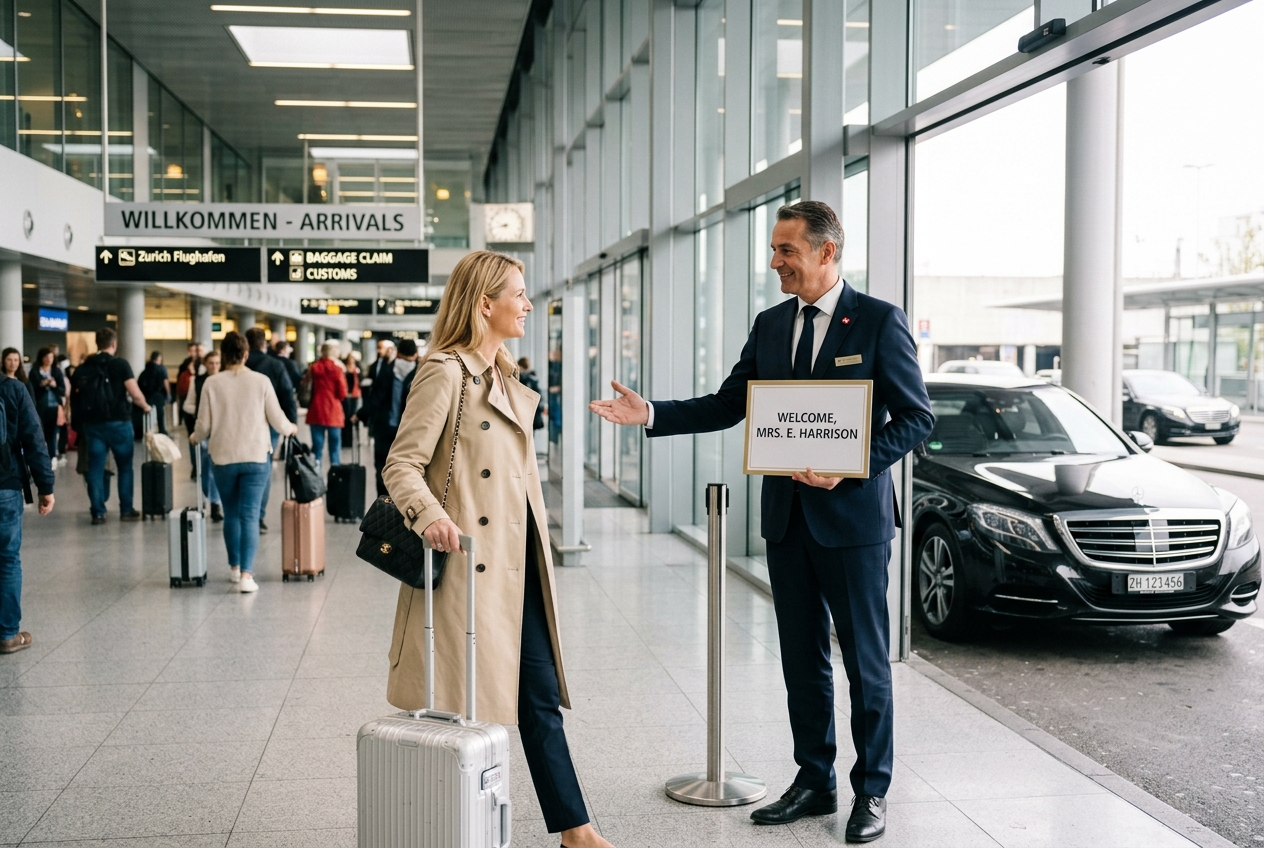
Pre-booked chauffeur services operating a proper meet-and-greet will have a driver waiting for you inside the Arrivals hall, holding a name board. This sounds like a small detail. In the context of a 06:15 arrival after ten hours in the air, it is anything but small.
Here is why it changes the experience qualitatively:
Orientation. When you exit passport control and baggage reclaim into the Arrivals hall, especially on a first or infrequent visit to Zurich, the signage is clear but you are making decisions under cognitive load. A name board removes every decision. You see your name, you walk towards it, you are done.
No phone scrambling. With a pre-booked chauffeur service, there is no need to unlock your phone, find a local SIM or functioning data signal, open an app, type an address, or call anyone. The driver is physically present and has already confirmed your flight.
Luggage assistance. The driver takes your bags from the moment of meeting. After a long-haul flight, this is not a luxury — it is a genuine relief.
Someone who already knows. A good chauffeur at this hour already knows your flight landed, knows what time it landed, and has adjusted their arrival at the airport accordingly. They are not surprised by your delayed passport queue. They have been tracking the flight.
BLACKTRANSFER uses real-time flight tracking for all airport pickups, monitoring the actual arrival time rather than the scheduled one. If your flight lands 22 minutes early or 45 minutes late, the driver adjusts without any action needed from you. Combined with a 60-minute free waiting period from the moment the flight lands, this means that even if your passport queue is slow, your bags take longer than usual, or you need a moment to find a lavatory before facing the world, your driver is still there, still waiting, and the meter has not started running. This policy exists precisely because inbound passengers cannot control ground time at the airport, and penalising them for a slow customs hall would be both unfair and counterproductive.
Practical Tips for the Inbound Passenger
A few concrete actions that make an early morning arrival at ZRH easier:
- Share your flight number when booking, not just your arrival time. The chauffeur service tracks the flight; you do not need to send updates if the schedule changes.
- Confirm the meeting point in advance. At ZRH, the standard meet-and-greet for pre-booked chauffeurs is in the main Arrivals hall, Level 1, usually near the exit from the baggage claim and customs area. Your booking confirmation should specify this clearly.
- Keep your phone charged for the walk through the terminal, even if you do not need to make calls — the driver may send a brief message confirming their position once you have cleared customs.
- Do not rush through baggage reclaim. Leaving without your bag because you were hurrying towards a waiting car is an entirely avoidable disaster. The 60-minute free waiting window exists so you do not have to rush.
- Dress for the Swiss morning. Even in summer, Zurich at 06:00 can be noticeably cool, and the walk from terminal to vehicle — even a short one — will remind you that you have just landed in the Alps-adjacent north. A light layer in your carry-on is sensible year-round.
- Inform your driver of any special requirements at the time of booking: oversized luggage, sports equipment, infant seats, or a stop at a pharmacy on the way into the city. None of these are problems when flagged in advance; all of them are easier to handle than at 06:30 in an Arrivals hall with no coffee in hand.
The Drive In: Why a Quiet Road Matters After a Red-Eye
One underappreciated benefit of an early morning arrival at ZRH is that the transfer into Zurich city or onward to a destination such as Zug, Lucerne, or even further afield is likely to be the smoothest road experience of your visit. The A1 motorway corridor linking the airport to the city carries very little traffic before 07:00 on weekdays and is genuinely quiet at weekends. The journey from the terminal to a central Zurich hotel, which can take 40 to 50 minutes in afternoon traffic, is often 18 to 25 minutes at this hour.
For passengers continuing beyond Zurich — to the Rigi-region, towards the Gotthard, or to a Graubünden resort — the early departure from the airport also means arriving at a destination before the mountain roads see any meaningful tourist traffic. In winter, this is particularly valuable: Alpine passes and access roads are often clearest in the early hours before the day's ski traffic builds.
The interior of the vehicle matters too. A pre-warmed, quiet, well-appointed car — with water in the door pocket, a phone charger already available, and a driver who understands that 06:30 arrivals generally do not want sustained conversation — is the correct antidote to a night flight. It is the moment the journey stops and the recovery begins.
If you are planning an early morning arrival into Zurich and want to arrange a seamless meet-and-greet transfer, get in touch with BLACKTRANSFER at info@blacktransfers.ch, via WhatsApp on +41 79 177 24 24, or through blacktransfers.ch — the team is available around the clock to confirm details and answer any questions about your specific flight and onward route.
Frequently Asked Questions About Early Morning Transfers at Zurich Airport
What is the absolute earliest pickup time BLACKTRANSFER can arrange for a Zurich Airport departure?
There is no lower limit. The service operates 24 hours a day, seven days a week, including public holidays, meaning a 02:00, 02:30 or even 01:45 pickup from your home or hotel is perfectly bookable. Switzerland's night-time road conditions actually make very early runs smoother than mid-morning ones: motorway traffic on the A1 and A3 corridors is negligible before 05:00, and journey times from most Zurich districts to the airport terminal are reliably short.
When booking for a pickup before 04:00, mention the exact departure time and terminal in the booking notes. Your chauffeur will have already reviewed the itinerary the evening before and will be stationed nearby — not driving across the city at the last minute.
Are drivers genuinely available at 02:00 or 03:00, or is that just marketing?
This is a fair question. Many taxi and ride-hailing platforms say "24/7" but rely on surge pricing to attract drivers at unsociable hours, with no guarantee of supply. A pre-booked chauffeur service works differently: a specific driver is assigned to your booking in advance, confirmed, and held accountable. There is no algorithm deciding at 02:45 whether your ride is economical.
BLACKTRANSFER dispatches a named, confirmed driver for every booking regardless of hour. If you have any doubt, call or WhatsApp +41 79 177 24 24 the day before to reconfirm. You will receive confirmation of the driver's details before pickup.
My overnight flight has been delayed — what happens to my pre-booked transfer?
Flight tracking is included in the service at no extra charge. The system monitors your flight's actual status in real time, so your driver is not sitting at the kerb at 04:00 waiting for a flight that now lands at 06:30. Arrival pickups include 60 minutes of free waiting time from the moment the flight lands, giving you time to clear passport control and baggage reclaim without stress.
If the delay pushes your arrival into a significantly different window, contact the dispatch team via WhatsApp or phone as soon as you know. For overnight delays where you end up staying at an airport hotel and rescheduling to the next day, the booking can be moved; cancellation terms (free up to 24 hours before the original pickup) apply, so early communication protects you financially.
I live in a remote Lake Zurich commune — Rapperswil, Schmerikon or similar. How do I arrange a transfer before 05:00 when local taxis are unlikely to operate?
This is precisely the gap a pre-booked chauffeur service fills. Communities along the south-eastern shore of Lake Zurich — Rapperswil-Jona, Schmerikon, Uznach, Eschenbach — sit roughly 40–55 km from Zurich Airport via the A53 and A1. At 03:30 in the morning there is virtually no traffic, but local taxi operators in those communes rarely guarantee service at that hour.
Practical steps:
- Book at least 48 hours in advance and specify your full address, including any gate codes or estate entrance details.
- Ask for the driver's mobile number so you can exchange a brief confirmation message the evening before.
- Allow a generous margin: if your flight departs at 06:30, a 03:45 pickup from Rapperswil gives a comfortable two-and-a-half-hour buffer for check-in and security, which at Zurich can move quickly in the early hours.
The V-Class is a practical choice for families from these areas, accommodating luggage for multiple travellers without compromising comfort on a 50-minute pre-dawn motorway run.
Is tipping expected for early morning or overnight transfers in Switzerland?
Tipping is not mandatory in Switzerland; the fare is all-inclusive and service is considered part of the professional offering. That said, a tip is always appreciated for early starts, particularly when a driver has had to position from a distance or has assisted extensively with heavy luggage.
A common convention among business travellers: round up to the nearest CHF 10 or CHF 20, or add 5–10% for genuinely exceptional service. Cash tips are straightforward; if you are paying by card you can specify an amount verbally before closing the transaction. There is no social pressure either way.
Can I request a child seat for a 04:00 airport run?
Yes. Child and infant seats must be requested at the time of booking — do not assume one will be available unless you have specifically asked. Specify the child's age and approximate weight so the correct seat type (infant shell, forward-facing toddler seat, or booster) can be fitted in advance. A properly installed child seat takes several minutes; your driver will have it fitted before arriving at your door.
Swiss law requires appropriate restraints for children regardless of journey time or hour, and this applies equally on motorways at 04:00 as at any other time.
Will I have Wi-Fi and charging points in the car during an early morning run?
All vehicles in the fleet — from the E-Class to the Maybach S-Class — are equipped with in-car Wi-Fi, bottled water, and phone charging points. This matters for early departures: if you need to pull up your boarding pass, respond to a client email before a transatlantic flight, or simply stay awake by checking the news, connectivity is available from the moment you sit down. There is no need to rely on your mobile data allowance on a pre-dawn Swiss motorway.
What are the cancellation terms for a red-eye or very early morning booking?
The standard policy applies regardless of departure time:
| Cancellation timing | Charge |
|---|---|
| More than 24 hours before pickup | No charge |
| Within 24 hours but more than 3 hours before pickup | 50% of the fare |
| Within 3 hours of pickup, or no-show | 100% of the fare |
For events, WEF Davos transfers and other special bookings, individual terms may apply — confirm these at the time of booking. The practical implication for red-eye travellers: if your schedule changes the evening before a 03:00 pickup, notify the team as early as possible. A WhatsApp message at 22:00 still puts you outside the three-hour window and limits your liability.
Do early morning pickups cost more than daytime transfers?
BLACKTRANSFER operates fixed, all-inclusive pricing. There is no night surcharge, no unsociable-hours premium and no dynamic pricing tied to time of day. The fare from Zurich city to the airport in an E-Class is the same at 03:00 as it is at 11:00. This is one of the meaningful practical differences between a pre-booked chauffeur service and a ride-hailing app, which typically applies surge multipliers precisely when demand is concentrated and supply is thin.
My flight has been cancelled outright — not delayed, cancelled. What should I do with my transfer?
Contact the dispatch team immediately, even if it is the middle of the night. The WhatsApp line (+41 79 177 24 24) is monitored around the clock. If the cancellation occurs more than 24 hours before your pickup, no charge applies. If it falls within that window, explaining the situation promptly allows the team to reassign the vehicle — which is in everyone's interest — and may influence how the booking is treated commercially.
Keep your cancellation confirmation from the airline as documentation. Corporate account holders on invoice terms should note the cancellation reference in any correspondence.
Can the driver cross into Germany or Austria during the night for an early morning trip?
Yes. Cross-border transfers to destinations such as Munich, Stuttgart, Innsbruck or Bregenz are fully available, including departures timed for early morning. Swiss-registered vehicles (ZH plates) cross at Konstanz, Kreuzlingen, Rheinfelden or the Vorarlberg border without issue at any hour; most of these crossings are open overnight.
What to bear in mind:
- A crossing into Germany or Austria is a different pricing tier from a domestic Swiss transfer — confirm the quote when booking.
- Journey times at 03:00 on the A96 toward Munich or the A14 toward Feldkirch are very fast with minimal traffic, but Swiss and German speed limits still apply in their respective jurisdictions.
- Your driver carries all necessary documentation; you simply need your own travel documents appropriate for the destination.
I am travelling alone as a woman on a very early transfer — how do I verify the driver is legitimate and stay safe?
This is a sensible and important question, not an overcautious one. A few practical measures:
- Confirm driver details in advance. When you book, you will receive the driver's name and vehicle registration before pickup. Check these match before getting in.
- Use the WhatsApp line to reconfirm the evening before. A brief "confirming my 03:30 pickup — can you send the driver's name and plate?" is entirely reasonable.
- Check the vehicle. All cars carry Swiss ZH registration plates and are clean, modern Mercedes or equivalent vehicles. A legitimate chauffeur will not object to you pausing to verify the plate.
- Share your itinerary. Send the booking confirmation, driver name and plate to a trusted contact before you leave. Most smartphones allow live location sharing via WhatsApp or iMessage.
- Sit in the rear. Swiss chauffeur practice is for passengers to use the rear seats; this is standard and expected.
- Trust your instincts. If anything about the situation feels wrong — a different vehicle than confirmed, pressure to get in quickly — step back, call the dispatch number, and verify before proceeding.
A professional chauffeur service is structurally safer than a street hail or unverified app ride precisely because the driver is pre-assigned, identified, and accountable to the company. Still, confirming details the evening before costs nothing and removes any ambiguity at 03:30 in the morning when your cognitive baseline is not at its sharpest.