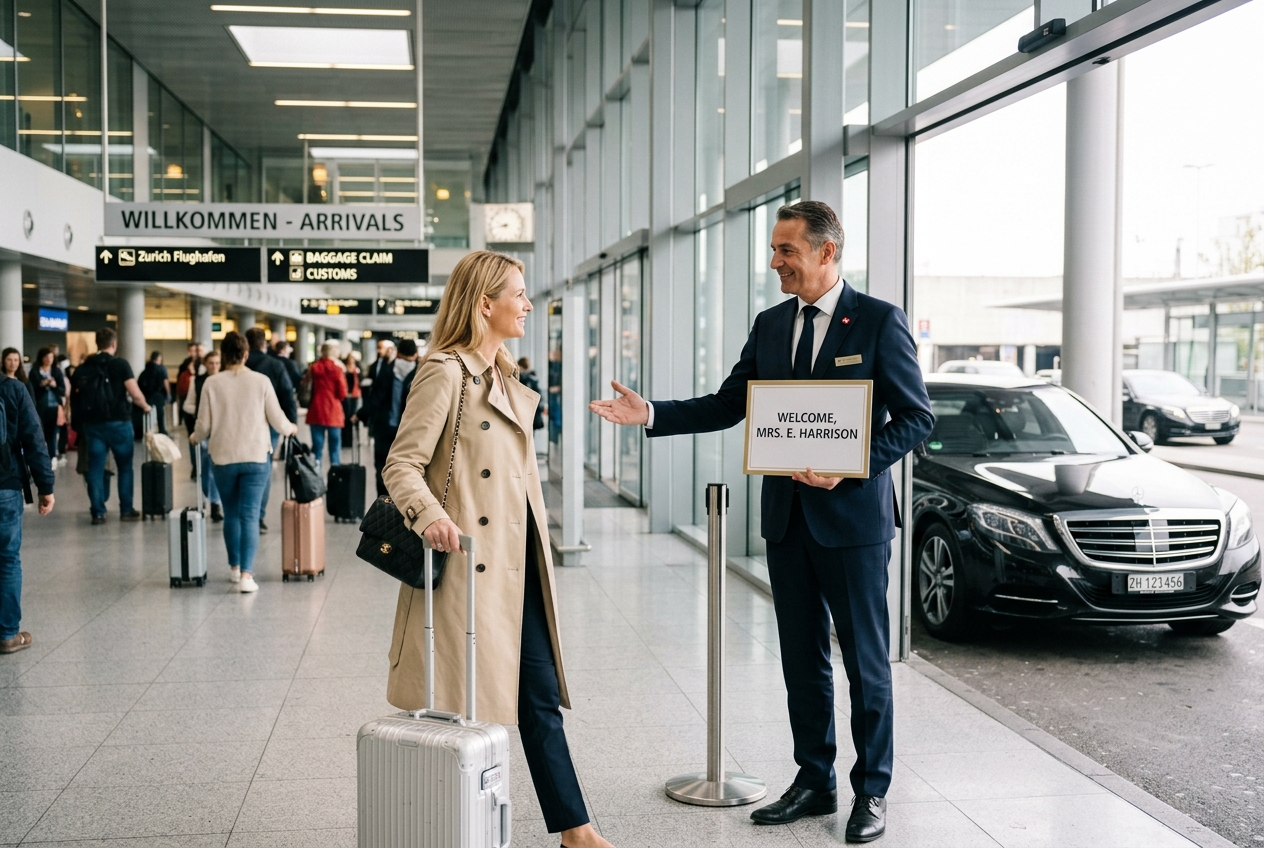
FBO Transfer Zurich Airport: The Complete Insider Guide (2026)
57 min read · 13,122 words
Arriving or departing via a Fixed Base Operator at Zurich Airport unlocks a world apart from the main terminal — but only if your ground transfer is planned to match. This guide covers every detail of the FBO transfer experience at ZRH, from tarmac-side logistics to vehicle selection and beyond.
What Is an FBO and Why It Changes Everything at ZRH
If you have spent any time navigating the chauffeur and ground transport world around Zurich Airport, you will have heard the acronym FBO used with a certain quiet authority. Pilots say it reflexively. PA assistants type it into briefs without explanation. Yet for many passengers — even frequent flyers who log more hours in the air than most people spend commuting in a year — the term remains curiously opaque. Understanding what an FBO actually is, and how it operates at Zurich specifically, is not merely an exercise in aviation vocabulary. It is the difference between a transfer that works invisibly and one that collapses in a confusion of wrong terminals, missed gates and avoidable waiting.
Defining the Fixed Base Operator
An FBO — Fixed Base Operator — is a commercial entity licensed to operate on airport grounds and provide support services to general aviation and business aviation aircraft. The "fixed base" part of the name is historical, dating to the early days of commercial flying in the United States when aviation authorities began distinguishing between itinerant barnstormers and operators who had a permanent, regulated presence at a specific aerodrome. Today the term is used globally, though usage varies: in North America it is universal; in Europe, the equivalent facilities are sometimes called private aviation terminals (PATs) or general aviation centres, though FBO has become the dominant shorthand even among Swiss handlers and operators.
What an FBO provides is essentially a full-service base for aircraft that are not operating on scheduled commercial routes. At a minimum, that means:
- Aircraft handling and parking — marshalling, towing, hangar space if required
- Fuelling — typically available around the clock
- Ground power and air-start units — for aircraft systems during turnaround
- Crew facilities — rest areas, briefing rooms, weather data terminals
- Passenger lounges — private, quiet, often luxuriously appointed, entirely separate from the commercial terminal crowds
- Customs and immigration facilitation — in many jurisdictions, FBOs coordinate directly with border authorities so that passport control happens in a private room at the FBO itself, not in a public queue
This last point is not a minor perk. It is architecturally and operationally transformative. A passenger arriving by private jet at Zurich does not join the immigration hall at Terminal 1. They do not collect luggage from a carousel. They do not pass through a public security screening area to depart. The entire public-facing commercial airport infrastructure — which serves tens of thousands of passengers each day at ZRH — simply does not apply to them.
How ZRH's Commercial Terminals Work, and Why They Are a Different World
Zurich Airport (IATA: ZRH, ICAO: LSZH) handles roughly 30 million passengers a year across its main terminal complex. The structure is integrated: Terminals 1, 2 and the Airside Centre connect internally, with Concourses A, B, D and E serving different airline alliances and route categories. Schengen and non-Schengen passengers are channelled through separate security and immigration streams. The kerb-side drop-off and pick-up zones for commercial traffic are busy, regulated by minute-by-minute enforcement, and designed to move the maximum number of taxis, ride-shares and private cars through a constrained physical space as quickly as possible.
For a professional chauffeur collecting a commercial flight passenger, the workflow involves: monitoring the flight's actual arrival, accounting for gate allocation, estimating the time from gate to luggage claim, then positioning the vehicle in the correct short-stay pick-up zone at roughly the right moment — all while managing the airport's strict rules on kerbside waiting. Errors in timing are measured in loops around the airport, in parking fees and in frustrated passengers standing on a pavement with luggage.
None of that applies to an FBO arrival or departure. The operational logic is fundamentally different.
Zurich's Private Aviation Infrastructure: The FBO Distinction
Zurich Airport hosts dedicated private and business aviation facilities physically separated from the commercial terminal complex. The principal handler for business aviation at ZRH is Jet Aviation, which has operated at Zurich for decades and manages one of the most comprehensively equipped FBO facilities in Central Europe. Jet Aviation's Zurich base handles hundreds of business aviation movements each week, ranging from light jets on short European hops to ultra-long-range aircraft arriving from North America, the Gulf and Asia.
The FBO is not accessed via the main terminal approach roads. It occupies its own section of the airport perimeter, with a dedicated access road and a separate apron area away from the commercial gates. This is not a detail — it is the core geographical fact that every ground transport professional working ZRH private aviation needs to internalise from day one.
The practical differences between arriving at the FBO versus the commercial terminal are significant enough to summarise side by side:
| Factor | Commercial Terminal (T1/T2) | FBO / Business Aviation Terminal |
|---|---|---|
| Passenger volume | Tens of thousands per day | Typically dozens per movement |
| Immigration process | Shared public hall, queues possible | Private room or dedicated officer, minimal waiting |
| Luggage handling | Public baggage carousel | Crew delivers directly to passenger or to vehicle |
| Kerbside access | Strictly regulated, timed zones | Controlled private apron-side or dedicated forecourt |
| Chauffeur positioning | External pick-up zone, vehicle must keep moving | Permitted to wait in designated area, often close to exit |
| Customs process | Standard commercial customs stream | Coordinated privately, often paperwork pre-cleared |
| Walking distance gate to car | 5–20+ minutes depending on concourse | Often fewer than 5 minutes, sometimes vehicle meets aircraft |
| Noise and crowding | High | Near zero |
This table is not about luxury for its own sake. Every one of these differences has a downstream effect on how ground transport must be planned and executed.
Why FBO Logistics Demand a Different Transfer Approach
Consider the timing problem first. At a commercial terminal, a chauffeur can reasonably estimate that a passenger who has just landed will reach the arrivals kerb somewhere between 20 and 60 minutes after touchdown — depending on whether they are in business class, whether they have hold luggage and how long immigration takes. Planning for that window requires experience and real-time flight tracking, but the window itself is predictable within certain bounds.
At the Zurich FBO, the passenger may be walking from the aircraft to the waiting vehicle in under ten minutes. There is no carousel wait. Immigration, if required, happens in a private room as part of the arrival sequence rather than as a separate post-gate process. This means a chauffeur who is not already in position at the FBO when the aircraft touches down risks keeping a private aviation passenger waiting — which is precisely the category of waiting that FBO users are paying to avoid entirely.
The access route itself requires pre-authorisation in many cases. Not every vehicle can simply drive to the FBO apron entrance. Commercial taxis, ride-share vehicles and unregistered private cars are typically unable to access the secure apron-side area where business aviation passengers exit. A professional chauffeur service that regularly handles FBO transfers at ZRH will have established the necessary familiarity with access procedures, co-ordination with the handler's ground team and understanding of where — and how far from the aircraft — a vehicle can legally wait.
Departure logistics present a mirror image of this challenge. A passenger departing by private jet from Zurich FBO does not need to arrive two hours before their slot time to queue for check-in and security. Depending on the aircraft type, crew readiness and whether the passenger is travelling within Schengen or outside it, a departure transfer can be timed with far greater precision. That precision, however, only holds if the ground transport provider understands the FBO process and is not applying commercial-terminal assumptions to a fundamentally different environment.
The Swiss Regulatory and Quality Context
Switzerland's approach to business aviation infrastructure is characterised by the same operational rigour that defines Swiss civil aviation more broadly. The Federal Office of Civil Aviation (BAZL) maintains strict oversight of all ground handling operations at Swiss airports. FBO handlers at ZRH operate under handling licences and are subject to Swiss data protection law (particularly relevant for VIP and high-profile passengers), security zone regulations and customs co-ordination protocols.
This regulatory backdrop has a cultural dimension too. Swiss business aviation clients — and the international clients who fly into Zurich for private banking appointments, board meetings, WEF in Davos or the ski resorts of Graubünden and Valais — expect a standard of discretion and professionalism that is genuinely non-negotiable. The FBO environment is designed to support that standard. Ground transport that operates in that environment must match it, not merely approach it.
Understanding what an FBO is and what it demands operationally is not background knowledge. For anyone involved in moving passengers between a private jet and a Swiss destination, it is the foundation on which everything else is built.
Zurich Airport's Private Aviation Infrastructure: A Ground-Level Map
Zurich Airport occupies a substantial footprint in the municipality of Kloten, sitting roughly 12 kilometres north of Zurich's city centre. Most travellers know only its commercial face — the gleaming Terminal 1, the airside shopping of the Airside Centre, the car-park towers that ring the public drop-off loops. The private aviation side of the airport is a different world entirely, physically separated from all of that, and understanding its geography is the first step to planning a transfer that works without friction.
The Business Aviation Centre: Where Private Aviation Lives at ZRH
The primary facility for private and business aviation at Zurich Airport is the Business Aviation Centre (BAC), which sits on the western edge of the airport boundary, accessed via Erlenweg in Kloten. This address — distinct from the commercial terminal zone on Flughafenstrasse — is where the vast majority of private jet passengers, crew and handling agents operate.
The BAC is not a single building in the way a commercial terminal is. It is better understood as a cluster of structures that includes the general aviation terminal, a dedicated passenger lounge, ground-handling ramps, fuel stations, aircraft parking stands, and the offices of several handling agents who co-ordinate between aircraft operators, customs, border control and ground transport. The terminal lounge itself is modest by design: private aviation favours intimacy over spectacle, and the BAC reflects that priority. Passengers clear Swiss customs and border formalities there, but the process unfolds in a controlled, unhurried atmosphere rather than in the queues that define the commercial arrivals hall.
The General Aviation Apron
Adjacent to the BAC is the general aviation (GA) apron, the hard-standing area where private and business aircraft park after landing. At Zurich, this apron is capable of accommodating a wide range of aircraft types — from light pistons and turboprops up to large-cabin jets such as the Gulfstream G700, Global 7500 and ACJ family.
A few practical characteristics of this apron matter for transfer planning:
- Stand allocation is not fixed in advance in the way that commercial gates are. The handling agent confirms the parking position only once the aircraft has vacated the active runway and is taxiing. This means a chauffeur cannot know, hours before arrival, precisely which corner of the apron a vehicle will ultimately pull up alongside.
- Apron access for ground vehicles is strictly controlled. Only vehicles pre-cleared by the handling agent and the airport authority may drive airside. A private chauffeur — however experienced — cannot simply pull up to the aircraft steps without prior coordination.
- Aircraft parking can shift. On busy private-jet days (Geneva Motor Show periods, World Economic Forum in Davos in late January, and major Zurich events) the GA apron fills quickly, and overflow parking may be directed to secondary stands that are slightly further from the BAC lounge. Handling agents manage this movement, but it can affect the time from aircraft door to vehicle door by several minutes.
Handling Agents: The Orchestrators of Ground-Level Logistics
At ZRH's private aviation side, the handling agent is the single most important operational actor for a ground-transfer team to work with. These companies — sometimes called FBOs in the American usage, though in European aviation the term "handling agent" is technically more precise — hold airport permits to operate airside, liaise with Swiss customs and border police (Grenzwacht), arrange fuel uplift, catering loading, and crucially, co-ordinate the movement of passengers between aircraft and the landside world.
Major handling agents operating at Zurich's BAC include Jet Aviation, which has a long history at the airport and operates one of the most established FBO lounges in Central Europe, and Swissport Business Aviation, which provides handling services alongside its broader commercial aviation division. Both maintain direct communication channels with ground-transport providers, and a chauffeur service operating at this level should have established contacts at both.
The handling agent's role in a transfer is not merely administrative:
- They confirm the estimated on-block time once the flight is on approach, which allows the chauffeur to time their landside position precisely.
- They physically escort arriving passengers from the aircraft steps, through the airside area, through customs or security as applicable, and into the lounge — from which the vehicle collects.
- For departures, they escort passengers from the lounge back to the aircraft, and the chauffeur must deliver to the landside drop-off zone at the BAC, not to the aircraft.
- They hold the paperwork for customs declarations, and if a passenger is carrying items requiring declaration, this process happens within the BAC, not at any commercial customs desk.
For a chauffeur, working without a handling agent contact is not viable at this level. A professional service will have already communicated with the relevant agent before the vehicle leaves Zurich city.
Road Access to the BAC: North Versus City Side
The geography of Kloten is a genuine operational factor that distinguishes a competent FBO transfer provider from a general taxi operator who has simply entered a postcode.
From Zurich city (south approach): Traffic from central Zurich, Zug, Lucerne or the Zurichsee lakeside communities typically approaches the airport via the A1 motorway, exiting at Zurich-Flughafen. From there, the route to the commercial terminals is well-signed and intuitive. The route to the BAC is less obvious and requires specific local knowledge: drivers must navigate via Kloten town rather than following the commercial terminal signs, continuing to Erlenweg, which runs along the airport's western boundary. During morning peak hours (07:00–09:00) and early-evening peaks (16:30–18:30), the A1 approach from Zurich can slow noticeably around the Gubrist tunnel section, adding 10–20 minutes to city-to-airport journey times.
From the north (Winterthur, Rhine Valley, Germany): Passengers arriving from Winterthur, Schaffhausen, or crossing from Germany via the A4/A7 corridor have a materially different road experience. The A4 connects directly into the Kloten road network without requiring passage through the Zurich city traffic system, making north-approach journeys often faster and more predictable — particularly for early morning departures when city traffic is light but still building on southern routes.
| Approach Direction | Typical Route | Distance to BAC from Start | Notable Congestion Points |
|---|---|---|---|
| Zurich City Centre | A1 Bern–Zurich → Flughafen exit → Kloten / Erlenweg | ~14 km | Gubrist tunnel, A1 merge near Affoltern |
| Zug / South | A4a → A3 → A1 → Flughafen exit | ~35 km | Zurich Süd / Brunau interchange |
| Winterthur / East | A1 Winterthur → Zurich-Flughafen exit | ~28 km | Airport ring road at peak times |
| Schaffhausen / North | A4 → Kloten direct | ~40 km | Minimal; mainly rural A-road |
| Basel / Northwest | A3 → A1 Zurich → Flughafen | ~80 km | Variable; clear at most hours |
The critical point for any transfer is that the BAC entrance on Erlenweg does not benefit from the same signage infrastructure as the commercial terminal. Satellite navigation programmes using a general "Zurich Airport" destination will direct a driver to Terminal 1 or the central car parks. A chauffeur must programme the specific BAC address or use saved coordinates to arrive at the correct gate.
Airside Escort Procedures: What Happens at the Boundary
The landside–airside boundary at the BAC operates under the same fundamental aviation-security regulations as the commercial terminals — Swiss federal law requires that all persons and vehicles entering the security-restricted area hold valid airport ID or be escorted by a badged handler. In practice, this means:
- Arriving passengers move airside-to-landside in the custody of the handling agent; they emerge through controlled doors into the BAC lounge, where the chauffeur waits landside.
- Departing passengers move landside-to-airside in the custody of the handling agent; the chauffeur drops at the BAC landside entrance, and the agent takes custody from that point.
- Chauffeur vehicles do not enter airside at ZRH in standard operations. The closest a vehicle comes to the aircraft is the designated pull-up area immediately outside the BAC entrance — a kerbside zone that handling agents keep clear of taxis, public vehicles and uncleared personnel.
- On rare occasions, for heads of state, diplomatic missions or special security arrangements, airside vehicle access can be pre-arranged through airport authority channels well in advance, but this requires formal clearance that operates entirely outside the normal booking process.
Understanding this boundary is essential to setting passenger expectations. The experience at a properly run ZRH FBO is that the gap between aircraft door and vehicle door is short — typically under ten minutes for a standard arrival — but the chauffeur's role in that sequence is landside, not airside. The handling agent covers the rest.
The Commercial Terminal Zone: Why It Is Irrelevant to This Journey
One last geographic point worth stating plainly: nothing about a private aviation transfer at ZRH involves Terminal 1, Terminal 2 (the Charter/Schengen building), the Airside Centre, or the public car parks. These structures lie on the eastern side of the airport campus, separated from the BAC by the full width of the active runway infrastructure and taxiway systems.
Passengers who have previously used Zurich Airport only for commercial flights sometimes expect their chauffeur to collect from the arrivals hall. Correcting this assumption before departure day — ideally at the point of booking — avoids the one form of confusion that no amount of professional service can remedy once it has happened.
FBO Arrival Procedures: From Touchdown to Kerbside
The moment a private aircraft's engines spool down on a Zurich FBO apron, the experience that follows bears almost no resemblance to the commercial terminal arrivals most travellers know. There are no queues at baggage reclaim, no crowds in the customs hall, and no scramble to find a driver somewhere beyond a security barrier. Instead, a carefully choreographed sequence unfolds — one that moves at the passenger's pace rather than the airport's. Understanding that sequence in detail, including its occasional variables, helps both first-time private flyers and seasoned fractional-jet users plan their surface transfers with precision.
Disembarkation: The First Two Minutes
On a typical FBO arrival, the aircraft taxis directly to the handling company's dedicated apron stand. At Zurich Airport (IATA: ZRH, ICAO: LSZH), the primary private aviation handlers operate from stands separated from the commercial terminal — physically and procedurally. Ground staff, often in branded high-visibility kit, meet the aircraft on foot the moment the door opens.
A passenger's experience from door-open to FBO lounge entrance is usually measured in minutes rather than the quarter-hours that define commercial connections. Depending on the handling company and the size of the aircraft, the sequence looks broadly like this:
- Door opens; a ground agent or operator representative stands at the foot of the airstairs.
- Passengers descend and walk — or, for larger groups or those with mobility requirements, are transported by vehicle — the short distance across the apron to the FBO facility.
- Carry-on luggage travels with the passenger; checked hold baggage is offloaded from the aircraft by the ground crew simultaneously.
- Baggage is typically delivered to a private room within the FBO building within ten to fifteen minutes of block-in, though the exact timing varies with aircraft size and cargo load.
The physical distance from the aircraft to the FBO building is short. On a fair-weather Zurich afternoon this is a pleasant transition; in January, when temperatures on the exposed apron sit well below freezing and a north-easterly wind cuts across the field, FBO staff will often have a vehicle ready to cover even that brief distance.
Passport Control and Customs: Switzerland's Schengen Position
Switzerland occupies a particular position in European travel law that catches occasional first-time visitors off-guard. The country is a full member of the Schengen Area despite not being a member of the European Union. This has practical consequences for private aviation arrivals:
Intra-Schengen flights (e.g., arriving from France, Germany, Austria, Italy, Spain): Passport control is, in principle, not required. However, the aircraft's operator will have filed a General Declaration and passenger manifest with Swiss border authorities in advance. At the FBO, a border official may — or may not — make a brief appearance. In practice, on well-established intra-Schengen routes with known operators and regular passengers, this can be entirely formality-free. Passengers should nonetheless carry valid travel documentation; Swiss border authorities retain the right to conduct checks at any time.
Extra-Schengen flights (e.g., arriving from the UK, UAE, USA, Russia, non-Schengen countries): Border formalities are mandatory and occur at the FBO, not in the commercial terminal. A Swiss Border Guard (Grenzwacht Corps / Corps des gardes-frontière) officer will process passports and entry documents in a designated area within or immediately adjacent to the FBO building. For most nationalities travelling on standard private aviation business — and carrying valid visas or benefiting from visa-free access — this is a brief, discreet and professionally handled process. There is no public queue; the officer comes to the passenger.
Customs declarations: Private aircraft arrivals carrying dutiable goods, currency above the statutory threshold, or certain restricted items must declare them. The FBO handling team will typically brief passengers or crew on any applicable requirements before or immediately after arrival. Passengers importing, for example, valuable artworks, watches purchased abroad, or commercial goods should have documentation prepared in advance. Switzerland's customs authority (Eidgenössische Zollverwaltung / Federal Customs Administration) has clear guidance available and FBO operators are experienced in coordinating these formalities smoothly.
| Arrival Type | Passport Check | Location | Typical Duration |
|---|---|---|---|
| Intra-Schengen, routine | Possible but often minimal | FBO arrival room | 0–5 minutes |
| Extra-Schengen, standard | Required | FBO private customs area | 5–15 minutes |
| Extra-Schengen with goods | Required + customs declaration | FBO customs area | 15–30 minutes |
| Diplomatic / VIP protocol | Coordinated separately | Variable | Pre-arranged |
These timings are approximations under normal conditions. Delays can occur during periods of heightened security, after major events such as WEF Davos or Zurich's Art Basel weekend, or when an aircraft arrives with an unusually large manifest.
Baggage Handling: What Happens to Your Luggage
Private aviation baggage handling is one of the most appreciated differentiators from commercial travel. Hold baggage is offloaded by apron staff and brought directly into the FBO building without entering any public-facing baggage system. It arrives in a dedicated space — often a private room, or a discrete corner of the FBO lounge area — where the passenger can identify and collect it personally or have it transferred directly to the waiting vehicle.
There is no carousel, no claim ticket and no anonymous conveyor belt. The luggage follows the passenger, not the other way around.
For oversized items — ski equipment, golf bags, musical instruments, large pieces of luggage associated with extended stays — the handling team coordinates loading directly into the transfer vehicle on the apron side or at the FBO's vehicle bay. A professional chauffeur service will communicate ahead of arrival about luggage volumes so that the correct vehicle class and boot configuration is confirmed. A group of four passengers arriving with a week's worth of ski luggage for St. Moritz, for example, will need a different vehicle arrangement than a solo executive with a single briefcase connecting to a Zurich city-centre meeting.
Where and How the Chauffeur Meets the Passenger
This is the aspect that most clearly distinguishes a professional FBO transfer from a standard airport pick-up — and it is where timing precision and communication matter most.
At Zurich Airport, chauffeur vehicles serving private aviation passengers do not wait in the public taxi rank or the commercial terminal car parks. They position in a designated vehicle holding area on the non-public side of the FBO facility. Depending on the specific handler and security configuration in use on a given day, the vehicle may be:
- Parked immediately outside the FBO exit, adjacent to the building
- Held in a nearby secure vehicle bay and dispatched to the exit as the passenger clears formalities
- Positioned on the airside apron itself for certain ultra-high-profile arrangements (this requires advance coordination with the handler and airport authority)
In standard practice, the chauffeur is present inside or immediately outside the FBO building, holding a discreet name board, and is in direct contact with a dispatcher who monitors the aircraft's progress in real time.
Accounting for ETA Uncertainty: The Private Flight Variable
Private aviation operates on a fundamentally different timetabling model from commercial aviation. Flight plans are filed closer to departure, slots are subject to network flow control (particularly into busy European airspace), weather diversions are a real possibility and passenger-driven schedule changes — a meeting that runs late, a decision to depart an hour earlier — are routine. Any ground transfer service working regularly with private aviation clients understands that an ETA is a well-informed estimate, not a contract.
A professional chauffeur operation builds in several layers of redundancy to account for this:
- Real-time flight tracking: The vehicle and dispatcher monitor the aircraft's actual position using aviation tracking data, not just the original filed ETA. When the aircraft is thirty minutes out, the transfer team is already adjusting the chauffeur's positioning accordingly.
- Direct communication with the FBO handler: Many established services maintain relationships with the handling companies on the ground, allowing for real-time updates when a flight is, say, holding over the Jura or diverting briefly to avoid a thunderstorm cell over the Alps.
- No fixed waiting cut-off on arrival: Unlike commercial airport transfers where a driver is typically held for sixty minutes beyond the scheduled flight arrival, private aviation transfers operate on a flexible standby model. The vehicle and chauffeur wait for the passenger — not the other way around.
- Proactive passenger communication: When a delay becomes apparent, a good service notifies the passenger or their PA directly, confirming that the vehicle is in place and updated to the revised ETA.
BLACKTRANSFER, which serves Zurich's private aviation sector regularly — including during high-demand periods such as WEF in Davos and the Swiss winter sports season — includes real-time flight monitoring and flexible FBO-side waiting as standard, at no additional charge for delays attributable to the flight itself. For a passenger stepping off an aircraft after several hours in the air, knowing that the vehicle is already positioned and the chauffeur fully briefed is a meaningful operational detail, not a marketing point.
The Kerbside Moment
When the passenger exits the FBO building, the transition to the vehicle should feel seamless. The chauffeur handles luggage loading; the passenger is guided to the door. There is no fumbling with addresses or payment terminals — all of that is settled in advance. Climate, music preference and any specific in-vehicle requests can be communicated ahead of time through the booking.
From touchdown to the vehicle moving out towards the A1 motorway or the city's Seestrasse, the elapsed time for a straightforward extra-Schengen arrival at a Zurich FBO typically runs between twenty and forty-five minutes — the lower end for a small aircraft with minimal formalities, the upper end when customs declarations or larger groups are involved. Planning a surface journey with that window in mind, rather than assuming instantaneous kerbside arrival, makes for a more comfortable and unhurried onward journey.
FBO Departure Logistics: Timing Your Transfer to the Tarmac
Departing from an FBO is, in many respects, a more choreographed affair than arriving. When you land, the sequence is largely reactive — the aircraft is already on the ground, the crew has handled customs, and your chauffeur is simply waiting. Departure is different. It is a forward-looking exercise in synchronisation, where a misplaced hour or a vague communication between passenger and chauffeur can cascade into a missed slot, an unplanned fuel stop delay, or a crew that has completed their pre-departure briefing and is standing idle on the tarmac while you are still in the car on the A1.
Getting it right is less about speed and more about precision — knowing what needs to happen, in what order, and communicating that clearly to every moving part in your ground logistics chain.
Understanding the Departure Timeline: Working Backwards from Wheels-Up
The most useful mental model for an FBO departure is to work backwards. Start with your planned take-off time — referred to as the EOBT (Estimated Off-Block Time) in aviation scheduling — and count backwards through every step that must occur before the aircraft can legally and safely push back.
A realistic minimum departure timeline at Zurich Airport (LSZH) for a private jet departure, assuming no complications, looks roughly like this:
| Step | Time Before EOBT |
|---|---|
| Aircraft chocks removed / push-back begins | 0 min |
| Passenger boarding complete, door closed | 10–15 min |
| Passenger arrives at FBO / airside escort begins | 20–30 min |
| Customs and border formalities (non-Schengen) | 30–50 min before boarding |
| Chauffeur delivers passenger to FBO kerb | 45–60 min before EOBT |
| Chauffeur departs pick-up location | [Drive time] + 30–45 min buffer |
For a purely intra-Schengen departure — say, from Zurich to Nice or Geneva — customs formalities are minimal and the timeline compresses somewhat. For a non-Schengen flight, such as Zurich to London Luton or Zurich to Dubai, Swiss border police will need to process the passengers through passport control, which at the private terminal takes far less time than at the main terminal but still requires a realistic window of 20 to 30 minutes on top of everything else.
The practical conclusion: most private passengers travelling on a non-Schengen route should plan to arrive at the FBO no later than 60 minutes before EOBT. For Schengen routes, 45 minutes is workable, though 60 remains sensible. These are not arbitrary buffers — they are the minimum time required for the process to unfold without pressure.
What "Slot Time" Actually Means for Your Chauffeur Brief
Zurich Airport operates under strict air traffic control slot management. Your operator or handling agent will receive a CTOT — a Calculated Take-Off Time — which may differ from your originally planned departure time depending on airspace congestion, especially on busy Monday mornings, pre-weekend Friday afternoons, or during high-traffic periods like the World Economic Forum in Davos or major trade fairs.
When briefing your chauffeur service, do not simply say "I fly at 14:00." That tells the chauffeur when the aircraft is scheduled to leave, not when you need to be at the FBO. Instead, communicate the following:
- Your EOBT or CTOT, as confirmed by your operator (e.g., "Slot is 14:15, EOBT is 14:00")
- Whether the flight is Schengen or non-Schengen, so the chauffeur can advise on appropriate arrival time at the FBO
- The name of your handling agent or FBO, since Zurich's private aviation facilities have different access routes and kerb procedures
- Whether there is a fuel stop planned, as this may delay the aircraft's readiness even if the slot is fixed
- Any known crew briefing or pre-departure inspection window that might push boarding slightly later than expected
A good chauffeur service treats this information not as background noise but as operational data. At BLACKTRANSFER, for instance, the dispatcher will cross-reference your stated EOBT against real-time traffic conditions on the Zurich ring road and the access roads to the private aviation area, and will schedule the departure from your address accordingly — not merely add a round number of minutes to the drive time.
The Fuel Stop Variable: Often Overlooked, Always Relevant
One of the most common causes of a passenger arriving at an FBO only to wait unexpectedly is an aircraft that is still being fuelled. Refuelling a midsize or heavy jet takes 20 to 40 minutes and cannot always be completed well in advance of departure, particularly if the aircraft has just arrived from another leg and the turnaround is tight.
If your charter operator or flight department informs you that the aircraft requires a fuel stop before your departure — meaning it will divert to another aerodrome to refuel during your flight rather than carrying full fuel from Zurich — this actually has no bearing on your FBO arrival time. What does matter is whether the aircraft itself is being refuelled on the ground at LSZH before push-back, and whether that refuelling is expected to be complete before your scheduled boarding time.
Ask your handling agent directly: "Will the aircraft be fuelled and ready for boarding at [X time]?" If the answer is uncertain, this is important information to pass along to your chauffeur, because it may mean that an earlier FBO arrival simply means waiting in the FBO lounge — which is no hardship, but which changes the calculus for whether a tight pick-up window is worth the stress.
The Difference Between a Rushed Departure and a Well-Choreographed One
A rushed FBO departure has a recognisable signature. The passenger arrives at the FBO with less than 30 minutes to EOBT. The handling agent is already anxious. The crew is waiting at the aircraft. Passport control, if required, becomes a brisk walk rather than a relaxed formality. Luggage tagging and security screening, while swift at a private terminal, still take finite time. The passenger boards slightly out of breath, the aircraft pushes back almost immediately, and the quality of the experience — which is precisely why private aviation exists — has been largely forfeited in the final 20 minutes.
A well-choreographed departure looks entirely different. The chauffeur has arrived at your address with sufficient lead time, has already confirmed with the handling agent (or, if the chauffeur service has an established relationship with the FBO, has received confirmation that the aircraft is ready and the slot is unchanged). You arrive at the FBO with 60 minutes to spare. There is time for a coffee, for a final email, for a brief conversation with the crew about the routing or the weather. The boarding process feels like the beginning of the journey, not a sprint to catch it.
The difference between these two scenarios is rarely about distance. The drive from central Zurich to the private aviation area at Kloten is not long. The difference is almost always about the quality of the initial briefing that the passenger provides to the chauffeur service, and whether the chauffeur service has the professional infrastructure to act on that briefing intelligently.
Practical Instructions to Give Your Chauffeur Service at Booking
When making a reservation for an FBO departure transfer, the information below should be communicated at the time of booking — not on the day of travel:
- Exact pick-up address and any access notes (e.g., private residence with gated entry, hotel with restricted kerb access)
- EOBT as confirmed by your flight operator, with a note if this is subject to ATC slot revision
- Flight route type: Schengen or non-Schengen, as this determines the border formality window
- Handling agent or FBO name, since different facilities have different vehicle access routes at LSZH
- Number of passengers and volume of luggage, so the correct vehicle class is assigned from the outset
- Any expected changes: crew rotation, late fuelling, or a departure pushed back by the operator
If your slot changes after booking — which happens frequently, particularly on routes through busy European airspace — contact your chauffeur service immediately. A professional operator can adjust pick-up times with relatively short notice, but only if they receive the updated information. A chauffeur who departs for a pick-up based on a 13:00 EOBT and then discovers at the door that the slot has moved to 15:30 has lost two hours that could have been used for another commitment.
Coordinating with Handling Agents: The Chauffeur's Role
The most seamless FBO departure transfers involve a chauffeur who does not merely drive but acts as a ground-side coordinator. In practice, this means the chauffeur or their dispatcher has a direct line to the handling agent — either a pre-existing relationship or a direct call on the morning of departure — to confirm:
- That the aircraft is on the ground and being prepared as planned
- That no slot revision has been issued since the previous evening
- That the boarding gate or airside vehicle escort is expected to be ready at the agreed time
- Whether there is any reason the passenger should arrive earlier than the standard window
This level of proactive coordination does not happen automatically. It is a function of how the chauffeur service operates — whether they treat an FBO transfer as a point-to-point drive or as a managed ground logistics assignment. For passengers who use private aviation regularly, the distinction quickly becomes apparent.
Choosing the Right Vehicle for an FBO Transfer
Selecting a vehicle for an FBO transfer is a different calculation from booking a standard airport taxi or even a conventional business-class chauffeur run. At a fixed-base operation, the variables multiply: luggage tends to be more substantial, companions often include personal assistants or security personnel, the visual context of the private terminal matters, and the transition from airside to kerbside is both more controlled and more exposed than a commercial terminal scrum. Getting the vehicle choice wrong is noticeable in a way that it simply isn't when you emerge from the arrivals hall at Terminal 1.
What follows is a practical framework, not a catalogue. It covers the real operational logic behind each vehicle class in the FBO environment, with specific attention to luggage realities, group configurations, and the understated visual register that most private aviation clients prefer.
The Luggage Problem Nobody Talks About
Commercial travellers typically follow airline weight and dimension rules, so their bags arrive in predictable shapes and quantities. Private aviation passengers do not have that constraint, and it shows in the transfer vehicle the moment the ground crew wheels the luggage trolley across the apron.
A family of four flying in from the Caribbean on a long-range business jet might easily carry:
- Four large hard-shell suitcases (average 80–100 litres each)
- Two to three carry-on-sized soft bags
- A pair of golf travel bags or a set of ski bags in wheeled sleeves
- A pushchair or buggy
- A box or two of fragile personal effects or wine
This is not an unusual load. It is the norm for any flight over three or four hours with a leisure component. Yet many passengers instinctively book a saloon car because that is what they associate with premium chauffeur service. The result is an awkward apron conversation, a second vehicle call-out, and a delay that undermines the entire point of flying privately.
The first question to answer honestly is not "which car do I prefer?" but "what volume of luggage is actually coming off that aircraft?"
The Mercedes-Benz E-Class: Appropriate Contexts and Clear Limits
The E-Class is a refined executive saloon with a boot capacity of around 540 litres — generous for a business trip with two cabin bags and a suit carrier, but not the vehicle for extended private travel with full-size luggage.
Where it genuinely works at an FBO:
- A solo executive or a travelling pair on a domestic or short-range European hop, often carrying a laptop bag, one compact suitcase, and perhaps a suit bag
- A roadshow participant moving between Geneva, Zurich, and Frankfurt who has deliberately packed light
- A business traveller who left luggage at their hotel and is simply returning to the aircraft with hand luggage
The E-Class also carries a slightly lower visual profile than the S-Class, which can occasionally be exactly what a client wants — arriving at an FBO in an E-Class reads as quietly confident rather than demonstrably status-conscious. That said, in the specific context of Zurich's private terminal, where the car parks alongside Gulfstreams and Falcons, the distinction is less pronounced than on a hotel forecourt.
Hard limits: Do not attempt ski bags, golf bags, or more than two full-size suitcases in an E-Class. It is not a question of squeezing things in; it is a question of the car being properly set up for the journey.
The Mercedes-Benz S-Class: The Benchmark for FBO Transfer Comfort
The S-Class is the default reference point for premium chauffeur work worldwide, and it earns that position in the FBO setting. Boot capacity sits at approximately 510 litres — marginally less than the E-Class due to the larger fuel tank and some structural elements — but the rear cabin is where the meaningful difference lies.
For a one-to-two passenger transfer with modest luggage, the S-Class offers an environment that directly mirrors the quality of a well-appointed business jet interior: massaging rear seats, ambient lighting that can be adjusted, excellent acoustic insulation, and a driving position that suggests effortless progress rather than hurried logistics. After several hours in a pressurised cabin, that sense of continuation matters.
Where the S-Class is the right call:
- A senior executive arriving alone or with one colleague, carrying standard business luggage
- A client who has asked the PA to specify "the best available saloon" — the S-Class fulfils that brief without ambiguity
- Situations where the client will be working or taking calls during the transfer, given the acoustic separation from the driver
One practical note: if ski bags or golf bags are involved, even one of each, discuss this with BLACKTRANSFER at the time of booking. It may still be manageable with creative loading, or it may point you toward a different class altogether.
The Mercedes-Benz V-Class: The Honest Workhorse of Private Aviation Transfers
The V-Class is, paradoxically, underused by clients who would benefit most from it. There is a persistent perception that a people-carrier represents a step down from a saloon. In the FBO world, that perception is simply incorrect.
Configured in its executive layout — individual captain's chairs, fold-flat tables, refrigerator, privacy glass — the V-Class accommodates up to seven passengers in genuine comfort, and its cargo capacity transforms the luggage equation entirely. A long partition between the passenger compartment and the rear cargo area means that bags do not intrude on the cabin, and the vehicle can absorb the sort of luggage load described in the opening section without any drama.
| Scenario | Why the V-Class Works |
|---|---|
| Family of four with ski gear after a ski charter | Ample boot depth for ski bags; child seats fitted to specification |
| Corporate group of five to six from a shared aircraft charter | All passengers travel together; no convoy needed |
| Principal with PA, security officer, and heavy luggage | Flexible seating configuration; luggage screened from view |
| Golf trip with four players and four golf travel bags | The only realistic saloon-class option for this load |
The V-Class also handles mountain road transfers — Davos, St. Moritz, Verbier via road from ZRH — with confident composure in winter conditions when fitted with appropriate tyres, which Swiss-registered vehicles are required to be.
The Mercedes-Maybach S-Class: When the Transfer Is Part of the Statement
The Maybach S-Class occupies a different register entirely. Compared to a standard S-Class, the wheelbase is extended by 18 centimetres, the rear legroom increases to a degree where a six-foot passenger can stretch fully, and the rear cabin is designed to function as a mobile office or rest environment rather than simply a comfortable back seat.
This is the appropriate vehicle when:
- A principal has been travelling for ten or more hours and wants to arrive at a hotel or residence genuinely rested
- The occasion demands a vehicle that signals a particular level of attention — an important client being collected, a principal whose own status warrants it
- There is a single rear passenger or a pair who want maximum space and absolute quiet
Boot capacity on the Maybach is reduced slightly compared to the standard S-Class because of the extended wheelbase mechanical requirements. For heavy luggage, a second vehicle or a V-Class for the bags is sometimes the more considered arrangement.
The Mercedes GLS and Cadillac Escalade: Operational Logic at High Altitude and in Winter
Both the GLS and the Escalade are full-size luxury SUVs, and they have earned their place in FBO transfer work for specific operational reasons that have little to do with fashion.
Ground clearance and seasonal conditions. The approach to Davos in January, or the private chalet driveways above Gstaad or Verbier, can involve unpaved or compressed-snow surfaces where a low-slung saloon creates practical difficulties. A GLS or Escalade navigates these conditions without compromise and without the client having to think about it.
Luggage volume with passenger comfort. Both vehicles offer the full rear passenger experience of an executive saloon while absorbing ski bags, snowboards, or large luggage without reconfiguring seats. The Escalade in particular has a cavernous third-row area that, when folded, accommodates a level of luggage that would require a van in any other configuration.
Group sizing. A group of five or six passengers who want SUV dynamics rather than a minivan aesthetic — whether for practical or personal preference reasons — will find the GLS or Escalade a natural fit.
Visual context. At an FBO apron, a large dark SUV is contextually unremarkable in a way that it might not be in a suburban street. It reads as security-conscious and purposeful, which is frequently exactly the desired signal.
Matching Vehicle to Journey: A Practical Summary
The matrix below is intended as a starting reference, not a rigid prescription. Discuss the specifics — actual passenger count, luggage list, destination road conditions, and any protocol requirements — directly with BLACKTRANSFER when booking, since combinations of factors often point to a solution that a simple category guide cannot capture.
| Party & Luggage Profile | Suggested Class | Notes |
|---|---|---|
| 1–2 passengers, briefcase and one cabin bag | E-Class or S-Class | S-Class if rear comfort matters |
| 1–2 passengers, extended trip luggage | S-Class + luggage discussion | Maybach if rest is priority |
| 2–3 passengers, ski or golf bags | V-Class or GLS | Always specify equipment dimensions |
| 4–7 passengers, any luggage volume | V-Class | Executive configuration recommended |
| Mountain destination in winter, any group | GLS or Escalade | Confirm road and driveway conditions |
| Principal requiring maximum discretion and rest | Maybach | Second vehicle for heavy luggage if needed |
| Security detail with principal | V-Class or coordinated convoy | Discuss protocol at booking |
One variable that passengers occasionally overlook: the presence of a security officer or personal assistant who travels with the principal but is not a guest. These individuals have specific seating preferences (often directly behind the driver or in a position with sight lines to the principal), and the vehicle configuration should accommodate this before anyone boards, not during an awkward negotiation on the apron.
Key Destinations from Zurich FBO: Times, Routes and What to Expect
The moment a private aircraft comes to a stop on the apron at Zurich Airport, the ground journey begins—and for most FBO passengers, that journey stretches far beyond the airport perimeter into the heart of Switzerland or across its borders. Understanding what each route actually involves, in terms of distance, realistic driving time, terrain and seasonal variables, is the difference between an itinerary that works and one that quietly unravels.
What follows is a destination-by-destination breakdown of the routes most frequently requested by FBO passengers at ZRH, written with ground-level accuracy rather than optimistic motorway averages.
Zurich City Centre: Bahnhofstrasse, Paradeplatz and the Hotel District
Distance: approximately 13–18 km depending on the specific destination within the city
Typical journey time: 20–40 minutes
Zurich city is the most common FBO transfer destination, and it is also the one most subject to underestimation. The airport sits in the north of the canton, connected to the city centre by the A1 motorway and Butzenbüelstrasse, but neither route is immune to congestion.
The critical corridor is the approach to the Milchbuck tunnel and onward to Bahnhofstrasse. During morning rush hours (07:30–09:00) and evening peak (17:00–19:00), travel times from the FBO to addresses on Bahnhofstrasse or around Paradeplatz can exceed 45 minutes. For business travellers with board meetings starting on the hour, building in a 15-minute buffer is not excessive—it is prudent.
The luxury hotel cluster—the Baur au Lac, Widder Hotel, Park Hyatt Zurich and Dolder Grand—spans a relatively compact area, but the Dolder Grand in particular sits above the city on Adlisberg hill, adding a short uphill drive that is entirely manageable but worth noting for departure timing.
Key considerations for this route:
- Avoid the Zurich city centre by car on days coinciding with major street events (Street Parade in August, Christmas markets in December) as road closures can add significant time
- The Baur au Lac has a discreet rear entrance via Talstrasse that experienced chauffeurs use to avoid the main hotel forecourt in busy periods
- Paradeplatz, the symbolic centre of Swiss private banking, is a low-emission zone during certain hours; professional chauffeur services account for this routing automatically
Zug: Switzerland's Quiet Financial Capital
Distance: approximately 35–40 km
Typical journey time: 35–55 minutes
Zug sits south of Zurich along the A4 motorway, passing through Baar before descending towards the lake. The route is largely comfortable and fast outside rush hours, but the Zurich Süd interchange and the Baar exit can slow considerably during morning peak periods when commuters from the Zurich Agglomeration head south and vice versa.
The town itself is compact, with most corporate headquarters and private offices concentrated around the Old Town and the lakefront. Chauffeurs familiar with the canton know that parking and vehicle access around Zug's central pedestrian zone requires local knowledge—dropping at the correct kerbside matters.
Zug is also notable as a year-round destination with no meaningful seasonal disruption to the road network. Unlike the alpine routes described below, the A4 corridor remains reliable in winter.
BLACKTRANSFER lists Zug as one of its standard fixed-price destinations from Zurich Airport, reflecting both the frequency of the route and its operational predictability.
Lucerne: The Lake Route South
Distance: approximately 55–60 km
Typical journey time: 45 minutes to 1 hour 15 minutes
The drive from ZRH to Lucerne uses the A14 via Rotkreuz or the A4 south to the Zug bypass before joining the A14 westbound towards the city. Both options converge near Buchrain before the final approach to Lucerne.
Lucerne's immediate surroundings present a bottleneck: the city has limited motorway access and a historic centre that is not designed for heavy traffic. The approach along the lake on Haldenstrasse towards the Grand Hotel National or the Bürgenstock Resort ferry connection requires patience during tourist high season (June through September) when the Vierwaldstättersee shore roads are noticeably busier.
For passengers staying at the Bürgenstock Resort, the logistics require particular attention. The resort sits on a private plateau above Lake Lucerne, accessible from Kehrsiten by funicular or by road via Ennetbürgen—a narrow, winding ascent that demands a skilled driver comfortable with alpine roads. Journey time from ZRH to the Bürgenstock Resort door is realistically 1 hour 30 minutes to 1 hour 45 minutes when accounting for the mountain approach.
Davos: WEF Country and Year-Round Alpine Transfer
Distance: approximately 150 km
Typical journey time: 1 hour 45 minutes to 2 hours 30 minutes
The route to Davos runs east via the A3 along the Rhine valley through Chur, then climbs through Landquart and follows the Prättigau valley up through Klosters before the final ascent into Davos. The road through Klosters—the Gotschnastrasse—is the standard approach from Landquart and is well-maintained, but it is a mountain road in every meaningful sense: gradient, hairpin bends and, in winter, dependence on weather and snowplough schedules.
Seasonal variables are significant here:
- Between November and April, snow chains or winter tyres are not merely advisable but legally required on sections of this route
- Road closures following heavy snowfall can temporarily divert traffic via the Wolfgang pass, adding 10–20 minutes
- During the World Economic Forum (WEF), typically held in late January, Davos becomes one of the most security-managed small towns in Europe. Security perimeters, convoy movements and credentialled access checkpoints can add 30–60 minutes to the final approach depending on an individual passenger's clearance level and hotel location
- Summer brings lighter traffic and the road is at its most predictable, with journey times consistently in the 1 hour 45 minute range
Davos itself straddles Davos Dorf and Davos Platz along a single main axis, so destination address matters for final drop-off routing.
St. Moritz: The Engadin Flagship
Distance: approximately 200 km
Typical journey time: 2 hours to 2 hours 45 minutes
St. Moritz is the longest and most topographically complex of the standard FBO transfer routes from ZRH. From Zurich, the route follows the A3 to Chur, then the A13 south briefly before turning east into the Albula or Maloja approaches—or via the Julier Pass if the Maloja is not the intended destination.
The Julier Pass (Passo del Giulia), at 2,284 metres above sea level, is the primary road access to the Engadin valley and St. Moritz from the north. It is kept open year-round by Graubünden cantonal authorities and is generally passable even in winter, but it is a high-altitude mountain pass with all that entails:
- Ice and compacted snow on the road surface in winter months (November–April), requiring full winter equipment
- Reduced visibility in poor weather or blowing snow
- The road narrows significantly on the descent towards Silvaplana and the Engadin lakes, demanding attentive driving
- In spring, rockfall warning signs become relevant on certain sections
An alternative approach via the Albula route (through Thusis, Tiefencastel and Filisur) is slightly longer in distance but avoids the highest elevations of the Julier; it connects to St. Moritz via Bever and Samedan. This route is used when Julier conditions are uncertain.
The St. Moritz hotel landscape is split between the lake-level properties (Badrutt's Palace, Kempinski Grand Hotel des Bains) and the hilltop area. Arrival during the ski season (December–March) coincides with the resort's busiest period, and both Samedan Airport (LSZS)—the private aviation alternative—and the road network reflect that volume.
Basel: The Northwest Corridor
Distance: approximately 85–90 km
Typical journey time: 55 minutes to 1 hour 20 minutes
Basel is a straightforward motorway run north-west on the A3, making it one of the more predictable routes in this list. The A3 connects the Zurich agglomeration to the Basel region with no meaningful altitude change and no seasonal pass complications.
The nuance with Basel lies at both ends. Near Zurich, the Nordring and Hardwald sections carry significant freight traffic and slow during peak hours. Near Basel, the approach into the city centre—particularly around Aeschenplatz and Messeplatz—can queue during Art Basel week (June) and during major pharmaceutical industry events, given that Basel is home to Novartis, Roche and their extensive campus infrastructure.
EuroAirport Basel-Mulhouse-Freiburg (BSL/MLH) sits 9 km north-west of Basel city proper, just across the French border, and is a separate entity from Basel city transfers—though some FBO passengers use BSL as their arrival point rather than ZRH.
Geneva: The Cross-Country Transfer
Distance: approximately 270–280 km
Typical journey time: 2 hours 30 minutes to 3 hours 15 minutes
Geneva is the longest pure road transfer on this list and qualifies as an inter-city journey rather than a regional one. The standard route uses the A1 motorway westbound from Zurich through Bern and then south-west towards Lausanne before the final section along the north shore of Lake Geneva into the city.
| Segment | Approx. Distance | Notes |
|---|---|---|
| ZRH to Bern | ~125 km | A1, generally fast; watch Schönbühl interchange |
| Bern to Lausanne | ~105 km | A12 / A1, rolling terrain, reliable |
| Lausanne to Geneva | ~60 km | A1 lakeside; tourist traffic in summer |
The lakeside section between Lausanne and Geneva—along what locals call the Corniche—is scenic but can back up around Morges and Rolle at peak times. Fridays from 16:00 onwards are particularly slow as weekenders head to Lausanne and Geneva from Zurich.
For passengers needing to reach Geneva Airport (GVA) rather than the city centre, the journey is marginally shorter; the airport sits on the north-western edge of the city adjacent to the A1.
An important practical note: Switzerland's national speed limits are enforced by radar throughout this corridor. Professional chauffeurs account for this in their timing—arriving on schedule is achieved through departure discipline, not by making up time on the motorway.
A Summary Comparison
| Destination | Approx. Distance from ZRH FBO | Conservative Journey Time | Key Variable |
|---|---|---|---|
| Zurich City Centre | 13–18 km | 20–40 min | Urban congestion |
| Zug | 35–40 km | 35–55 min | A4 rush-hour traffic |
| Lucerne | 55–60 km | 45 min–1 h 15 min | City approach, Bürgenstock add-on |
| Davos | ~150 km | 1 h 45 min–2 h 30 min | Mountain road, WEF security |
| St. Moritz | ~200 km | 2 h–2 h 45 min | Julier Pass conditions |
| Basel | 85–90 km | 55 min–1 h 20 min | City traffic, event calendar |
| Geneva | 270–280 km | 2 h 30 min–3 h 15 min | Lausanne–Geneva corridor |
All journey times assume a professional driver departing at an appropriate time relative to flight arrival or departure, with full knowledge of the route and current road conditions. They do not assume empty motorways—they assume Switzerland as it actually operates.
Discretion, Protocol and Professional Standards at Swiss FBOs
The moment a chauffeur's vehicle rolls through the security barrier into the FBO landside zone, the rules of engagement change completely. This is not a taxi rank or a public arrivals hall; it is a carefully controlled environment where every professional present — from the handling agent on the ramp to the crew coordinator at the front desk — operates according to an unspoken but rigorously observed code of conduct. A chauffeur who understands that code becomes invisible in exactly the right way. One who does not stands out immediately, and not to anyone's advantage.
The Swiss Disposition: Understatement as a Competitive Advantage
Switzerland's private aviation culture is shaped by the same values that govern Swiss business life more broadly: precision, restraint, and an instinctive distrust of ostentation. At Zurich's FBO facilities, this manifests in a very specific atmosphere. Voices are kept low. Phones are used discreetly. No one lingers in the lounge comparing notes about who just landed. The handling staff move efficiently and say only what is necessary.
A professional chauffeur operating in this environment must internalise the same ethos. Brash greetings, unnecessary commentary about the aircraft or the journey, loud phone calls taken in the vehicle staging area — all of these mark a driver as someone who does not belong. Swiss FBO clients do not want a performance of service; they want service itself, delivered with quiet competence.
This extends to the vehicle presentation. A spotlessly clean, current-model saloon or van positioned exactly where it was agreed to be — without the driver pacing the kerbside, checking their watch theatrically or waving a sign unnecessarily — communicates professionalism before a single word is exchanged. The name board, where required, is held calmly and at a natural height. Everything about the physical presentation says: I have done this before, I know where I am, and I am entirely at your service.
NDA-Aware Conduct: What It Means in Practice
Many passengers using private aviation travel under non-disclosure agreements that cover not just their business conversations but their movements, their companions and, in some cases, the mere fact of their presence in Switzerland. A chauffeur is not typically a signatory to such agreements, but the professional obligation to behave as though they were is absolute.
In practical terms, NDA-aware conduct means:
- Never confirming or denying a passenger's identity to third parties, including other FBO staff, hotel doormen, event organisers or — particularly — journalists. If asked who you have just collected, the correct answer is always a variation of "I'm afraid I can't help with that."
- Not initiating conversation about a passenger's schedule beyond what is strictly necessary for the journey. If the passenger does not volunteer where they are going next, the chauffeur does not ask.
- Ensuring the vehicle's communications are secure. This means no speakerphone conversations in which a passenger's name or destination might be overheard, and no leaving a booking manifest visible on a dashboard-mounted tablet.
- Treating overheard conversations as if they did not occur. This is perhaps the hardest discipline, because high-value passengers often conduct sensitive calls during transfers. The professional standard is complete amnesia — not discretion applied selectively, but a total absence of retention or repetition.
For corporate clients whose travel is managed by a PA or travel desk, discretion also extends to the information channel itself. Journey confirmations, passenger names and pickup details should be communicated only through the channel the client has designated, whether that is a secure corporate email, a WhatsApp thread with the PA or a dedicated booking platform. A chauffeur who calls the passenger directly when instructions say to communicate via the EA has already made a misstep.
Coordinating with Security Principals and Close Protection Officers
A significant proportion of private aviation passengers travelling through Zurich travel with security details. This may be a single close protection officer (CPO) sitting in the front of the vehicle, or it may be a multi-vehicle convoy with an advance team that has already inspected the route. In either case, the chauffeur's role is to integrate smoothly into the security principal's plan rather than to assert their own preferences.
Key principles for working alongside security personnel:
| Situation | Correct chauffeur conduct |
|---|---|
| CPO requests a route change mid-journey | Comply immediately without debate; the security professional has information you do not |
| Advance team asks to inspect the vehicle before passenger boards | Cooperate fully; open all compartments, step away if asked |
| Security principal requests radio silence / no phone use | Acknowledge and comply; notify your operations desk in advance if possible |
| CPO sits in the front passenger seat | Do not engage in conversation unless spoken to; keep eyes on the road |
| Convoy position is dictated by the lead vehicle | Maintain the assigned gap; do not attempt to overtake or adjust formation |
| Passenger is travelling with a personal bodyguard who boards last | Hold the door open, wait for confirmation before moving off |
The cardinal rule is that in a security-accompanied transfer, the chauffeur is a mobility specialist, not a decision-maker. Ego and initiative are both liabilities. Calmness, predictability and precise vehicle control are the assets.
If you have not worked with a particular security team before, a brief, professional introduction at the vehicle-staging point — "Good morning, I'm your driver today, here are my credentials, please let me know your preferred seating arrangement" — establishes cooperation without overstepping.
Communication Etiquette with FBO Handling Staff
The relationship between a chauffeur and the FBO's ground handlers is one of mutual professional respect. Handlers have their own chain of command and their own priorities; they are not there to facilitate the chauffeur's schedule, and treating them as such is both ineffective and counterproductive.
Effective communication with FBO staff follows a simple framework:
- Arrive early and announce your presence quietly at the front desk. Give your name, your company, the flight number or tail number you are meeting, and your estimated parking position. Keep the interaction brief.
- Respect the handler's information hierarchy. They will tell you what they can, when they can. Flight arrival times, passenger readiness and ramp access are all subject to change, and the handler's information is more current than anything on a flight-tracking app.
- Do not loiter on or near the ramp without explicit permission. Even in facilities where landside vehicle access is granted, the apron itself is a controlled zone. Wandering towards it — particularly if an aircraft is taxiing — is both dangerous and immediately disqualifying.
- Exchange mobile numbers with the handling coordinator so that communication during the passenger's transfer from aircraft to vehicle is direct and efficient, without requiring the passenger to wait.
Tone matters throughout. Swiss handling staff are courteous but not deferential to drivers who haven't earned respect. A calm, knowledgeable, unhurried manner — the same manner you would present to the passenger — produces far better cooperation than urgency or name-dropping.
The No-Photography Rule and Digital Hygiene on the Apron
The prohibition on photography within FBO facilities and on the apron is not merely a courtesy guideline; in many cases it is a security requirement enforced by the handling company and underpinned by airport authority regulations. Aircraft registrations, passenger identities, security arrangements and even the presence of certain delegations are all sensitive information that a photograph might inadvertently capture and transmit.
A professional chauffeur's phone stays in their pocket while they are within the FBO perimeter. This applies equally to video, to screenshots of booking details taken "for reference", and to social-media check-ins. The fact that you operate in private aviation is not, in this environment, a marketing opportunity.
Digital hygiene extends beyond photography. Booking data — passenger names, flight details, hotel destinations — should be stored in encrypted systems and shared only on a need-to-know basis within your organisation. If a booking platform requires you to log journey details, ensure that the platform meets the data-protection standards expected under Swiss law and, where applicable, the EU's GDPR framework (which continues to apply to passengers originating or arriving from EU states).
Punctuality as a Form of Respect
In the Swiss professional context, punctuality is not merely politeness — it is a statement about the value you place on another person's time. For FBO transfers, this standard is even more acute. A private aviation passenger has, by definition, organised their journey around precise timing. A chauffeur who is late does not merely cause inconvenience; they introduce unpredictability into a process that the passenger has paid specifically to make predictable.
The professional standard is to be staged and ready a minimum of fifteen minutes before the earliest realistic passenger arrival at the vehicle, with a continuous communication link to the handling coordinator in case the timeline shifts. If anything threatens that timeline — traffic, a vehicle issue, an unexpected delay — the client or their PA is informed immediately, not when the situation has already become a problem.
Punctuality at Swiss FBOs is, ultimately, an expression of the same values that define the entire experience: quiet, total reliability.
For passengers and travel managers who require this level of operational rigour as a matter of course, the team at BLACKTRANSFER is available around the clock at +41 79 177 24 24 to discuss your specific FBO protocols and arrange transfers that meet them precisely.
FBO Transfer Zurich: Frequently Asked Questions
Can the Chauffeur Meet Me Airside at Zurich's Private Aviation Terminal?
Yes — and this is one of the clearest distinctions between an FBO transfer and a conventional taxi pickup. At Zurich Airport, private aviation passengers arrive through a dedicated general aviation facility rather than the main terminal, and a professional chauffeur service can coordinate directly with the handling agent on duty to position the vehicle within the private compound. In practice this means your driver — holding a clearly visible name sign — is waiting inside the FBO lounge or immediately at the building's landside exit by the time you clear customs and collect your documents.
Whether the driver can physically stand on the apron itself depends on the handling agent's current security protocols and your operator's pre-arrangements. What never changes is that a well-briefed chauffeur arrives at the FBO building, not at the main kerbside road used by conventional traffic. If your operator has arranged for the handling team to escort you directly to the car, your driver will be positioned accordingly — often door-to-car in under three minutes.
How Does Flight Tracking Work for Private Flights That Have No Public Data?
Commercial flights appear on open databases almost in real time, but private aircraft are a different matter. Many operators file flight plans through private channels, and some owners request that their tail number be withheld from public tracking platforms for legitimate discretion reasons.
A professional chauffeur service working regularly in the FBO environment handles this in two ways:
- Direct communication with the flight operator or PA. When you book, you provide the tail number, operator contact or estimated block-in time. The chauffeur company then liaises directly rather than relying on consumer-facing tracking apps.
- Handler-to-driver coordination. Your handling agent at Zurich receives the inbound slot and actual landing time from the tower. A chauffeur service with an established FBO workflow maintains a communication channel with the handler so that the driver is updated the moment the aircraft is on the ground.
BLACKTRANSFER requests this information at the booking stage and keeps communication open with whoever manages the trip — operator, PA or the passenger directly — so that the car is always positioned at the right moment, regardless of whether the flight is publicly visible.
What Happens if My Slot Is Delayed by ATC?
Slot delays in European airspace are routine, particularly during summer convective weather or periods of heavy traffic at EUROCONTROL-managed hubs. For an FBO transfer this means your ground time may shift by thirty minutes to well over an hour with little warning.
Because private flights are tracked through operator and handler contacts rather than public boards, a competent chauffeur service absorbs this by:
- Keeping the driver on standby rather than releasing them between jobs
- Charging no additional waiting fee during standard airport waiting periods — at BLACKTRANSFER, sixty minutes of complimentary waiting is included for all airport pickups
- Remaining reachable by phone or WhatsApp so you or your PA can push the revised ETA through the moment the new slot is confirmed
The practical upshot: your driver does not disappear and return, which is what happens with ride-hail apps. The car, the driver and the communication channel stay live until you are in the vehicle.
Can I Bring Pets or Oversized Luggage?
Both are possible with the right vehicle and advance notice.
Pets: Switzerland is strict on animal entry documentation — PETS passport, microchip and, for non-EU origin, rabies titration tests are standard requirements enforced at the border even for private arrivals. From the transfer perspective, a crate-trained dog or cat travelling in an approved carrier is readily accommodated in a V-Class or GLS with the rear seats configured to create a flat load area. Notify the chauffeur service when booking so that protective boot lining is placed and the driver is prepared.
Oversized luggage — skis, golf bags, large cases: The V-Class (up to seven passengers) and the GLS both have generous boot volumes. A single passenger with four large suitcases and two ski bags is a realistic load for these vehicles. The table below gives a rough capacity guide:
| Vehicle | Passenger capacity | Large suitcases (approx.) | Ski bags / bulky items |
|---|---|---|---|
| Mercedes E-Class | 3 | 3 | Not recommended |
| Mercedes S-Class | 3 | 3 | Not recommended |
| Mercedes V-Class | up to 7 | 6–7 | 2–3 (roof storage not included) |
| Mercedes GLS | 4–5 | 4–5 | 2 |
| Cadillac Escalade | 5–6 | 5–6 | 2–3 |
| Mercedes-Maybach S-Class | 3 | 3 | Not recommended |
When travelling with extreme volumes — production equipment, medical devices, multiple sets of sports gear — a luggage vehicle can be arranged to follow the passenger car.
How Do I Book a Return Leg from a Remote Swiss Resort Back to the FBO?
The process mirrors the outbound booking but requires slightly more coordination because departure times from ski resorts or mountain venues are often pinned to the aircraft's slot rather than a fixed clock time.
The recommended sequence:
- Confirm your outbound slot or estimated departure window with your operator.
- Book the transfer with adequate buffer — mountain roads to Zurich from Zermatt, St. Moritz or Verbier can take two to three hours under normal conditions; add thirty minutes in winter.
- Provide both the operator's contact and your PA's number so the driver can receive a slot-change update without interrupting you.
- For pre-dawn or late-evening departures, confirm 24/7 availability with your chauffeur company at the time of booking.
BLACKTRANSFER operates across Switzerland at all hours, so a 04:30 pickup from St. Moritz for a 08:00 slot out of Zurich FBO is a standard request rather than an exceptional one.
What Is the Difference Between a Handling Agent and a Chauffeur Service?
These two roles are complementary but entirely separate.
A handling agent (such as those operating within Zurich's general aviation infrastructure) manages everything on the aeronautical side: coordinating with the tower for slots, marshalling the aircraft, fuelling, catering, customs and immigration facilitation, and managing the FBO lounge. They are licensed aviation-service providers whose responsibility ends when you step off the apron or into the landside area.
A chauffeur service takes over the moment you leave the secure zone. It is responsible for the ground journey — the vehicle, the route, the timing, the luggage, and the comfort standards during travel. A professional service will communicate with the handler to synchronise timing, but the handler does not arrange ground transport and the chauffeur does not manage anything airside.
Are Zurich FBO Transfers Available 24/7?
Yes. Private aviation is inherently time-agnostic — transatlantic arrivals at 02:00, pre-dawn departures for early European meetings and late-night repositioning flights are all commonplace. BLACKTRANSFER operates around the clock, every day of the year including public holidays.
When booking a night transfer, it is worth confirming the pickup point precisely in advance, as staffing levels at the FBO building may differ from daytime and the landside access route may have minor variations in how vehicles queue.
How Far in Advance Should I Book?
For standard transfers — a single vehicle, normal luggage — 24 to 48 hours is usually sufficient. However, for:
- WEF Davos period (January): Book weeks ahead. The entire Zurich–Davos corridor is saturated with concurrent demands.
- Large groups requiring multiple vehicles: At least 72 hours, preferably more.
- Exotic or specialist vehicles (Bentley Flying Spur, Maybach): 48–72 hours minimum.
- Events coinciding with major Zurich trade shows or Art Basel weekend: A week or more is prudent.
Booking early also allows your PA to share the complete trip brief — tail number, handler contact, onward hotel, preferences — so the driver is fully prepared rather than briefed in the car.
What Vehicle Is Best for a Group of Five with Large Luggage?
The Mercedes-Benz V-Class is the practical answer for most configurations. It seats up to seven passengers and offers a boot volume that comfortably accepts five large rolling cases alongside smaller carry-on bags. For five passengers with ski equipment, consider pairing a V-Class for passengers with a second vehicle for bags, or choosing the GLS or Cadillac Escalade if the group prefers a traditional SUV format.
The Cadillac Escalade in particular offers a commanding interior with genuine six-foot headroom and three-row seating, making it a preferred choice for taller passengers who find the V-Class's sliding-door format less comfortable.
Can a Chauffeur Coordinate Directly with My PA or Flight Operator?
Absolutely — and for regular private aviation travellers this is the standard workflow. Rather than routing every message through the passenger, the chauffeur service maintains a live communication thread with whoever holds the trip details. This might be an executive PA in London, a charter operator's flight-watch desk, or an estate manager handling the full logistics of a family trip.
At BLACKTRANSFER, the booking can be made entirely by a third party, with the passenger's name, vehicle preference and all contact details lodged in advance. Updates — slot changes, additional luggage, an extra passenger joining — are handled between the service and the PA without the principal needing to be involved.
How Is Pricing Structured for FBO Transfers — Fixed or Metered?
FBO transfers are priced as fixed, all-inclusive fares calculated at the time of booking. There is no meter running, no surge pricing and no ambiguity about the final bill. The fixed price covers the journey, tolls, complimentary waiting time at the airport, and VAT.
For illustrative reference, a transfer from Zurich Airport to Zurich city centre starts from CHF 120 in an E-Class; longer routes such as Zurich FBO to St. Moritz run to CHF 890 and Zermatt to CHF 990 in an E-Class, reflecting the mountain distances involved. Hourly bookings (minimum three hours) are available for city use or for clients who need a chauffeur on standby during a layover.
Corporate accounts are invoiced post-travel, which simplifies expense reconciliation across multiple trips.
What Identification or Documentation Does the Driver Need to Access the Private Aviation Area?
This varies by the specific FBO and the current security configuration at Zurich Airport's general aviation perimeter. In most cases, the driver does not require airside security clearance because they wait within the FBO's landside zone — the building's public reception area or the vehicle staging area immediately outside. Access to the apron or the secure ramp area requires a dedicated airport ID and is restricted to handling-agent staff.
What the driver does need:
- A confirmed booking with passenger name and tail number — this allows the handling agent to verify the car on the anticipated arrival list.
- A professional, credentialled vehicle — Swiss-registered, fully insured, and identifiable as a legitimate chauffeur car. Handling agents are accustomed to turning away informal operators who appear without pre-coordination.
- Valid Swiss driving licence and vehicle documents — standard requirements that any licensed chauffeur service will have in order.
If your operator requires the vehicle to be pre-approved and added to the handler's manifest, your chauffeur service should be prepared to supply registration details and driver identification to the handling agent in advance — something a service with regular FBO experience will handle routinely without needing to be prompted.