24/7 Limousine Service Zürich: The Night-and-Day 2026 Guide
59 min read · 13,495 words
Zürich never truly sleeps, and neither should your ground transport. This guide covers every practical dimension of round-the-clock limousine service in the city – from how operators manage overnight shifts to what passengers should expect at 3 a.m. versus 3 p.m.
Why Zürich Demands a Genuinely 24/7 Limousine Service
Zürich is not a city that sleeps on schedule. Behind its ordered tram lines and punctual trains lies a metropolitan rhythm that answers to Frankfurt bond desks, New York closing bells, Tokyo opening prices and the flight programmes of more than 80 airlines operating through Zürich Airport (ZRH). When those rhythms collide with the reality of ground transport, the gaps become visible — and consequential.
A City Wired to Global Time Zones
Switzerland's largest financial centre hosts the European and international headquarters of some of the world's most consequential institutions: UBS, Julius Bär, Zurich Insurance, Roche's commercial operations, Novartis's global HQ in Basel (a frequent day-trip destination), and dozens of private banks whose clients measure service quality in minutes, not margins of error. The people who run these institutions, advise them or pitch to them do not organise their travel around a timetable that suits the local municipality. A managing director flying in from Singapore lands when Singapore Airlines lands. A roadshow team shuttling between Zürich and Geneva for back-to-back investor meetings departs when the first slot is available. A family-office principal who has just closed a transaction in New York needs ground transport the moment their NetJets flight touches down at ZRH's FBO terminal — not in forty minutes when the next train runs.
This is the foundational reality behind genuine 24/7 demand in Zürich. It is not a marketing convenience. It is a structural feature of the city's economic identity.
Zürich Airport's Operating Window
ZRH is one of Central Europe's busiest international hubs, handling well over 25 million passengers in recent years and operating with a noise-curfew that allows commercial arrivals until approximately 00:30 and departures from around 06:00, with some flexibility for delays. In practical terms, this means:
- Late-night arrivals cluster between 22:00 and 00:30, as transatlantic, Middle Eastern and Asian long-haul services reach Zürich at the end of their flight day.
- Early-morning departures begin loading passengers from 04:30 to 05:00, targeting business travellers who need to reach Frankfurt, London or Paris in time for a 09:00 meeting.
- Redeye connections from Gulf hubs (Dubai, Abu Dhabi, Doha) deliver passengers into ZRH between 05:30 and 07:30, often after ten or more hours in the air.
Each of these windows creates a distinct transport need that cannot be served adequately by scheduled public transport.
The Public Transport Gap: Precise and Predictable
Zürich's public transport network — S-Bahn, tram, bus and the Polybahn — is rightly celebrated for its precision and coverage. But precision is only useful when service exists. The overnight gap is neither secret nor debated; it is documented in the timetables.
| Service | Last departure (approx.) | First departure (approx.) | Gap duration |
|---|---|---|---|
| S-Bahn S2/S16 Zürich HB → Airport (Mon–Thu) | ~00:30 | ~05:00 | ~4.5 hours |
| S-Bahn S2/S16 Zürich HB → Airport (Fri–Sat) | ~02:00 | ~05:00 | ~3 hours |
| City tram network (Mon–Thu) | ~00:30 | ~05:30 | ~5 hours |
| City tram network (Fri–Sat night) | ~02:00 | ~05:30 | ~3.5 hours |
| Postbus (inter-city routes) | Varies, often ~23:00 | ~06:00 | 7+ hours |
The S-Bahn connection between Zürich Hauptbahnhof and Zürich Airport is legitimately excellent during operating hours: the journey takes approximately 11 to 13 minutes, trains run every few minutes at peak times, and the station sits directly beneath Terminal 1's arrivals hall. For a passenger arriving at 19:00, it is perfectly rational to take the train into the city. For a passenger whose flight lands at 23:45, the arithmetic changes entirely. By the time they have cleared immigration (which for non-Schengen arrivals can add 20 to 40 minutes), collected luggage and emerged from the baggage hall, the last S-Bahn may already have departed. The platform becomes an academic fact.
On Friday and Saturday nights, the network extends to around 02:00, which covers more of the late-night entertainment and short-haul flight window. But even this extension leaves a three-hour gap before the first morning trains — and it does not solve the problem for a traveller landing at 01:15 on a Tuesday.
Why Taxis Alone Do Not Solve the Problem
The obvious fallback is a taxi. Zürich has licensed taxis, and they do operate overnight. But anyone who has stood at the ZRH arrivals rank at 01:00 on a rainy January night with three colleagues, two carry-on bags and a 90-minute drive to Davos ahead of them knows the limitations. Availability is inconsistent in the deep overnight hours, the vehicles may not suit a group of four or five, and — critically — the driver has no knowledge of your flight status, no system tracking your delay, and no obligation to wait if you are twenty minutes late from customs.
For individual leisure travellers, an inconsistent taxi experience is an inconvenience. For corporate travellers representing institutions, for VIP principals who expect discretion and reliability, and for families with children arriving exhausted after a long-haul flight, it is not an acceptable proposition.
The WEF Effect: January as the Pressure Test
Every January, Davos hosts the World Economic Forum, and Zürich becomes the effective gateway for the world's most time-constrained travellers. Heads of state, central bank governors, chief executives of the world's largest companies, and the journalists, security personnel and advisers who accompany them all funnel through ZRH and — increasingly — Zürich's city hotels, before making the approximately two-hour drive to Davos.
WEF creates a specific and intense 24/7 demand pattern:
- Private jets and commercial long-haul flights arrive at all hours, including deep overnight, as participants travel from North America, Asia and the Gulf.
- The drive from Zürich to Davos via the A3 and then the mountain roads requires a driver who knows the route in winter conditions — not a navigation app and a city taxi.
- Participants often need to be collected from Davos late at night, after dinners and private sessions, and returned to Zürich for early-morning flights or onward connections.
- Security considerations demand vehicles that are pre-booked, tracked and driven by vetted, professional chauffeurs — not hailed from a kerb.
During WEF week, the gap between "we have a 24/7 service" as a marketing statement and actually having vehicles, drivers and dispatch capacity at 03:00 on a Tuesday in January becomes ruthlessly apparent.
Pharmaceutical Roadshows and Banking Schedules
Beyond WEF, Zürich's calendar is punctuated by a quieter but equally demanding form of 24/7 pressure: the investor roadshow. When a Swiss pharmaceutical company is preparing a major clinical readout or a banking group is conducting a capital markets roadshow across European financial centres, the schedule is built around investors' availability — not around sensible driving hours.
A typical two-day Zürich roadshow might look like this:
- Day one: 07:00 breakfast meeting at the Baur au Lac, then a 90-minute drive to Basel for midday meetings at a bank headquarters, back to Zürich by 16:00 for two more slots, dinner at Restaurant Kronenhalle, return to hotel by 23:00.
- Day two: 05:30 pickup from the hotel, 06:30 flight to Frankfurt, return flight arrives ZRH at 22:10, transfer to hotel or, if the team drives, a corporate vehicle with Wi-Fi so the CFO can review the next day's deck.
No element of that schedule aligns with public transport. The entire two days require ground transport that is available precisely when needed — which, at 05:30 in the morning and 22:30 at night, means a service that is genuinely operating, not one that opens at 07:00 and closes at midnight.
Ski Season: The Alpine Transfer Window
From December through to late March, Zürich Airport handles a significant volume of ski-season traffic destined for Graubünden, Valais and the Bernese Oberland. Destinations such as St. Moritz, Zermatt, Verbier and Klosters require road journeys of two to four hours — and the guests who travel to them often set their own schedules.
A family flying from London on a Friday afternoon may land at ZRH at 18:30, wanting to be at their chalet in St. Moritz in time for dinner. A single traveller returning from a week in Verbier may have a Sunday-evening flight at 20:00 and need collection from the mountain at 15:00. Neither of these is extraordinary. Both are entirely outside the scope of any public transport option that is practical, direct and capable of handling ski equipment, child seats and the kind of discretion that guests at five-star mountain properties expect.
The combination of long drive times, mountain road conditions, equipment logistics and the expectation of a seamless door-to-door experience makes ski-season alpine transfers one of the clearest illustrations of why 24/7 private ground transport is not a luxury add-on in Zürich — it is a functional necessity.
The Sum of the Parts
Taken individually, any one of these demand drivers — late-night arrivals, early-morning departures, WEF, roadshows, ski transfers — might be addressed with a patchwork of solutions. Taken together, as they exist in Zürich simultaneously across twelve months of the year, they define a market that requires professional ground transport operators to maintain genuine round-the-clock capability: staffed dispatch, tracked vehicles, qualified chauffeurs, and the operational infrastructure to honour a booking made at 14:00 for a 03:30 pickup without anyone having to phone around looking for an available driver.
That is the specific, unglamorous and entirely real reason why the phrase "24/7 limousine service" in Zürich either means something operational and verifiable, or it means very little at all.
What '24/7' Actually Means for a Limousine Operator
The phrase "available around the clock" appears on almost every limousine and transfer website in Switzerland. What separates a genuine 24/7 operation from a marketing claim written at midday on a Tuesday is not intention — it is infrastructure. Running a limousine service at 03:00 on a Wednesday in February requires a completely different set of systems, people and contingencies than running one at 14:00 on a sunny Thursday in May. Understanding those differences helps any traveller or travel manager choose a provider who will actually be there when the unusual hour arrives.
Driver Scheduling Across Three Shifts
A credible round-the-clock operation does not rely on a single pool of drivers who sleep when business is slow. It builds its roster around three overlapping shifts that mirror the rhythm of a city like Zürich: a day shift covering roughly 06:00–14:00, a swing shift covering 13:00–22:00, and a night shift covering 21:00–07:00. The one-hour overlaps are deliberate — they create a handover window during which the outgoing driver can brief the incoming one on traffic patterns, vehicle condition, any quirks from that day's bookings and, critically, any late-arriving passengers still en route.
What this means in practice:
- Minimum fleet coverage: A genuine three-shift model requires at least enough drivers so that no single person works a double shift as a routine matter. In a city where Zürich Airport (ZRH) receives intercontinental arrivals between 06:00 and 23:00 and transatlantic arrivals can divert or delay well past midnight, the night-shift driver must be rested, not finishing their fourteenth hour.
- Driver certification and local knowledge: Each shift driver holds the cantonal professional driver licence required in Zürich and knows the city's one-way systems, the fastest route from the A1 to the Bahnhofquai at 04:00 versus 08:00, and which hotel entrance to use when the main forecourt is blocked for an early delivery.
- Backup and contingency: Legitimate operators keep a standby driver on call during the smallest-volume hours — typically between 01:00 and 05:00. If the assigned driver falls ill or a vehicle develops a fault, the standby activates. An operator without this redundancy will either phone you at 03:45 to apologise or, worse, say nothing and simply not appear.
Dispatcher Availability at 03:00
The driver is only half the equation. Behind every on-time 04:15 pickup is a dispatcher who has been tracking that flight since the previous evening, has confirmed the vehicle assignment, and is reachable if anything changes. At 03:00, when a passenger's flight from Dubai diverts temporarily to Bern or a connecting passenger misses their last leg and rebooks onto the first morning service, someone needs to answer the phone, assess the situation and communicate a revised plan.
A dedicated dispatcher on duty during night hours is one of the clearest signs of operational maturity. This is not a person who works from home on a laptop, half-asleep, monitoring a chat queue. It is someone — or a small team — with access to the live booking system, the vehicle GPS locations, the flight-status feeds and the authority to reallocate resources on the spot.
What to look for when evaluating a provider:
| Feature | Genuine 24/7 Operator | Aggregator or Broker |
|---|---|---|
| Dispatcher reachable by phone at 03:00 | Yes — dedicated night shift | Often chat-only or voicemail |
| Can amend a booking in real time | Yes — direct system access | Depends on third-party availability |
| Knows which driver is closest to ZRH | Yes — own GPS fleet view | No — sends a push notification and waits |
| Can authorise a vehicle swap instantly | Yes — owns the fleet | No — must contact the sub-contractor |
| Accountable if something goes wrong | Yes — single point of contact | Disputed — app T&Cs often exclude liability |
The phone number matters enormously here. A local Swiss number — one that passengers and corporate travel desks have called before, staffed by a person who knows the account — is structurally different from a chat widget that routes to a contact centre in another time zone. When a passenger is standing at Arrivals Hall 2 at ZRH at 04:20 with no sign of their driver, they will not type a message and wait. They will call. The operator who answers in two rings and says "Mr Hofer, your driver Stefan is coming around from the parking deck, ETA ninety seconds" has earned the next booking. The operator whose chat widget shows "average response time 8 minutes" has not.
How Flight-Tracking Software Works — and Why It Matters
Modern professional operators use flight-tracking integration directly inside their booking and dispatch platform. When a booking is created with a flight number, the system automatically monitors that flight's real-time status — departure gate, airborne time, estimated arrival, any ATC-ordered holding patterns over Kloten — and adjusts the driver's dispatch time accordingly.
This matters for three interconnected reasons:
-
The passenger is not woken. If your flight from Singapore departs two hours late, a well-configured system detects the delay, recalculates when your driver should leave to be at the kerbside at the right moment, and updates the assignment automatically. You receive a quiet notification — or simply nothing, depending on your preference — rather than a call at 02:00 asking whether you'd like to reschedule.
-
The driver arrives neither too early nor too late. Sending a chauffeur to ZRH ninety minutes before a revised landing time wastes their rest hours and adds unnecessary cost. Sending them on the original schedule means they arrive, wait, and the vehicle may not be available for the next booking. Good flight-tracking calibrates departure time to arrival time minus the expected walk from gate to Arrivals, minus baggage-claim duration for that particular route and airline — a figure that differs between, say, a SWISS short-haul from London and a long-haul Emirates service with large checked luggage volumes.
-
Diversions and cancellations trigger human review. Automated tracking handles delays cleanly. Diversions — where a flight lands at a completely different airport — or full cancellations require a human dispatcher to make a judgement call. The best systems flag these events immediately to the night-shift dispatcher rather than attempting an automated resolution that may go wrong.
The Critical Difference: Local Base Versus Brokered Network
This is the distinction that affects you most acutely at 04:15 when wheels touch down at ZRH.
An operator with a physical Zürich base — an address, a fleet of vehicles on Swiss plates, drivers on the payroll, and a dispatcher in the city — has every incentive and every capability to meet you on time. Their vehicles are sitting in a nearby garage or staging area. Their driver has been briefed on your booking specifically. The vehicle is already warmed, the water is cold, the Wi-Fi is live. If something goes wrong mechanically, a backup vehicle is in the same postal district.
A brokered network or aggregator app operates differently. It holds no vehicles. It employs no drivers. When you book, the platform pushes your request to a pool of affiliated operators — some excellent, some not — and assigns whoever accepts the job. At 14:00 on a Tuesday, that pool is deep and the quality variance is manageable. At 04:15 on a Wednesday morning in January, the pool is thin, the accepting operator may be based in Winterthur or Baden, and the "chauffeur" who shows up may not be familiar with the Terminal 2 Arrivals layout, may not speak the language you need, and has no relationship with anyone you could escalate a complaint to.
The consequences of this difference compound under pressure:
- A mechanical fault with a brokered vehicle at 04:00 means the app sends a new request to whoever is awake. That process takes time you do not have.
- A flight diversion to Geneva means a local Zürich operator can advise you clearly on your options — an alternative vehicle, a different arrangement — whereas a broker can only update the app record and hope an affiliated Geneva operator accepts.
- Corporate travel managers who need a single invoice, a named account manager and consistent service quality across fifty bookings a month cannot get that from an aggregator. They can get it from an operator with an in-house team and a corporate billing structure.
The Local Phone Line as Infrastructure
It is worth being precise about why a dedicated local phone line — not WhatsApp-only, not a chat widget, not an email address monitored during business hours — is a structural feature of a genuine 24/7 service rather than a preference.
A phone call takes seconds to connect and seconds to resolve a straightforward query. It creates a verbal record that both parties remember. It conveys urgency in a way that a typed message cannot. And at 04:15, when adrenaline and exhaustion meet confusion in an airport arrivals hall, a calm human voice on a local number is not a luxury — it is the service itself.
Operators who provide a direct mobile number alongside a landline, staffed at all hours, are signalling that they consider night-time availability a core part of their product, not an afterthought. BLACKTRANSFER, for example, publishes three Swiss mobile numbers and offers WhatsApp contact on the same lines — not as a replacement for voice, but as a parallel channel for passengers who prefer to confirm details in writing before a flight or send a last-minute luggage note without making a call.
The safest test when evaluating any Zürich limousine provider: call their contact number at an unusual hour before you book. The quality of that answer — speed, composure, accuracy — will tell you more than any website.
The Hours That Test Any Transfer Service: Key Time Windows
Running a transfer operation round the clock is easy to claim and genuinely difficult to execute. The difference between a company that answers the phone at 02:30 and one that simply lists a 24/7 badge on its website becomes painfully apparent at four specific time windows. These are the hours when public transport is either absent or unreliable, when taxis are scarce, and when the margin for error — a missed connection, a confused handover, a car that shows up late — collapses to zero.
Window 1: Late-Night Arrivals, 23:00–01:00
Zürich Airport (ZRH) handles a substantial volume of long-haul and intercontinental traffic that touches down well after the last S-Bahn train has departed. The airport's rail link to the city centre operates until roughly 00:24 on weekday nights and slightly later on Fridays and Saturdays, but the timetable is thin by 23:00 and the direct connection to Zürich HB takes approximately 10 minutes — when it runs. Once the trains stop, the options narrow sharply.
This window is where delays compound. A flight scheduled to land at 22:15 from Dubai, Singapore or New York is entirely capable of touching down at 23:45 or later after air-traffic-control holding, a late push-back at the origin, or a slot restriction over central Europe. By the time the passenger clears Swiss border control, collects luggage from Carousel 5 or 6 at Dock E or Dock B, and walks to the arrivals hall, it can easily be 00:30 or 01:00. The city's taxis thin out considerably at this point; rideshare supply is inconsistent; and shuttle buses to most hotels have long since finished.
What a genuine 24/7 operator does here:
- Monitors the live inbound flight status from the moment of booking, not just from scheduled arrival time
- Adjusts the chauffeur's arrival at Terminal 1's Arrivals Level automatically if the flight lands 40 or 90 minutes late
- Provides a full 60-minute free waiting window from the actual landing time, so that immigration queues — which at ZRH can stretch during peak long-haul arrival waves — do not penalise the passenger financially
- Has a meet-and-greet driver standing at Arrivals with a name board, rather than asking a tired traveller to navigate to a car park in the dark
The journey from ZRH to central Zürich at this hour is one of the more pleasant aspects. The A1/A51 approach to the city and the Stadtautobahn are essentially clear after 23:00. A door-to-door transfer from the terminal to a hotel on Bahnhofstrasse — the strip running from Zürich HB south towards the lake that holds properties including the Baur au Lac and the Widder — typically takes 15 to 20 minutes. Compare that with the same route during a weekday morning peak, when construction on the approach roads, school-run traffic through Opfikon, and the bottleneck at the Schöneggkreisel can push the same journey to 30–40 minutes or beyond. The night-time window is, paradoxically, the easiest time to drive in Zürich — provided the car and driver are actually there.
Hotels that generate particularly high late-night arrival demand include those in Kreis 1 (the old town), where business travellers attending next-day meetings at the banks and law firms clustered around Paradeplatz check in after intercontinental flights, and Kreis 8 Seefeld, a residential and boutique-hotel district east of the lake where a quieter clientele tends to arrive on evening flights from London, Frankfurt or Doha.
Window 2: The Dead Zone, 01:00–04:00
This is the hour window that most genuinely exposes whether a 24/7 claim is real. Demand is at its daily minimum, which means a provider that is operationally stretched will deprioritise coverage here: dispatchers work reduced shifts, standby drivers may have gone home, and the response lag from a booking made at 02:15 for a 03:00 pickup can be fatal to a corporate traveller catching an early international connection.
The passengers who need service at this hour are a specific group:
| Passenger type | Typical scenario | Destination from city |
|---|---|---|
| Long-haul business traveller | Catches 05:55 departure to Asia or North America | ZRH, requiring pickup at ~03:30 from city |
| Shift worker in financial sector | Night-trading desk finish in Zürich West | Home address, Kreis 4 or 6 |
| Medical professional | On-call transfer, Universitätsspital or Triemli | Various |
| Event or festival crew | Load-out finished after venue curfew | Hotel or private address |
| Connecting international passenger | Overnight stopover, needs onward to Basel EuroAirport (BSL) | BSL, approximately 75 km / 55 min drive |
The route to Basel EuroAirport from Zürich at 03:00 is straightforward — the A3/A2/A22 corridor is empty, and a journey that takes 55 minutes at this hour might take 80–90 minutes during a busy Tuesday morning. But "straightforward" only applies if the driver is dispatched, awake and confirmed. A service relying on a single on-call phone that may or may not be answered at 02:30 is not genuinely 24/7; it is daytime-first with aspirational coverage overnight.
Corporate accounts are disproportionately represented in this window. A roadshow team that lands in Zürich late, sleeps for three hours at the Park Hyatt on Beethovenstrasse in Kreis 2, and needs to be at a Geneva or Frankfurt airport by dawn is a real scenario in Switzerland's financial calendar — particularly around earnings seasons and the January forum cycle. These passengers cannot improvise. They need confirmed bookings with named drivers and a vehicle number texted the night before.
Window 3: The Pre-Dawn Rush, 04:00–06:00
Zürich's first departure wave is a genuine operational challenge. Flights to Middle Eastern hubs, the early London Heathrow slots, and the first services to Frankfurt and Amsterdam typically push back between 06:00 and 07:30. Working backwards through ZRH's check-in recommendation of 2 hours for international and 90 minutes for Schengen, and then adding journey time from the city, produces a cluster of pickups between 04:00 and 06:00.
This is the window where a 24/7 service must match the discipline of a morning-peak operation, not the flexibility of a quiet overnight shift. Multiple cars may need to move simultaneously across the city. A driver collecting a passenger from the Baur au Lac on Talstrasse at 04:15, another from a private residence in Küsnacht on the eastern lake shore at 04:30, and a third from the Dolder Grand — perched on the Zürichberg hillside above Kreis 7 — at 05:00 represent three different city microclimates that all converge on ZRH between 05:00 and 05:45.
At this hour, the road is as quiet as the 01:00–03:00 dead zone: 15–20 minutes from central Zürich to the terminal is realistic. The Dolder Grand, sitting higher and slightly further out, adds perhaps five minutes. Küsnacht, heading north along the lake's eastern shore on the Seestrasse before picking up the motorway, adds perhaps ten. None of these are problematic in terms of journey time; all of them require precise scheduling and a driver who has slept and is punctual to the minute.
Practical notes for this window:
- Chauffeurs working pre-dawn airport runs should ideally be stationed close to their assigned pickup zone, not driving in from a distant suburb at 03:50
- The A51 to ZRH is clear, but the terminal approach road can briefly queue after 05:30 as the first departure push builds and taxis accumulate at Departures Level 3 — local knowledge of the drop-off sequencing helps
- Passengers on early-morning flights are typically less communicative than daytime travellers; a professional chauffeur reads that preference and drives quietly, offers water, and does not make small talk unless invited
Window 4: Early Sunday Morning After Saturday-Night Zürich
Saturday night in Zürich has a distinct geography. The Langstrasse axis through Kreis 4 and Kreis 5 is the city's nightlife spine — clubs, bars and restaurants draw both residents and international visitors until 04:00 or later. Kreis 1's Niederdorf neighbourhood adds a second concentration of late-night activity around the old town's medieval lanes. Private events at venues such as the Zurich Opera House, the Tonhalle or corporate dinner venues in the Seefeld district can run until 01:00 or beyond, particularly when private hire removes the venue's standard curfew.
The result is a Sunday-morning demand profile unlike any other in the week. Passengers need transfers not because they are catching a flight — though some are — but because:
- They are staying at hotels in the city centre and returning to private homes in the canton's quieter communities: Wollerau, Rüschlikon, Männedorf, or further afield in Zug
- International guests at private dinners in lakeside villas need returning to ZRH for early Sunday departures
- Corporate guests at events overlapping with a Saturday-into-Sunday structure (a common format during industry conferences) need pickups that a reduced Sunday taxi fleet simply cannot guarantee
Sunday-morning road conditions are the best of the entire week. The journey from Kreis 4 to ZRH at 05:30 on a Sunday takes approximately 15 minutes; the same journey on a Monday at 08:15 might take 35–40. Yet Sunday is also the day when an under-resourced operator is most likely to have reduced staffing, assuming the week's serious business is over. Passengers who book transfers for Saturday night should confirm explicitly — and receive written confirmation — that a named driver and specific vehicle are assigned to their Sunday-morning transfer, not simply that "a car will be available."
The overlap of Zürich's cultural, financial and social calendars means that none of these four windows is genuinely low-priority. Each one represents a real population of passengers for whom failure of service has measurable consequences: a missed intercontinental flight, a stranded guest, a compromised business schedule. That is the operational reality that any honest 24/7 limousine service in Zürich must plan around, staff for, and be held accountable to.
Fleet Considerations for Round-the-Clock Travel
Every vehicle in a chauffeur fleet tells a different story depending on the hour you need it. A compact executive saloon that feels perfectly sized at 10 a.m. can feel conspicuously sparse at 3 a.m. when a worn-out board member steps off a transatlantic connection at Zürich Airport. Conversely, a flagship limousine dispatched for a single analyst travelling light on a Tuesday morning is commercial overkill. Round-the-clock operations force a chauffeur company to think not just about which cars it owns, but about whether those cars can genuinely be matched to the right passenger, at the right hour, with zero margin for mechanical improvisation.
The Mercedes-Benz E-Class: Efficient Workhorse for Odd Hours
The E-Class occupies a particular sweet spot in overnight and early-morning operations. It is an executive saloon in every meaningful sense – refined cabin, rear-seat legroom that handles a 45-minute ride from the airport to the city comfortably, and a footprint compact enough to navigate Zürich's narrower Altstadt streets or slip into a hotel forecourt without ceremony.
For the solo business traveller landing on a red-eye from New York or Singapore, the E-Class delivers everything that matters at 04:30: a quiet, dark interior, a driver who knows the route, and a door-to-desk journey that wastes no one's time. The economics work, too. At a fixed all-inclusive rate of CHF 120 from Zürich Airport to the city centre, it is the pragmatic choice when the only performance metric is "get there, get to bed."
Where the E-Class earns its reputation in round-the-clock rosters is consistency. Because it runs more frequently than prestige models, a well-operated fleet keeps E-Class vehicles on tighter maintenance cycles – tyres, brake fluid, cabin air filters. On overnight routes, where a mechanical delay means a passenger stranded on an empty motorway rather than mildly inconvenienced in midday traffic, that consistency is the point.
The Mercedes-Benz S-Class and Mercedes-Maybach: When Comfort Is Non-Negotiable at Any Hour
There is a subset of traveller for whom vehicle class is not a preference but an operational requirement. C-suite executives, heads of state delegations, senior private-equity partners arriving on a last-minute business-class flight from Dubai – these passengers have structured their professional lives so that fatigue does not visibly accumulate. The cabin they occupy from kerb to office is part of that structure.
The S-Class provides the baseline here. Massaging rear seats, near-silent acoustic insulation, ambient lighting that can be adjusted to something closer to dim hospitality than bright automotive – at 02:00, these features are not indulgences but tools. A managing director who lands at 01:45 and has a breakfast briefing at 07:30 needs the 35-minute drive to their hotel to function as the beginning of recovery, not an afterthought.
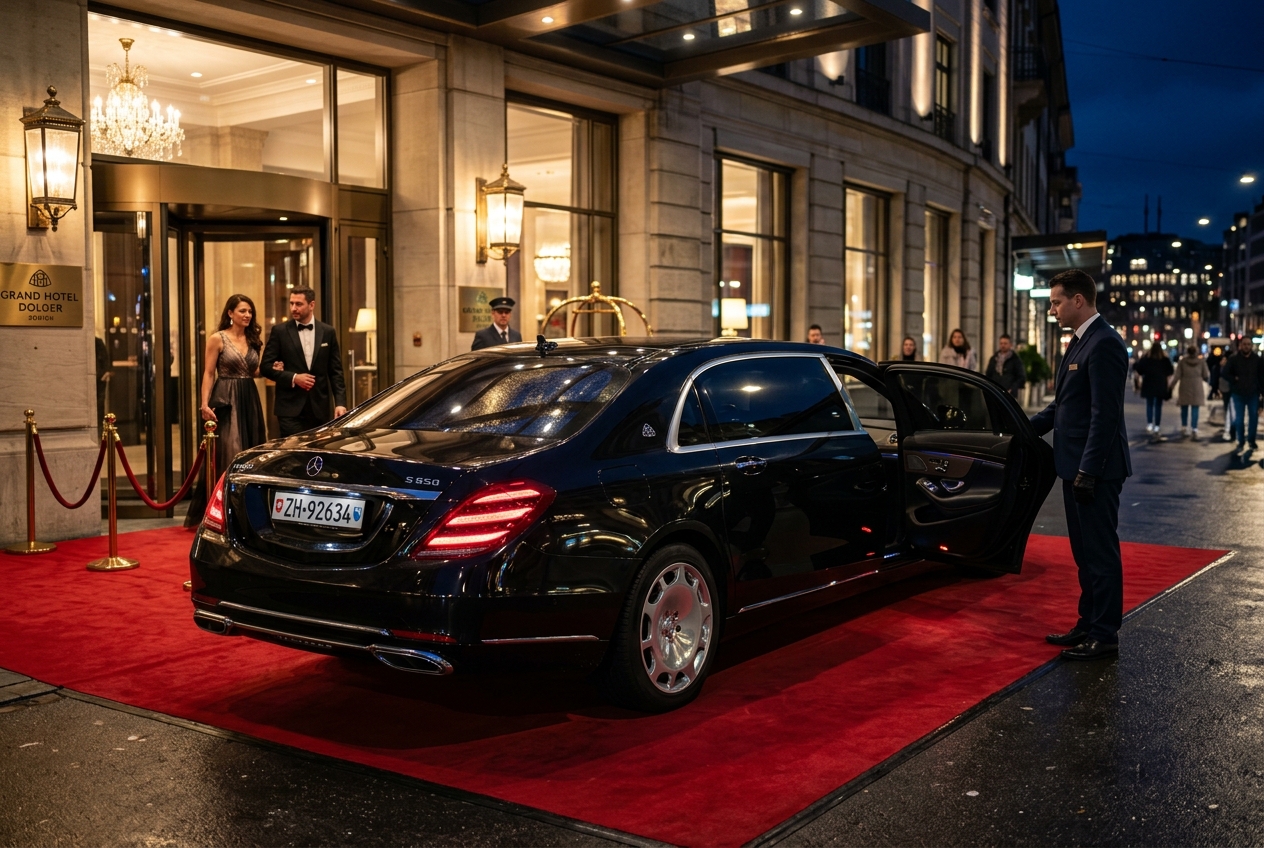
The Mercedes-Maybach S-Class represents a further step. Extended wheelbase, individual rear seats that recline to near-horizontal, a cabin environment that competes favourably with the business-class seat the passenger just vacated. For those arriving on private aviation at Zürich's general aviation terminals, or connecting from a long-haul flagship carrier, the Maybach communicates a specific message: the ground journey has been considered with the same care as every other element of the trip.
| Vehicle | Best Overnight / Early-Morning Use Case | All-In Price: ZRH → Zürich City |
|---|---|---|
| Mercedes-Benz E-Class | Solo business traveller, late connection, efficiency priority | CHF 120 |
| Mercedes-Benz S-Class | C-suite, business-class arrival, comfort and discretion | CHF 160 |
| Mercedes-Maybach S-Class | Private aviation, VIP, near-cabin-grade recovery en route | CHF 290 |
| Mercedes-Benz V-Class | Groups up to 7, corporate dinners, ski weekends | CHF 150 |
| Mercedes GLS / Cadillac Escalade | VIP security, elevated ride height, protection details | On request |
| Bentley Flying Spur | Ultra-premium, exceptional occasions | On request |
The Mercedes-Benz V-Class: Groups Returning at Any Hour
Group travel at night has a dynamic of its own. A team of six leaving a corporate dinner in Zürich's Seefeld district at midnight is not going to split into three separate taxis. A board retreat breaking up after a post-skiing dinner in Klosters at 23:00 needs a single, comfortable vehicle that can take the mountain roads home without anyone sitting on a jump seat. The V-Class is that vehicle.
Configured for up to seven passengers, with full executive fit-out in better-operated fleets – individual captain seats, folding tables, climate control throughout the cabin – the V-Class handles group journeys that the saloon options structurally cannot. The overnight ski-transfer scenario is particularly relevant in the Swiss context: January and February see a consistent pattern of groups arriving on Friday evening flights and returning Sunday night after a weekend in Verbier, Davos or St. Moritz. These journeys are long (Zürich to St. Moritz is roughly two and a half hours under normal winter conditions), they take place on alpine roads that demand alert, experienced drivers, and they involve luggage – ski bags, boot bags, weekend cases – that requires a vehicle with genuine boot capacity.
At night, the V-Class also handles corporate event pickups, gala dinners at the Baur au Lac or Dolder Grand, and the particular logistics of moving a small team between Zürich Hauptbahnhof and a conference hotel in Zug when the last regional train has already departed.
Larger Formats: The Cadillac Escalade and Mercedes GLS for Security-Aware Assignments
Not every overnight passenger in Zürich is simply tired. Some face a security dimension that shapes every element of their travel. VIP principals, high-net-worth individuals travelling in Switzerland for financial meetings or discreet family reasons, and senior political or diplomatic figures all require ground transport that integrates with their protection protocols.
The Cadillac Escalade and Mercedes GLS occupy this space. Both offer elevated ride height – a practical advantage in close-protection contexts because it improves driver sightlines and complicates certain threat vectors. Both provide substantial interior volume for accompanying security personnel to be seated without compromising the principal's space. The Escalade's bulk and familiar profile, well understood in the international VIP transport world, communicates a level of seriousness that a saloon cannot.
At night, these vehicles matter for an additional reason: route flexibility. Alpine crossings, late border transits between Switzerland and Germany or Austria, diversions around motorway closures – a larger, well-specified vehicle with an experienced driver who knows alternative routes is a contingency asset, not just a status symbol.
Why Fleet Age and Maintenance Standards Are a Night-Time Issue
This point does not arise naturally in daytime travel planning, because the consequences of a mechanical problem during the day are inconvenient but manageable. At 03:00 on a weeknight, with a passenger who has a 06:00 flight out of Geneva, they are not.
Mercedes dealerships in Zürich do not operate at 3 a.m. Independent mechanics do not return calls before sunrise. A vehicle that needs a sensor reset, a tyre changed on the A3 motorway, or a charging system that has developed an overnight fault is effectively a liability. The only real mitigation is preventive: rigorous maintenance scheduling, genuine Swiss registration with current mandatory inspection compliance (which in Switzerland under the MFK scheme is demanding by European standards), and a fleet that is young enough that component wear has not yet become a statistical risk.
Swiss-plated vehicles – ZH plates in the case of Zürich-based operators – are subject to Swiss periodic technical inspection (MFK, Motorfahrzeugkontrolle) requirements. This is not a minor procedural point. The inspection regime covers brakes, lighting, emissions, steering geometry and structural integrity, and vehicles that fail do not legally operate on public roads. For a passenger at 2 a.m., knowing that a vehicle has current Swiss registration and is maintained to these standards is the closest available proxy for "this car will not leave me stranded."
Beyond inspection compliance, modern fleet management for overnight operations typically involves pre-shift vehicle checks – tyre pressure, fluid levels, interior condition, charging ports, water stock – carried out before the driver departs the depot. This is the difference between a professional overnight operation and a daytime taxi service that happens to have accepted a late booking.
In-Cabin Amenities: More Important After Dark Than They Appear
Wi-Fi, bottled water, and phone charging points are often presented in marketing material as premium flourishes. On a midday airport run lasting 30 minutes, they are conveniences. On a 2.5-hour overnight transfer from Zürich to St. Moritz, or a 3 a.m. drive to Geneva to catch an early intercontinental departure, they shift category.
Consider the practical sequence:
- Bottled still water on a night ride matters because long-haul cabin air is dehydrating. A passenger who has just crossed multiple time zones in pressurised air and then sat in a heated vehicle for an hour without water arrives at their hotel or airport in a meaningfully worse physical state.
- In-vehicle Wi-Fi allows a passenger who has been offline for 11 hours on a transatlantic flight to reconnect, triage email, and brief their assistant before reaching the hotel – turning dead travel time into productive use even at 04:00.
- USB-A, USB-C and wireless charging address the reality that most passengers have depleted devices by the time they land. A phone at 4% battery when checking into a hotel at 3 a.m. is a small problem with several large consequences (alarm clock, key card backup, morning schedule access). A full charge on arrival is a minor operational detail that removes an unnecessary friction point from an already demanding travel day.
The Bentley Flying Spur, for occasions when nothing less is appropriate, combines all of the above with a cabin environment that has no real automotive equivalent in terms of materials, acoustics, and spatial presence – relevant context for an ultra-premium event or a particularly significant business visit where the ground journey itself sends a message.
None of these amenities compensate for a poorly maintained vehicle or a driver who doesn't know the roads. But in a well-run overnight operation, they complete the picture of a journey that has been thought through from wheels-up to hotel lobby.
Pricing, Surcharges and What to Watch For After Hours
Transparency about money is where premium limousine services either earn long-term trust or quietly lose it. Zürich's transport market contains a wide spectrum of operators—licensed taxis, ride-hailing apps, private-hire companies and dedicated chauffeur services—and their pricing structures differ enormously, particularly once the clock moves past 10 p.m. Understanding exactly what you will pay, and why, before you confirm a booking is the foundation of a genuinely stress-free transfer.
The Fundamental Split: Fixed Quotes Versus Variable Pricing
The single most important distinction to make when comparing providers is whether the price you receive at the point of booking is the price you actually pay on arrival.
Variable pricing models include:
- Taxi meters – the fare accumulates in real time based on distance and time. Swiss taxis are permitted to apply a higher tariff (Tarif 2) between 22:00 and 06:00, on Sundays, and on public holidays. On a long nocturnal run—say, from Zürich Airport to Davos—that surcharge compounds over a journey lasting around two hours, and the final figure can differ substantially from any estimate.
- Surge or dynamic pricing – used by several app-based platforms, where the multiplier is set algorithmically based on demand. Demand peaks at 04:30–06:00 (the pre-dawn wave of early business departures) and again at 22:00–24:00 on Friday and Saturday nights. The surcharge during these windows can reach 1.5× to 2.5× the base rate, and the estimate displayed at booking is explicitly non-binding.
- Per-kilometre quotes with time additions – some mid-market private-hire operators quote a base distance rate but add a night supplement and a separate waiting charge once the driver has been stationary for more than a few minutes.
Fixed all-inclusive quotes work differently. The operator calculates the full cost—distance, time, any road tolls, VAT at the Swiss standard rate—before you confirm the booking, and that figure does not change regardless of what time the journey takes place or how long it takes. There are no night-rate columns, no fuel-cost add-ons, no rounding-up of minutes.
For a passenger arriving on a delayed red-eye from Singapore into Zürich at 02:30 on a Tuesday, the practical difference between these two models is not academic. It is the difference between knowing your transfer to the Baur au Lac will cost CHF 120 and discovering at the payment terminal that it cost CHF 174 because of Tarif 2, a twenty-minute traffic hold on the A1, and an administrative fee for exceeding a free-waiting window you were never told about.
Reference Points: What Fixed Nocturnal Pricing Actually Looks Like
To give concrete shape to the numbers, BLACKTRANSFER publishes indicative fixed prices that apply identically at any hour of the day or night. A selection of the most common routes from Zürich Airport (ZRH):
| Route | E-Class | S-Class | V-Class (up to 7 pax) | Mercedes-Maybach |
|---|---|---|---|---|
| ZRH → Zürich City Centre | CHF 120 | CHF 160 | CHF 150 | CHF 290 |
| ZRH → Zug | CHF 190 | – | – | – |
| ZRH → Lucerne | CHF 290 | – | – | – |
| ZRH → Basel | CHF 390 | – | – | – |
| ZRH → Bern | CHF 420 | – | – | – |
| ZRH → Davos | CHF 690 | – | – | – |
| ZRH → St. Moritz | CHF 890 | – | – | – |
| ZRH → Zermatt | CHF 990 | – | – | – |
| ZRH → Geneva | CHF 1,150 | – | – | – |
All figures are indicative and include VAT, tolls and the standard airport waiting allowance. Prices are subject to change; always confirm the exact quote at the time of booking.
These prices illustrate a critical point about long-distance overnight transfers. The ZRH–Davos route at CHF 690 in an E-Class covers roughly 150 kilometres through mountain roads—a journey that, in winter, can involve the Landquart–Klosters–Wolfgang corridor in snow and ice. A metered taxi applying Tarif 2 for the full nocturnal run, plus any waiting time, would produce a materially higher and less predictable figure. For corporate travel managers who need to reconcile expenses or pre-approve spend limits, the fixed quote is not merely a convenience; it is an operational requirement.
Night Surcharges: How Common Are They and Should You Expect One?
Across Switzerland's private-hire industry, a night surcharge of between 20% and 30% applied to transfers departing or arriving between 22:00 and 06:00 is a standard practice. It exists for legitimate reasons: nocturnal shifts are harder to staff, vehicles must be positioned in advance for early-morning departures, and the operational cost of a driver who begins work at 03:00 is genuinely higher than one who starts at 08:00.
The question is not whether this cost is justified, but whether it is disclosed upfront or buried in small print. There are three approaches you will encounter:
- Disclosed surcharge on a base rate – the operator quotes a daytime price and states clearly that a 25% supplement applies between 22:00 and 06:00. This is transparent and manageable.
- Undisclosed surcharge applied at payment – the quote looks competitive, but the receipt shows an "after-hours supplement" or "night differential" that was never mentioned. This is the model to avoid.
- Flat all-inclusive rate with no time differentiation – the quote is the same at 14:00 as it is at 03:00. This approach, used by BLACKTRANSFER, eliminates the ambiguity entirely. The operator absorbs the operational complexity of running a genuinely round-the-clock service without passing a variable surcharge to the passenger.
When evaluating any provider, ask one direct question: "Is the price you are quoting me right now the price I will pay if my transfer starts at 04:00?" The answer will tell you everything about how that operator structures its pricing.
The 60-Minute Free Waiting Policy and Overnight Flights
Airport transfers introduce a specific complication that becomes particularly acute after midnight: flight delays. A short-haul European service that should land at 23:10 can arrive at 00:45 because of a delayed departure from Madrid or a holding pattern over Kloten. The passenger cannot control this. What matters is whether the waiting policy accommodates it without generating a surprise charge.
BLACKTRANSFER's policy provides 60 minutes of complimentary waiting time at Zürich Airport, measured from the actual landing time of the flight—not the scheduled arrival. This is paired with active flight tracking, meaning the chauffeur monitors real-time landing data and adjusts the meet time accordingly, rather than arriving at the original scheduled slot and beginning to count waiting minutes.
The practical effect for late-night passengers is significant:
- A flight landing at 01:15 instead of 23:50 means the driver meets you at 01:15, not 23:50.
- The 60-minute free window runs from actual landing, accommodating the additional time required for disembarkation, the walk to baggage reclaim, and the often-extended waits for luggage on night flights when ground handling is reduced.
- If your bags are lost and you spend 45 minutes at the lost-luggage desk, you still have 15 minutes of the free window remaining.
Where waiting time does eventually exceed 60 minutes, any additional charges should be agreed in writing as part of the original booking terms—not announced at the car door. Always clarify this in advance, particularly for intercontinental arrivals where customs queues or document checks can extend ground time unpredictably.
Cancellation Terms and Why They Matter After Hours
Late-night and early-morning bookings often involve itineraries that can change at short notice—a meeting overrunning, a flight brought forward, a connecting flight missed in Frankfurt. The cancellation structure a provider applies determines how much financial exposure you carry when plans shift.
BLACKTRANSFER's published terms are:
- Free cancellation up to 24 hours before the scheduled pickup – no charge, no question.
- 50% of the fare charged if cancelled within 24 hours of pickup – this reflects the fact that the vehicle has been allocated and the driver's schedule has been built around the booking.
- 100% of the fare charged if cancelled within 3 hours of pickup, or in the event of a no-show – at this point the driver is either en route or has already positioned at the pickup location.
For overnight and early-morning transfers, the 3-hour threshold deserves particular attention. If your pickup is at 04:30 for a 06:00 flight, the 3-hour no-cancellation window begins at 01:30. If you receive news at 02:00 that the flight has been cancelled, you are within that window. This is not an arbitrary penalty; the driver has been working a night shift and has declined other bookings to hold your slot.
The practical advice is to book early and, if your plans are genuinely uncertain, to discuss flexible terms with the operator at the time of booking rather than after a late-night cancellation becomes necessary. For events with non-standard cancellation terms—WEF Davos, major Zürich trade fairs, corporate roadshows—operators typically quote individual conditions that should be read carefully before confirming.
What the CHF-Denominated Quote Protects You From
Currency denomination is a detail that matters for international travellers. Receiving a quote in Swiss Francs from a Swiss-registered operator means:
- There is no currency conversion risk if your card is billed in your home currency; the CHF amount is fixed and your bank or card provider applies the rate, not the operator.
- The operator cannot retrospectively claim that "market conditions" changed the price, as can happen with dollar- or euro-denominated bookings that were always intended to be converted.
- VAT is already included at the Swiss rate, so there are no regional tax additions to calculate.
For corporate bookers managing travel across multiple Swiss engagements—client dinners in Zürich, investor meetings in Zug, a site visit near Basel—receiving CHF-fixed quotes for all legs simplifies finance department approvals and eliminates the small but real irritation of receipts that differ from pre-approved amounts.
The combination of a fixed CHF quote, flight-tracking-adjusted waiting, and a clear cancellation policy is not a luxury add-on. It is the baseline standard that a genuinely 24/7 limousine service in Zürich should be able to demonstrate before you confirm your first booking.
Booking a Night or Early-Morning Transfer: Step-by-Step
Getting a car at 03:00 when the city is asleep requires more than simply dialling a number in the hope that someone answers. It demands a repeatable, low-stress workflow you can execute partly the night before, partly in the small hours, and partly from an arrivals hall when your brain is running on recycled cabin air. The steps below build that workflow.
Step 1 – Decide How Far in Advance to Book
The honest answer is: as early as you can, and ideally no less than 24 hours before pickup.
For unsociable-hour runs — anything departing or arriving between roughly 22:00 and 06:00 — the practical reason is straightforward. A chauffeur company that is genuinely staffed around the clock still needs to schedule drivers for night shifts. Booking 24 hours ahead ensures the right vehicle is assigned, the driver is briefed on your specific requirements, and nobody is scrambling at midnight.
That said, same-day and even same-hour bookings do happen. If you land unexpectedly early, if a colleague cancels and you inherit their trip, or if your original taxi app fails you at 04:00, calling a premium transfer service remains an option. The probability of success is higher in Zürich than in many cities because the airport runs continuously and the chauffeur market serving it is sized accordingly. However, treating same-day as a reliable strategy rather than a contingency is a gamble you will eventually lose on a busy trade-fair week or a WEF run.
Practical booking windows:
| Scenario | Recommended lead time | Notes |
|---|---|---|
| Scheduled early-morning departure (before 07:00) | 48–72 hours | Allows overnight vehicle positioning |
| Scheduled late-night arrival (after 22:00) | 24–48 hours | Flight tracking covers minor delays |
| Same-day urgent booking | As early as you know | Call directly rather than online form |
| Corporate roadshow / multiple legs | 5–10 business days | Enables coordinated scheduling |
| WEF, Baselworld, Zurich Film Festival | 2–4 weeks minimum | Fleet competition is intense |
Step 2 – Gather the Exact Information Before You Contact the Operator
Fumbling for your booking reference in a dark hotel room costs time and goodwill. Before you pick up the phone or open WhatsApp, have the following to hand:
- Flight number — this is non-negotiable for any airport pickup. A flight number allows the operator to track departure and arrival in real time. Without it, the driver is guessing.
- Departure or arrival airport and terminal — Zürich Airport (ZRH) has one main terminal with multiple check-in zones (1, 2 and 3) and two arrivals halls (A and B). Geneva (GVA) has separate terminals for Schengen and non-Schengen arrivals. Specifying correctly avoids the driver waiting at the wrong door.
- Pickup time versus flight time — for departures, state the time you want the car at your door, not the flight's departure time. Let the operator calculate backwards based on check-in requirements and route distance.
- Destination address — full street address, not just "the Baur au Lac" or "the main station." Names of hotels and landmarks are helpful context, but a street address protects against confusion if properties have multiple entrances.
- Number of passengers and bags — a solo traveller with carry-on has different vehicle requirements from three colleagues with golf bags. Mention oversized luggage, ski equipment or child seats explicitly.
- Special instructions — silence in the car, a particular newspaper, the need to make calls during the journey, a required stop en route.
Providing all of this in a single message — whether by phone, email to info@blacktransfers.ch, or WhatsApp — removes the need for back-and-forth and creates a clear written record on both sides.
Step 3 – Use WhatsApp to Confirm Without Waking Anyone
This is where messaging genuinely earns its place in a night-travel workflow. Once you have received a booking confirmation, use WhatsApp to send your final confirmation message before you go to sleep. A simple message to +41 79 177 24 24 — something like: "Confirming tomorrow's 03:15 pickup at [address], ZRH Terminal B, flight LX17 to JFK, two passengers, two bags" — creates a timestamped record and gives the dispatcher a chance to flag any issue before your alarm goes off.
The reverse is equally useful. If your inbound flight is diverted or lands very late, a WhatsApp message sent from the aircraft the moment the doors open is faster than a phone call and avoids the awkwardness of calling at 04:30. The operator can acknowledge with a simple confirmation, adjust the driver's ETA, and you emerge into the arrivals hall knowing the car has been updated.
Key advantages of WhatsApp for night transfers:
- Asynchronous communication — you send when it suits you; the operator's night team replies when they see it, without either party being forced into real-time conversation at 03:00.
- Written record — both sides have the conversation thread. No disputes about pickup time or destination.
- Quick updates — a single message handles a gate change, a delayed connection or a revised bag count.
- No international call costs — important for travellers arriving on foreign SIM cards.
BLACKTRANSFER is reachable 24/7 by both phone and WhatsApp at +41 79 177 24 24. Night-shift dispatchers monitor incoming messages, so a WhatsApp sent at 02:00 will not disappear into a void until morning.
Step 4 – Confirm the Chauffeur's Details Before You Sleep
Before the night of travel, you should know:
- Driver's name — so you can tell your hotel concierge or security team who to admit.
- Vehicle make and plate number — especially relevant in underground car parks or busy hotel forecourts where multiple cars wait simultaneously.
- Where the driver will stand — at ZRH arrivals, professional chauffeurs typically wait in the designated meeting area after passport control, holding a name sign. Confirm this, particularly if your operator uses a different protocol.
- What happens if you cannot find each other — have the driver's direct mobile number, not just the dispatch line. At 04:00 in a half-empty terminal, being able to call the specific driver rather than explaining your situation to a dispatcher saves minutes.
A reputable operator will send these details automatically as part of a pre-trip confirmation message. If yours does not, ask explicitly.
Step 5 – Know the Flight-Diversion and Severe-Delay Protocol
Flights diverted to an alternate airport — say, your ZRH arrival redirected to Friedrichshafen (FDH) or Bern (BRN) — are genuinely disruptive and, while rare, do occur. The protocol to follow:
- Message the operator immediately with the diversion airport and your best estimate of when you will be moving.
- Do not cancel the original booking unilaterally; discuss options. A good operator will either reposition the car (if the distance is manageable), help you arrange an alternative for the diverted leg, or advise clearly on what is practical.
- For severe delays beyond the complimentary waiting period: BLACKTRANSFER includes 60 minutes of free waiting at airports. If your flight is tracking more than 60 minutes late from the time the driver would normally begin waiting, the flight-tracking system should prompt the operator to hold the driver back and begin waiting later. Ask specifically whether this is standard practice when you book — with most professional operators it is, but confirming costs nothing.
For corporate travellers with frequent schedules, noting your operator's diversion policy in your travel brief prevents the 03:00 panic call.
Step 6 – Set Up a Corporate Account to Remove Card Payments from the Equation
Paying by credit card at 04:00 after a transatlantic arrival is a minor but genuine friction point — typing a card number on a cramped phone screen, dealing with international transaction alerts from your bank, or hunting for a card that a colleague borrowed. Corporate accounts with BLACKTRANSFER eliminate this entirely.
Monthly invoicing means that every transfer taken by any employee in the account is consolidated, itemised and billed on a schedule that suits the finance department. For companies that run frequent Zürich transfers — roadshows, investor meetings, management team travel — the operational simplicity is significant.
What a corporate account typically provides:
- Invoiced billing — no per-trip card transaction, no receipts to photograph at midnight.
- Named traveller profiles — preferences (vehicle class, temperature, silence, newspapers) stored against each traveller's name.
- Consolidated reporting — monthly breakdown by employee, cost centre or project code, useful for accounting and auditing.
- Priority booking — during peak periods such as WEF, accounts with established relationships are prioritised over anonymous one-off bookings.
To open an account, contact info@blacktransfers.ch with your company name, billing address and an estimate of monthly transfer volume. Setup is typically handled by email and requires no in-person meeting.
What Happens If You Simply Cannot Sleep Until You Know the Car Is Confirmed?
Call. The phones at +41 79 177 24 24 are answered around the clock. Speaking to a dispatcher at 23:00 to verify that your 03:15 pickup is logged correctly takes two minutes and costs nothing. For passengers with early-morning anxiety about logistics — which is a rational response to the consequences of a missed car at 04:00 for a transatlantic departure — a brief voice confirmation before sleep is a legitimate use of a 24/7 line.
Beyond the Airport: Other 24/7 Scenarios Zürich Passengers Face
The assumption that a round-the-clock limousine service is only relevant at the airport misses a substantial portion of how people actually move around Zürich and Switzerland. The city's cultural calendar, its role as a global financial hub, its proximity to world-class ski resorts and its position as the gateway to events like the World Economic Forum all create legitimate, recurring demand for premium chauffeur transport at hours most taxi apps would rather ignore.
Late-Night Culture: Zürich Opera, Tonhalle and the City's Evening Rhythm
Zürich punches well above its weight culturally. The Zürich Opera House on the Sechseläutenplatz stages performances that routinely end between 22:30 and 23:30, and for Saturday evening productions the final curtain can fall even later. The Tonhalle — temporarily relocated to the Maag-Areal during renovation cycles but returning to its lakeside home — holds symphony concerts and recitals that follow a similarly late schedule. The audience leaving these venues is not the demographic that queues for a ride-share app in the rain.
The logistical challenge here is deceptively simple: guests typically dress formally, are often accompanied by colleagues or clients from out of town, and want the door held open and a warm interior waiting for them the moment they step outside. For a chauffeur, this means:
- Monitoring the programme finish time in advance, not just the clock
- Being positioned near the venue without causing obstruction — a skill that requires local knowledge of the loading bays, taxi stands and restricted zones around the Sechseläutenplatz and the Maag-Areal respectively
- Having the vehicle at the correct temperature, whether that means heating in a January frost or ventilation after a July evening
- Managing onward logistics if guests are continuing to a restaurant in Zürich's Niederdorf quarter, the Kronenhalle or a hotel bar in the Langstrasse area before eventually returning to their hotel
None of this is complicated for an experienced chauffeur who knows the city. It is entirely beyond the capability of a service that dispatches drivers without local briefing.
Corporate Roadshows: Switzerland in a Single Working Day
Multi-city roadshow days are a fixture of Swiss corporate life, particularly in the finance and pharmaceuticals sectors. A common format runs something like this: an 08:00 management presentation in Zürich city, a 10:30 meeting in Zug (roughly 25–30 minutes by road), a lunch in Basel (approximately 70–80 minutes from Zug, depending on traffic through Olten), an afternoon session in Bern (around 60–70 minutes from Basel via the A1) and a closing dinner back in Zürich or at a hotel near the Bern Bahnhof. By the time the dinner ends and the client is returned to their accommodation, it is not unusual for the day to extend past midnight.
The Mercedes-Benz V-Class, which seats up to seven passengers, is particularly well-suited to this kind of day. A senior team can travel together, review documents on the move, maintain confidential conversations and arrive at each meeting in a composed state rather than having disembarked from a series of regional trains and taxis.
Key considerations for a roadshow day that demands 24/7 capability:
| Leg | Approximate road distance | Typical driving time |
|---|---|---|
| Zürich city → Zug | 27 km | 25–35 min |
| Zug → Basel | 90 km | 70–85 min |
| Basel → Bern | 95 km | 60–75 min |
| Bern → Zürich (return) | 125 km | 80–100 min |
These are estimates under normal conditions; roadworks on the A1 corridor and heavy freight traffic between Basel and Bern can add time. A chauffeur service that understands Swiss motorway patterns and can propose route adjustments in real time is not a luxury — it is a practical business asset.
New Year's Eve and Basel Fasnacht: Festive Pressure Points
Two events in particular push demand for late-night and overnight chauffeur transport to an extreme.
New Year's Eve in Zürich concentrates enormous numbers of people around the Zürich lakefront, the Bahnhofstrasse and the bars and private venues of the Kreis 1 and Kreis 2 districts. Public transport runs extended hours but is overwhelmed. Taxis and ride-share platforms apply surge pricing that can reach multiples of the standard fare, and availability collapses precisely when it is most needed — between midnight and 03:00. A pre-booked chauffeur at a fixed, agreed price eliminates that uncertainty entirely.
Basel Fasnacht is less well known internationally than its equivalent in Rio or Venice, but it is one of the most atmospheric carnival traditions in Europe. It begins at exactly 04:00 on the Monday after Ash Wednesday (in 2026 this falls in late February) with the Morgestraich — a complete extinguishing of street lighting followed by a procession of thousands of lantern-carrying participants through the old town. People travel from Zürich specifically for the Morgestraich, which means departing Zürich at around 02:00 or 03:00. The Basel event continues across the following three days, with Schnitzelbängg (satirical cabaret performances in taverns) running until the early hours each night. For guests combining the cultural experience with business activity in Basel, a chauffeur available to collect from Zürich, remain in the city across the event period and return at an unconventional hour is an entirely practical arrangement.
Post-Event Transfers: Hallenstadion and Dolder Grand Galas
Zürich's Hallenstadion in Oerlikon is one of Switzerland's principal indoor arenas, hosting concerts by international artists, major ice hockey fixtures and corporate events. A sold-out evening at the Hallenstadion releases 15,000 or more people simultaneously onto Oerlikon's streets, typically between 22:30 and midnight. The area around the arena is well-served by public transport in theory, but the volume of simultaneous departures and the distance from central hotel locations mean that private transfers arranged in advance are significantly more practical.
The Dolder Grand on the Adlisberg hill above Zürich occupies a different register entirely. Gala dinners and private events here — often hosted by the financial services community or international cultural foundations — tend to conclude late and draw guests from across Switzerland and from international travel. The approach road to the Dolder is narrow and winding; it is not a location where a driver unfamiliar with the property should attempt a late-night pick-up under time pressure. The hotel has its own etiquette around vehicle positioning and guest departure, and a chauffeur who knows the property manages this without fuss.
WEF Davos: Alpine Overnight Operations in January
The World Economic Forum, held each January in Davos, represents the most logistically demanding single week in the Swiss chauffeur calendar. The drive from Zürich to Davos via the A3 motorway and the cantonal road through Landquart and the Prättigau valley covers approximately 150 kilometres and takes around 90 minutes under good conditions. In January, conditions are rarely ideal.
What this means in practice:
- Chauffeurs travelling to Davos during WEF may be required to wait at altitude — between 1,560 metres elevation — for several hours while principals attend sessions, bilateral meetings or dinners at the Congress Centre or in private chalets
- Night-time temperatures in Davos in January regularly fall to −10 °C or below; vehicles need to be kept running or periodically warmed to ensure passenger comfort on departure
- Access to Davos during WEF is subject to significant security restrictions on certain roads and during certain time windows; an experienced WEF driver will know which access routes are cleared, where vehicles can stage, and how to navigate the accreditation zones
- The return to Zürich after a late WEF dinner can mean driving mountain roads in the early hours under potential snowfall — a drive that requires winter tyres as a minimum, and ideally a driver with genuine alpine experience rather than one who happens to have driven the route once in summer
BLACKTRANSFER's WEF transfers are arranged under individual terms, which allows for the overnight waiting time and extended operational windows that a standard booking structure would not accommodate.
Ski Resort Transfers: Why the 04:00 Pickup Is Not Optional
Early-morning ski transfers to Zermatt or St. Moritz are not simply inconvenient — they are structurally unavoidable for guests who want to maximise time on the mountain.
Zermatt is a car-free village. The last connection point for private vehicles is Täsch, approximately five kilometres down the valley, from which guests take the Matterhorn Gotthard Bahn to the resort. From Zürich Airport, the road distance to Täsch is approximately 230 kilometres. In clear winter conditions, driving time is around two and a half to three hours. To be at Täsch by 08:00 — a reasonable target to connect with early gondola openings — a passenger collecting from ZRH needs to depart at approximately 05:00. If the pickup point is a city hotel, the chauffeur may need to be at the door by 04:30.
St. Moritz in the Engadin valley sits at 1,856 metres elevation. The approach via the Julier Pass, which reaches 2,284 metres, can be challenging in January and February conditions, making the choice of route and driver experience material safety considerations, not merely preferences.
The fixed price from Zürich Airport to Zermatt is approximately CHF 990; St. Moritz is approximately CHF 890. These figures are inclusive of waiting, tolls and VAT — and they reflect the genuine cost of operating a properly equipped, appropriately driven vehicle over difficult alpine terrain in darkness.
Why the driver matters as much as the vehicle in this context:
- Winter tyres and chains: Swiss law requires appropriate winter equipment on mountain roads; a compliant Swiss-registered vehicle will have this, but confirmation is worth seeking
- Route knowledge: the Zermatt and St. Moritz approaches have several decision points where local knowledge determines whether a journey completes safely or not
- Timing awareness: departure delays compound on alpine routes in a way they do not in the city; an experienced chauffeur builds buffer into the schedule without being asked
For guests travelling in groups of up to seven, the V-Class is a practical choice, allowing ski equipment to be accommodated without the need for a separate luggage vehicle.
Reach out to BLACKTRANSFER directly — by phone, WhatsApp or email — to discuss any of these scenarios in advance and arrange a transfer that works around your schedule, not the other way around.
Frequently Asked Questions About 24/7 Limousine Service in Zürich
Is there really a chauffeur available at 03:00 in Zürich?
Yes — and this is not merely a marketing claim. Zürich's position as a global financial hub, home to major banks, pharmaceutical multinationals and the Swiss Federal Railways' busiest interchange, generates genuine passenger demand at every hour of the clock. BLACKTRANSFER operates with a dispatcher and at least one active chauffeur on duty through the night, every night of the year, including public holidays such as Berchtoldstag on 2 January and the Zürich Sechseläuten holiday in April. If you book a 03:00 pickup, a uniformed driver in a current-model Mercedes-Benz will be at your door or at the arrivals hall at 03:00 — not approximately, not "within 30 minutes". Swiss punctuality is a professional standard here, not a cliché.
How far in advance must I book a midnight or late-night pickup?
For most destinations within the greater Zürich area and for standard airport transfers, booking two to four hours before the pickup time is technically sufficient, provided a vehicle of your chosen class is still available. In practice, however, the following guidelines help ensure everything runs smoothly:
| Scenario | Recommended advance notice |
|---|---|
| Zürich city ↔ ZRH airport, any hour | 3–6 hours minimum; 24 hours preferred |
| Intercity night run (e.g. Zürich → Lucerne or Zug) | 6–12 hours |
| Long-distance overnight (Zürich → Davos, St. Moritz, Geneva) | 24–48 hours |
| Special fleet requests (Maybach, Bentley Flying Spur) | 48–72 hours |
| WEF Davos period or major events (Zürich Film Festival, etc.) | 1–2 weeks minimum |
Same-day bookings are accepted subject to availability, but midnight and early-morning slots fill faster than you might expect — particularly from Thursday to Sunday and throughout the winter ski season from late December to March.
Do night transfers cost more than daytime ones?
BLACKTRANSFER publishes fixed, all-inclusive prices that do not carry an automatic overnight surcharge. The rate from Zürich Airport to the city centre in an E-Class is CHF 120 whether you land at 14:00 or at 02:00. This transparency matters because some operators apply a 20–30 % night premium after 22:00 or before 06:00 that is buried in the small print.
What can affect your total cost at night is not the hour but the circumstances:
- Extended waiting time: The first 60 minutes of airport waiting are always free to account for customs, baggage and immigration. Waiting beyond that is billed at the vehicle's hourly rate.
- Long-distance night routes: These are priced by distance, not by hour of day. A run to St. Moritz costs CHF 890 from ZRH regardless of departure time.
- Last-minute booking fees: Some operators add a surcharge for bookings made less than one hour before pickup. Confirm this when booking.
Always ask for written confirmation of the final fixed price before you travel.
What happens if my ZRH flight is severely delayed overnight?
Zürich Airport (ZRH) closes its runways to arriving traffic roughly between midnight and 06:00 under noise-abatement regulations. If your inbound flight is diverted or delayed past this window, you may land at an unexpected hour or, in rare cases, be redirected to another airport such as Geneva (GVA) or Basel EuroAirport (BSL).
BLACKTRANSFER tracks every incoming flight using real-time flight data. If your flight is delayed by two hours, your chauffeur's departure from base is adjusted automatically — you will not find a driver who has been waiting in a car park for four hours and is exhausted. If a diversion to another airport occurs, contact the team immediately via WhatsApp (+41 79 177 24 24) or phone; they will coordinate a pickup from the alternate airport, with any difference in distance quoted before the journey begins.
Can I book for a same-day 04:00 airport departure?
Yes. A 04:00 departure from Zürich for a morning flight — perhaps to catch a connection to London, Frankfurt or Dubai — is one of the most common overnight bookings. ZRH's first departing flights typically push back between 05:30 and 06:30, meaning a pickup from central Zürich at 04:00–04:30 is perfectly calibrated for standard check-in and security times at a moderately busy terminal.
For a same-day booking made late the previous evening, use WhatsApp or call directly rather than relying solely on the online form. A live confirmation from the dispatcher gives you certainty that the booking is in the system and a specific driver has been assigned.
Which hotels in Zürich are covered for late-night pickup?
Every hotel in the city and canton is covered — there is no restricted zone. Whether you are staying at the Baur au Lac on Talstrasse, the Park Hyatt on Beethovenstrasse, a business hotel near Zürich-Oerlikon or a boutique property in the old town (Altstadt), the chauffeur will come to you. The driver will typically wait in an agreed spot that avoids hotel loading-bay restrictions; if the hotel has a dedicated limousine bay, the driver will use it.
For properties outside the city — such as the Widder Hotel, Dolder Grand or hotels in Küsnacht along the Gold Coast — collection works identically. Give the full address and any specific entrance instructions (for instance, gated residences or private car parks) when you book.
Is there a minimum booking duration for hourly overnight service?
Yes. The minimum for hourly chauffeur hire is three hours, regardless of the time of day. This applies equally at midday and at midnight. The hourly rates are:
- E-Class: CHF 95 per hour (minimum CHF 285 for three hours)
- S-Class: CHF 130 per hour (minimum CHF 390)
- V-Class: CHF 120 per hour (minimum CHF 360)
- Mercedes-Maybach S-Class: CHF 220 per hour (minimum CHF 660)
Overnight hourly hire is particularly useful for business events with unpredictable end times — a late-running dinner, a private function at a Zürich venue, or a roadshow where the schedule may compress or expand depending on client availability. The chauffeur remains on standby at no extra charge during waiting periods within the booked hours.
How does meet-and-greet work when I land at 01:30?
The procedure is identical to daytime arrivals. Your chauffeur will be in the arrivals hall at ZRH — typically in the main meeting area between the baggage carousels and the exit doors — holding a sign with your name (or your company name, if you prefer discretion). Flight tracking means the driver knows your actual landing time and adjusts if the aircraft parks late or passport control is slow at that hour.
At 01:30, ZRH's arrivals hall is quieter than during peak hours, which often means a faster journey through baggage claim. Once you exit, the chauffeur takes your luggage, escorts you to the vehicle, and departs. There is no need to find a taxi rank, negotiate with an unlicensed driver or wait for a rideshare surge.
Can I pay by corporate invoice for an overnight transfer?
Yes. Companies with a corporate account can receive invoiced billing in CHF, with payment terms agreed in advance. For individual overnight trips without a pre-existing account, payment is accepted via Visa, Mastercard, Apple Pay, Google Pay and PayPal. All prices include Swiss VAT, road tolls and standard airport parking — no hidden additions appear on the receipt.
Corporate accounts are particularly practical for finance, legal and consulting firms whose teams travel irregularly, including late-night returns from client sites or early-morning departures for roadshows across Europe.
What vehicle is best for a lone traveller arriving after midnight?
The Mercedes-Benz E-Class is the most practical choice for a single passenger: comfortable, immaculately presented, equipped with Wi-Fi, water and phone chargers, and priced at CHF 120 from ZRH to central Zürich. After a long-haul flight arriving at an unsociable hour, the rear seat of an E-Class offers enough space to decompress quietly without the formality of a full saloon.
If you have significant luggage, consider the Mercedes GLS or V-Class, both of which handle multiple large cases with ease. The V-Class is also valuable if a colleague is travelling on the same itinerary and you wish to share a single vehicle.
Do drivers know the mountain routes to Davos or Zermatt in winter darkness?
All chauffeurs who operate mountain routes hold experience on Swiss alpine roads and are familiar with the specific conditions on the A28 to Davos via Landquart and Klosters, the approach to Zermatt via Visp and Täsch (where private vehicles are prohibited beyond Täsch and passengers transfer to the mountain railway), and the routes to St. Moritz via the Julier Pass or through the Engadin valley. Winter tyres are fitted across the fleet from November onwards in compliance with Swiss road regulations.
Night driving on mountain routes demands particular attention to black ice, unmarked avalanche debris and low-visibility fog in valley bottoms — experienced chauffeurs monitor weather alerts from MeteoSwiss before and during the journey and can adjust routing if conditions deteriorate.
What is the cancellation policy if I miss my overnight flight?
If you miss your departure flight and no longer need the outbound transfer, the standard policy applies:
- Cancelled more than 24 hours before pickup: No charge.
- Cancelled between 3 and 24 hours before pickup: 50 % of the agreed fare.
- Cancelled less than 3 hours before pickup, or no-show: 100 % of the agreed fare.
If you miss a flight and now need a return transfer — for example, you need to come back from the airport into the city — call or WhatsApp immediately. The team can often organise a return journey within a short window, and the two bookings (the missed outbound and the new inbound) are handled as separate transactions.
For events, WEF Davos and bespoke arrangements, individual cancellation terms are agreed in writing at the time of booking.
Is WhatsApp support available at 04:00?
Yes. The WhatsApp number (+41 79 177 24 24) is monitored around the clock by the operations team, not an automated chatbot. At 04:00 on a Tuesday in February, a real person can confirm your booking, update pickup details, pass a message to the driver already en route, or take a new booking if capacity allows. Voice calls to the same number and to the alternative numbers (+41 76 389 64 52 and +41 78 739 12 21) are answered on the same basis.
Text-based contact via WhatsApp is particularly useful when you have just landed, are in a noisy terminal, or are in a hotel room and do not wish to disturb other guests with a phone call.
Can the chauffeur wait while I have a late-night business dinner?
Yes — this is precisely the use case for hourly chauffeur hire. You book a minimum of three hours, the driver takes you to your restaurant or private dining venue (a common scenario in Zürich's Seefeld district, at the Kronenhalle, or at private bank dining rooms near Paradeplatz), and remains on standby nearby. When you are ready to leave — whether that is at 22:30 or 01:00 — you send a WhatsApp message or call, and the car is at the entrance within a few minutes.
If dinner runs beyond the originally booked hours, additional time is billed at the vehicle's standard hourly rate. There is no penalty for finishing early; the booking simply ends when you reach your destination.