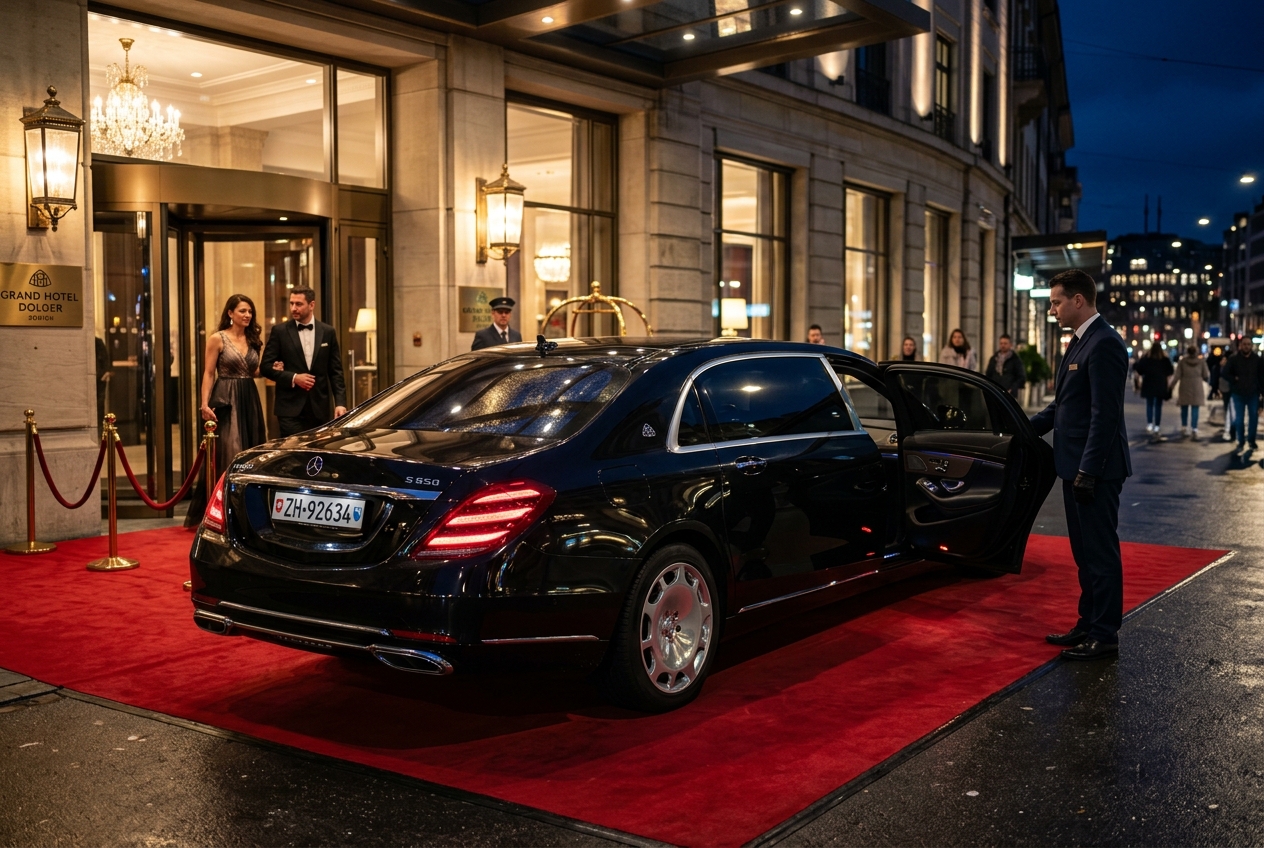
24-Hour Chauffeur Service Zurich: The Night-Owl's 2026 Guide
56 min read · 12,960 words
Zurich never truly sleeps — early morning flights, late-night board dinners and last-minute ski departures all demand reliable transport at hours when taxis vanish. This guide explains exactly how round-the-clock chauffeur services work in Switzerland's largest city, from the realities of overnight airport runs to the etiquette of 3 a.m. pick-ups.
Why 24-Hour Availability Actually Matters in Zurich
Zurich does not sleep the way other cities sleep. It pauses — briefly, lightly — and then resumes. The first long-haul departures from Zürich Airport push off the stands before six in the morning, the trading floors on Bahnhofstrasse begin humming before seven, and by the time the last bar on Langstrasse closes at three, an entirely different set of professionals is already pulling on suit jackets and checking boarding-pass notifications. Understanding why a 24-hour chauffeur service is genuinely necessary here — not a marketing add-on, not a premium-tier flourish — requires understanding the specific, overlapping rhythms that make this city function on a schedule that standard transport infrastructure simply was not designed to accommodate.
Zurich's Position as a Round-the-Clock Financial Capital
Switzerland hosts the headquarters or major regional operations of some of the world's largest private banks, asset managers, reinsurers and pharmaceutical groups. Many of them are concentrated in and around Zurich, and the professionals who run them operate on a calendar that is fundamentally global in character.
A senior banker finishing a client dinner in Singapore lands at Zürich Airport on an early morning connection from Frankfurt or Amsterdam. A fund manager based in Zug needs to be at a breakfast meeting in the Zurich Paradeplatz district at seven-thirty, which means leaving home before six-thirty. A legal team flying in from New York for a corporate transaction arrives into Zurich on a transatlantic service that touches down between five and seven in the morning, local time — because that is precisely when those long eastbound flights land after an overnight crossing.
None of these scenarios is exotic or rare. They occur daily, across the week, across the year. And none of them fits comfortably into the rhythm of standard urban transport.
The Airport's Early-Morning Surge
Zürich Airport (IATA: ZRH) operates one of the busiest hub schedules in continental Europe. Swiss International Air Lines, the home carrier, structures its long-haul programme around a wave system. The first outbound wave — intercontinental and long-European services — departs primarily between five in the morning and seven-thirty. To make a six o'clock departure, a passenger checking a bag should be at the terminal no later than four-thirty. For a traveller staying in central Zurich, that means leaving the hotel between three-fifty and four-ten, depending on traffic.
This is not a corner case. Here is a representative sample of what that early-morning wave looks like in 2026 terms:
| Departure time | Typical destination type | Earliest practical leave time from Zurich city |
|---|---|---|
| 05:50–06:20 | European short-haul, early connects | 04:10–04:30 |
| 06:30–07:00 | Long-haul transoceanic, Middle East | 04:45–05:15 |
| 07:00–07:45 | Business routes, second European wave | 05:15–05:50 |
| 07:45–08:30 | Connecting hub flights, North Africa | 05:50–06:30 |
At four in the morning, there is no tram running. There is no S-Bahn. Zürich's urban rail service does not resume until approximately five o'clock on weekdays, and even then, the Airport Line (S16) runs on a limited timetable in its earliest slots. A passenger with two suitcases, a laptop bag and a need to check in for a six o'clock departure is not well-served by a train that, if it runs at all, deposits them at the airport station with minimal margin and no help with luggage.
Late Transatlantic Arrivals and the Evening Gap
The other pressure point is arrivals. Long-haul services from North America — particularly from New York, Toronto and Chicago — typically land at Zurich between six and nine in the morning, which is manageable from a transport standpoint. But return services, and many Middle East connections, land in the late evening or at night.
Flights from the Gulf region routinely touch down between ten at night and midnight. Business-class passengers on these services are frequently senior executives who have been travelling for five or more hours and are expected at a meeting or site visit first thing the following morning. They need a clean, quiet, reliable journey from Arrivals to their hotel or home — not a taxi queue, not a congested rank with uncertain wait times, and certainly not a surge-priced ride-hail vehicle at two hundred percent the base rate.
The last direct S-Bahn from Zürich Airport to the main station (Zürich HB) via the Airport Line runs just before midnight on most nights. After that, the only public option is a night bus — the Nachtbus network — which runs on fixed routes with fixed stops, does not serve all residential districts, and requires passengers to manage their own luggage on board. For anyone arriving with significant baggage, staying at a hotel outside the direct network, or simply exhausted after a twelve-hour journey, this is not a realistic option.
WEF Davos and the Pre-Dawn Ski Season
Every January, the World Economic Forum in Davos reconfigures the travel patterns of an entire region. Government ministers, central bank governors, chief executives and heads of international organisations converge on a mountain town that has a single access road from Landquart and limited helicopter capacity. The professional movement begins days before the forum opens and peaks during a compressed forty-eight-hour window.
A delegation flying into Zurich from Washington or Brussels on a late Tuesday evening might need to reach Davos by early Wednesday morning. That journey — roughly one hundred and fifty kilometres via the A3 and through the Prättigau valley — takes between two and two and a half hours in good conditions. In January, the Flüelapass is typically closed, the Wolfgangpass may be restricted, and the road through Klosters can be affected by snowfall or ice treatment schedules. A pre-booked, experienced chauffeur who knows the winter routing is not an optional extra in this context; it is the difference between arriving on time and arriving at all.
The ski season more broadly — which runs from late November through to April across the major resorts — generates its own pattern of pre-dawn transfers. Guests staying in Zurich or at the airport who have booked first lifts at Zermatt, St. Moritz or Verbier tend to depart between four and six in the morning. These are long journeys — Zermatt is nearly two hundred kilometres from Zurich Airport, Verbier further still — and they require a driver who is alert, experienced on mountain roads, and able to fit ski equipment alongside passenger luggage. An impromptu ride-hail booking at four in the morning will not produce that.
The Ride-Hail Surge Problem at Unsociable Hours
Ride-hailing platforms operating in Zurich are governed by the same supply-and-demand mechanics that apply everywhere else. Between two and four in the morning on a weekend — particularly after major events, concerts at the Hallenstadion, or simply a busy Saturday evening in the city's bar and club district — surge pricing regularly reaches two to three times the base rate. That is an acceptable cost for a short urban hop. It is a very different proposition for a forty-five-minute transfer to Zürich Airport with luggage for an early departure.
The deeper problem is unpredictability. A surge multiplier of 2.5x is not communicated until the moment of booking. The vehicle class and its condition cannot be verified in advance. The driver's familiarity with the specific terminal layout — which terminal, which arrival level, where the meet-and-greet zone is — is unknown. And if the vehicle does not arrive, or cancels en route, the passenger has limited recourse at three in the morning.
For leisure travel, these are irritants. For professional travel — a managing director with a board meeting in London that cannot be rescheduled, a legal partner carrying original signed documents for a time-sensitive closing — they are genuine operational risks.
Why This Adds Up to a Structural Need
The cumulative picture is not of occasional inconvenience but of a systematic gap between what Zurich's transport infrastructure provides and what the city's professional and international population actually requires, at the hours they actually require it.
- Public transport in Zurich is excellent between approximately six in the morning and midnight. Outside those hours, it is patchy, infrequent and not designed for passengers with luggage or complex itineraries.
- Taxi availability at unsociable hours is geography-dependent and queue-dependent; at ZRH arrivals after a late-night wave, waits of twenty minutes or more are not unusual.
- Ride-hail platforms introduce price volatility and vehicle-quality uncertainty that is incompatible with time-critical professional travel.
- Private car ownership in Zurich is lower than in comparable cities — the parking infrastructure and cost structure of the city actively discourage it — meaning many residents and hotel guests have no personal vehicle alternative.
Against this backdrop, a properly structured 24-hour chauffeur operation — one with a confirmed booking, a known price, a tracked flight and a driver waiting inside the terminal with a name board — is not a luxury. It is a functional solution to a real problem that the city's standard transport ecosystem does not solve.
BLACKTRANSFER operates on exactly this basis from its Zurich base, covering Zürich Airport, Geneva Airport and Basel EuroAirport with no blackout hours and no minimum notice requirements for pre-booked transfers. The vehicle is confirmed, the driver is assigned, and the price is fixed before the journey begins — at two in the afternoon or two in the morning.
How Zurich Airport Operates Around the Clock — and What That Means for Your Transfer
Zurich Airport sits in a curious position among major European hubs: it is efficient, orderly and punctual in the Swiss tradition, yet it never truly sleeps. Understanding its operational rhythm is essential if you are arranging a transfer at any point outside the standard 07:00–22:00 window — because the airport's structure, its curfew rules and the flight patterns that result from them will directly shape when your chauffeur needs to leave Zurich city, where they will wait, and how long you should reasonably expect the meet-and-greet process to take.
The Runway Curfew: What It Is and What It Is Not
Zurich Airport enforces a night flight restriction that broadly prohibits scheduled commercial operations between approximately 23:00 and 06:00 local time. This is not an absolute blackout — cargo flights, medical evacuations, military movements and certain technical ferry flights are exempt — but for the vast majority of passengers the practical effect is clear: no commercial airliner is supposed to land or take off during those hours under normal conditions.
What this curfew does not mean, however, is that the airport closes. Ground-floor arrivals halls remain accessible. Baggage reclaim systems stay operational for aircraft that have already crossed the threshold before 23:00. Check-in desks for early-morning departures begin opening as early as 04:00, and the terminals start filling with passengers heading for the first wave of short-haul European departures that push off between 06:00 and 07:30. By 05:30 on any weekday, Zurich Airport is already a purposeful, busy place.
The "Pinch Points": Late Arrivals Before Curfew and Dawn Departures
Two windows create the highest demand for overnight chauffeur services at ZRH:
1. The late-evening arrival cluster (20:30–22:45) Long-haul routes from North America, the Gulf and East Asia are scheduled to arrive in this window precisely because operators are working against the curfew. Flights from New York JFK on Swiss International Air Lines, United or Delta, transatlantic services from Toronto, Chicago and Los Angeles, as well as Gulf-hub connections from Dubai, Doha and Abu Dhabi that have collected passengers from across South and South-East Asia — all funnel into ZRH in the last two hours before the restriction kicks in. An aircraft landing at 22:40 may not have its doors open until 22:55, and if you have checked baggage, 23:20 or even 23:30 is a realistic exit time from the arrivals hall.
2. The pre-dawn departure rush (04:30–06:30) Swiss and Edelweiss operate a number of long-haul departures in the 06:00–07:00 slot, as do Lufthansa for Frankfurt connections and several low-cost carriers. To be airside in time, passengers on these flights need to check in between 04:00 and 04:30, which means leaving central Zurich, or a hotel in Zug, Lucerne or Baden, between 02:30 and 03:30 at the latest. For a guest staying in Geneva the night before a 06:15 departure, an overnight road transfer is often the only reliable option.
Night Cargo and Why It Keeps the Airport Alive
While passenger operations are curtailed after 23:00, cargo activity continues. Zurich is one of Europe's more significant cargo hubs, handling pharmaceutical shipments, precision machinery and perishables — industries that Switzerland is deeply embedded in. Freighter aircraft from Memphis, Louisville and various Asian cargo hubs arrive and depart through the night. The infrastructure that supports them — fuel trucks, handling agents, customs officers, surface access roads — means the airport perimeter is staffed and lit throughout the night. For a chauffeur approaching ZRH at 03:00, the access roads are clear, the drop-off and pick-up zones are operational, and there are no surprises. This is meaningfully different from some regional airports that effectively lock their gates after the last commercial flight.
Flight Tracking: The Core of a True 24-Hour Service
Here is where the operational picture of the airport connects directly to what a professional chauffeur service must do differently at unsociable hours.
When your flight from Doha departs 55 minutes late, that delay is visible the moment the gate closes in Qatar. A competent 24/7 operation monitors departure and arrival data in real time — not once, not twice, but continuously — from the moment the booking is confirmed right through until the aircraft's wheels touch down. This matters more at night than at any other time, for several reasons:
- Traffic conditions change, but travel time does not disappear. At 01:00 there is almost no traffic between Zurich city and the airport, so a chauffeur can leave later and arrive with precision. But "later" must be calculated against a live, updated ETA, not the original schedule.
- The cost of being early is different at night. Waiting at ZRH at 14:00 is straightforward — there are cafés, lounges, people. Waiting at 02:00 in an empty terminal car park is a different proposition. Knowing the aircraft is still 40 minutes out allows the chauffeur to remain nearby without unnecessarily sitting in a cold bay for an hour.
- You cannot simply call the passenger. If your flight has just landed and you are in the immigration queue at 23:40 with your phone on flight mode, you are not available. The chauffeur must already know, independently, that the aircraft is on the ground and approximately how long customs and baggage reclaim will take.
BLACKTRANSFER tracks all inbound flights in real time, adjusting the chauffeur's departure from standby accordingly. For airport pickups, the standard policy includes 60 minutes of complimentary waiting time calculated from the actual landing time — not the scheduled arrival time. That distinction is significant when a flight lands 35 minutes late and you still need to collect three suitcases.
Arrivals Logistics at ZRH: Terminals A, B and E
Zurich Airport has three passenger terminal zones relevant to arrivals, and knowing which one your flight uses is not merely convenient — at midnight, when signage is harder to parse after a long-haul flight, it can save meaningful time.
| Terminal Zone | Typical Traffic | Arrivals Hall Exit | Common Carrier Examples |
|---|---|---|---|
| Terminal A | Schengen arrivals (no passport control) | Airside to landside via travelator, exits to Level 1 | Swiss (European routes), Lufthansa, Austrian, easyJet |
| Terminal B | Non-Schengen arrivals (passport control required) | Passport control on Level 1, baggage reclaim below | Swiss (intercontinental), Delta, United, Emirates codeshares |
| Terminal E | Separate satellite building, Schengen and some non-Schengen | Connected to main terminal via underground transit train | SWISS regional, some Star Alliance partners |
A few practical notes for late-night arrivals:
- Terminal B non-Schengen arrivals experience the longest post-landing processing times. Passport control is typically the bottleneck rather than baggage reclaim. For a full wide-body aircraft arriving at 22:40, it is entirely plausible that some passengers will not exit the controlled zone until 23:35 or later, particularly if there is a queue at automated e-gates.
- Terminal E requires the intra-airport transit train, which adds roughly 10–12 minutes to the post-landing process. Passengers arriving at E often underestimate this when communicating their expected exit time.
- The official chauffeur meeting point in the arrivals hall is clearly signed with name-board zones. At quiet overnight hours, the waiting area thins out, which actually makes it easier to locate your driver — a professional holding a clearly printed name sign is immediately visible in a near-empty hall.
The Meeting-Point Protocol at Night
The mechanics of a meet-and-greet do not change at midnight, but the environment does. A few things to know:
- Chauffeurs waiting inside the arrivals hall must enter via landside public access, which remains open throughout the night for exactly this purpose.
- Name signs should be clearly printed or displayed on a tablet — in a dimly lit, sparsely populated arrivals hall, a well-lit digital sign is easier to spot than a paper card.
- If you exit and cannot immediately locate your driver, the first step is to check WhatsApp or SMS (your chauffeur will have sent a message confirming their position as soon as the flight landed). BLACKTRANSFER provides the driver's direct mobile number at the time of booking confirmation precisely for this scenario.
- Vehicles park in the designated pickup zone adjacent to the terminal. At night, traffic in these bays moves freely, which means walk time from arrivals exit to vehicle is typically under three minutes.
What the 60-Minute Wait Actually Covers at Night
The complimentary waiting period — 60 minutes from confirmed landing — accounts for the realistic range of post-landing scenarios at ZRH:
- A swift non-Schengen arrival with hand luggage only: perhaps 20–25 minutes from touchdown to exit.
- A Schengen arrival with checked bags: 25–35 minutes.
- A busy non-Schengen flight with a full passport control queue and two checked bags: 45–60 minutes.
- A delayed wide-body with a long queue at non-EU passport control: 60 minutes is a genuine outer edge.
The policy means that in virtually every standard scenario — including the more taxing late-night arrivals — passengers are covered without any additional cost. Only in genuinely exceptional circumstances, such as a very long customs inspection or a missing bag query, does the timeline extend beyond what the complimentary window absorbs.
The Anatomy of a True 24/7 Chauffeur Operation
There is a meaningful gap between a company that lists "24/7" on its website and one that has genuinely engineered its entire operation around that promise. Understanding the difference protects you from the scenario that every frequent traveller dreads: standing at Zurich Airport's arrivals hall at 3:47 a.m., watching unanswered calls ring out and an app showing no available vehicles.
The Staffing Model Is Everything
The most telling indicator of genuine round-the-clock capability is how a provider structures its workforce — specifically, whether it uses salaried, in-house drivers on formalised shift rotations or relies on a pool of freelance contractors who are notified ad hoc when a booking appears.
In-house shift rotation means the company employs or contracts dedicated drivers across three overlapping periods — roughly a day shift, an evening shift and a night shift — with defined handover points. At those handover moments, the outgoing driver briefs the incoming one: which clients are mid-journey, which flights are being monitored, whether a vehicle has a minor mechanical concern that needs watching. The structure creates accountability. Someone is always responsible, always reachable and always aware of live operations.
Ad-hoc freelance dispatch works differently. A booking comes in at 2 a.m., and the company's system — or a duty coordinator — begins contacting available contractors. Response time depends entirely on who happens to be awake, willing and geographically positioned. This model can function well during peak daytime demand, but its fragility is exposed at unsociable hours when the pool of available contractors thins dramatically.
The practical consequence: under the freelance model, a last-minute midnight booking may take 45 minutes to confirm, or it may not be fulfilled at all. Under a shift-rotation model, the night driver is already active, vehicle ready, and confirmation can come within minutes.
What Happens at Shift Handover?
Ask any prospective provider to describe their shift handover procedure. The answer tells you a great deal.
A rigorous handover process includes:
- A structured briefing between outgoing and incoming drivers covering all live and upcoming bookings
- Transfer of vehicle custody with a quick condition check — fuel level, cleanliness, onboard supplies (water, phone chargers, Wi-Fi connectivity)
- Confirmation that flight-tracking software is active and monitoring any arriving passengers
- Escalation of any open issues — a delayed flight, a client who has requested a specific collection point, a vehicle that showed a dashboard warning light
A provider that cannot articulate this process — or describes it vaguely as "the next driver just picks up where the last one left off" — is telling you that handover is informal and therefore a potential failure point.
The handover period itself, typically somewhere between 5 a.m. and 7 a.m. for morning transitions, is worth probing. Some operations run skeleton coverage during these windows. A traveller booked for a 6:15 a.m. pickup to Zurich Airport should confirm explicitly that this transition does not affect their booking.
Vehicle Readiness at 3 a.m.
A night-shift driver who is actively deployed has a vehicle. That is obvious. What is less obvious is the status of backup vehicles during overnight hours.
During the day, a company with five cars on the road and two in reserve can substitute rapidly if a vehicle develops a fault. At 3 a.m., if the sole active night vehicle experiences a problem — a flat tyre, an electronic fault, a minor collision — what happens?
The questions to ask:
- Is a backup vehicle physically available overnight, or would a substitute have to be retrieved from a depot or sourced from a partner company?
- How long would a backup take to arrive at a hypothetical location — say, the Niederdorf district of Zurich's old town at 2:30 a.m.?
- Is there a partner network, and if so, are those partners equally vetted for vehicle standard and driver professionalism?
The scenario matters more than it might seem. A traveller catching a 5:30 a.m. Emirates flight from Zurich Airport (ZRH) to Dubai has almost no tolerance for a 40-minute delay waiting for a replacement car. The runway waits for no one.
| Scenario | Shift-rotation operation | Ad-hoc freelance operation |
|---|---|---|
| Midnight booking, 90 min notice | Driver confirmed within 10 min | May take 30–60 min to secure a driver |
| Vehicle fault at 3 a.m. | Backup vehicle dispatched from nearby | Replacement sourced from contractor pool; timing unpredictable |
| Flight delayed by 2 hours | Duty manager adjusts pickup automatically | Client may need to call repeatedly to update |
| Client needs to modify pickup address at 4 a.m. | Duty manager reachable, vehicle rerouted | Reaches voicemail or automated system |
| Booking placed at 4:30 a.m. for 6:00 a.m. pickup | Confirmed and dispatched within minutes | Uncertain; contractor may not be available |
Control-Room and Duty-Manager Availability
Genuine 24/7 operations maintain some form of live coordination function overnight — whether that is a staffed control room, a duty manager on call or a senior dispatcher who carries a dedicated line and has authority to make real-time decisions.
This is distinct from an answering service or a voicemail box. An answering service can record your message and flag it for the morning. A duty manager can look at a live map, see where the active vehicle is, and tell you in thirty seconds whether your 4 a.m. pickup is on schedule.
The practical test: call the provider's phone number at an unusual hour — not to place a booking, but to ask a specific operational question, such as whether the driver for your 5:00 a.m. transfer has been confirmed. If you reach a knowledgeable human who can answer that question directly, the operation is genuinely staffed. If you reach a recording, an offshore answering service with no access to booking data, or a very groggy person who needs to "check and call you back," you have your answer.
BLACKTRANSFER, for instance, maintains round-the-clock reachability across three phone lines as well as WhatsApp, meaning a passenger can send a message at any hour and receive a response from someone with actual visibility of their booking.
Booking-Channel Responsiveness After Hours
Modern travellers expect multiple contact channels, but channel availability and channel responsiveness are different things. Consider the range:
- Online booking forms are passive — they record a request but guarantee nothing about when it is reviewed.
- Email is asynchronous by nature and entirely unsuitable for same-night bookings.
- Automated booking apps can confirm a booking instantly in theory, but depend on live driver availability and can fail precisely when demand is spikiest.
- Phone remains the most reliable real-time channel, provided a human answers.
- WhatsApp has become increasingly important for professional transfers, combining the immediacy of phone contact with the convenience of written confirmation — a passenger can send a message, receive a confirmed reply and have a written record of the exchange, all within minutes.
For overnight or early-morning bookings, a combination of phone and WhatsApp is the most robust approach: call to speak with a duty manager, then request written confirmation via WhatsApp so you have the driver's name, vehicle registration and estimated arrival time documented.
Questions to Ask When Vetting a Provider
Before committing to any 24/7 chauffeur service for a time-sensitive overnight journey, put these questions directly to the company:
- Do you use employed drivers on fixed shifts, or independent contractors dispatched per booking?
- Who is the duty manager or on-call contact between midnight and 6 a.m., and what is their direct number?
- If my assigned vehicle has a mechanical problem at 2 a.m., what is your backup procedure, and what is the realistic response time?
- Is flight tracking for my arrival automated, or does it depend on someone manually checking?
- If my flight is delayed and arrives outside your standard free waiting window, what happens?
- Can you send me written confirmation of driver name and vehicle details the evening before my early-morning pickup?
A provider that answers these questions fluently and specifically — with actual procedures rather than reassuring generalities — has almost certainly thought through the operational realities of night-time service. A provider that responds with vague commitments ("don't worry, we'll sort it") has not.
The Difference in Practice
Picture two travellers, both flying into Zurich Airport at 01:50 a.m. on a Tuesday.
The first booked with a company whose website prominently advertises 24/7 service. On landing, she switches her phone off flight mode and calls the number. It rings eleven times and goes to voicemail. She sends a WhatsApp — no reply. She stands at baggage reclaim for twenty minutes before someone calls back to say the driver "is on the way." The car arrives forty minutes after she cleared customs. She does not know the driver's name until he appears.
The second booked with an operation built for overnight service. On approach to Zurich, she received a WhatsApp message confirming her driver's name, mobile number and vehicle details. She landed to find a message saying the driver was already in the arrivals hall with a name sign. By the time she reached the meeting point, he had been tracking the flight's progress for two hours and had adjusted his arrival accordingly. The car was warm, water was in the door pocket, and she was in her Zurich hotel within twenty-five minutes of touchdown.
Both companies claimed to offer 24-hour service. Only one had built the operational infrastructure to deliver it.
Overnight and Off-Hours Routes: Key Corridors from Zurich
There is a quiet irony to travelling through Zurich between midnight and six in the morning: the city that spends its daylight hours moving at the relentless pace of global finance becomes, briefly, one of the most stress-free places on the continent to cover ground. Roads that grind to a standstill during the morning commute flow freely. The A1 motorway, which can swallow forty minutes of a daytime airport run in sheer congestion, reverts to its designed purpose. Journey times compress, predictability soars, and the quality of the ride improves in ways that matter to anyone who has stepped off a long-haul flight at half past two in the morning and simply wants to reach their hotel bed with minimum friction.
The corridors described below are the ones that genuinely define off-hours chauffeur travel in and out of Zurich — the routes where the absence of traffic transforms the arithmetic of the journey and where professional chauffeur service delivers its clearest advantage over any alternative.
Zurich Airport to Zurich City Centre
By day, the roughly 13-kilometre distance between Zurich Airport (ZRH) and the city centre is no guarantee of a short journey. The A1 slip roads, the Schaffhauserstrasse corridor and the approach to the Hauptbahnhof can collectively absorb 35 to 50 minutes during peak hours, sometimes more when construction or events compound the usual pressure. At night — say, from around 22:00 until 06:00 — the same journey routinely takes 15 to 25 minutes, depending on the precise drop-off point. A guest arriving at Terminal 1 at 01:30 and heading to the Baur au Lac on Talstrasse, for instance, can be at the hotel entrance in under twenty minutes under normal overnight conditions.
What changes at night is not just speed but texture. There are no aggressive lane merges, no buses blocking the kerb lane, no delivery lorries reversing into narrow streets. A chauffeur can select the optimal routing — typically via the Gubristtunnel bypass or directly along the Birchstrasse corridor, depending on where precisely in the city the guest is heading — without the usual contingency thinking required during the day.
Indicative pricing (BLACKTRANSFER, fixed all-inclusive):
| Vehicle | Approx. Fare (ZRH → Zurich City) |
|---|---|
| Mercedes-Benz E-Class | CHF 120 |
| Mercedes-Benz S-Class | CHF 160 |
| Mercedes-Benz V-Class (up to 7 guests) | CHF 150 |
| Mercedes-Maybach S-Class | CHF 290 |
These fares cover VAT, tolls and the standard 60-minute free waiting period — relevant if a flight arrives late or baggage reclaim takes longer than expected. Prices are indicative and subject to change.
Zurich Airport to Zug and Lucerne
Zug and Lucerne represent the two most common medium-distance overnight corridors from the airport, and both benefit enormously from off-hours timing.
Zug sits roughly 30 kilometres south of the airport. During the working day, the routing via the A4 and A14 can take 40 to 55 minutes. After midnight, with no construction slowdowns at the Zürichsee-Südportal or around the Knonaueramt interchange, the same journey shrinks to around 25 to 35 minutes. Zug's status as a hub for commodity trading firms and international holding companies means a steady stream of executive arrivals on late transatlantic connections — guests for whom a predictable, quiet door-to-door transfer carries genuine professional value. Indicative fare from ZRH to Zug: CHF 190 (E-Class).
Lucerne is roughly 55 kilometres from the airport and offers one of the most pleasant overnight drives in the Swiss Mittelland — a smooth southward run via the A14 through Rotkreuz, past the edge of the Zugersee, and into the bowl of the Reuss valley. By day this corridor can produce 60 to 80 minutes of travel time with traffic; at night, 40 to 50 minutes is a realistic expectation. Arriving guests bound for the Bürgenstock Resort or the Palace Hotel frequently choose a pre-dawn transfer precisely because it is the most reliable window in the entire timetable. Indicative fare: CHF 290 (E-Class).
Early Ski Departures: Davos and St. Moritz
The alpine transfer market has its own distinct rhythm, and it is firmly nocturnal. Guests departing for Davos or St. Moritz who want to be on the mountain by mid-morning — or who need to reach a meeting in Davos before the conference day begins — routinely book pre-dawn departures from Zurich city hotels or directly from the airport after a red-eye arrival.
Davos is approximately 150 kilometres from Zurich Airport and, under good road conditions, takes around 90 minutes to two hours by road. The standard routing follows the A3 south to Chur, then the Prättigau valley via Landquart and the B28 up to Davos Dorf or Davos Platz. In daytime this route is manageable but not immune to delays — particularly around Chur's ring road and the single-carriageway climb through Klosters. In the early morning hours before 06:00, the road is essentially private: no lorries from the Vorarlberg, no tourist coaches, no queues at the Klosters narrows. A departure from Zurich at 04:00 can place a guest in Davos by 05:30 to 05:45, well ahead of the morning commuter traffic that builds on the valley roads after seven. Indicative fare from ZRH: CHF 690 (E-Class).
St. Moritz requires more route planning, and the choice of pass matters. Two primary options exist:
-
Julier Pass (Pass dal Güglia, 2,284 m): The more direct route from Chur, via Tiefencastel and Silvaplana. The Julier is kept open year-round and is treated with priority by Graubünden's road authority. In winter 2026 conditions, it can be icy in the small hours and requires winter tyres as standard — something any reputable Swiss chauffeur service takes as given. Travel time from ZRH: approximately 2.5 hours under overnight conditions.
-
Maloja Pass (1,815 m) via the Engadin valley approach: Often used as a return route or when approaching from the Italian Lakes direction. Less relevant for a pure Zurich departure, but occasionally preferred if the Julier is temporarily closed due to heavy snowfall or wind.
A pre-dawn departure from Zurich at 03:30 or 04:00 for St. Moritz — common during the high winter season and during major events — reaches the Engadin before the light arrives and long before any meaningful road pressure builds. Indicative fare from ZRH: CHF 890 (E-Class).
For both ski destinations, the V-Class merits specific mention: a party of four to six travelling with ski bags, boot bags and luggage finds the V-Class's cargo capacity essential. It carries the same route cost efficiency as the E-Class calculation above but accommodates groups that would otherwise require two vehicles.
Cross-Border Overnight Runs: Munich and Milan
International overnight transfers represent the category where off-peak timing delivers its most dramatic advantage, because the gains compound across multiple potential bottleneck points.
Zurich to Munich covers approximately 320 kilometres, most of it motorway. The A3 east from Zurich to the German border at Kreuzlingen or the A7 via Bregenz (depending on routing preference) feeds into the German Autobahn network. In daytime, the section approaching Munich — particularly the A8 between Rosenheim and the Munich ring — is one of the most reliably congested stretches in Bavaria. At 02:00 or 03:00, it is not. A total journey time of 3 to 3.5 hours is achievable overnight versus 4 to 5 hours or more during the day. This makes early-morning Zurich departures popular with executives catching early morning Munich flights or attending breakfast meetings in the city.
Zurich to Milan runs approximately 290 kilometres via the A2 south through the Gotthard Tunnel. The Gotthard is Switzerland's great chokepoint — a tunnel that generates tailbacks measured in hours during summer weekends and holiday Fridays. At night, in the low season or mid-week, the same crossing is swift and uneventful. The N2/A2 motorway continues through Lugano and the Swiss-Italian border into Como, then the A9 and A8 into central Milan. Overnight, door-to-door from Zurich to a Milan hotel: 3 to 3.5 hours in reasonable conditions. Add 30 to 45 minutes during the Gotthard construction phases currently ongoing through 2026.
Both cross-border routes involve Swiss and EU motorway vignettes and relevant tolls, all of which are included in BLACKTRANSFER's fixed all-inclusive pricing rather than appearing as surprise additions on arrival.
Why Off-Peak Timing Is Its Own Form of Precision
There is a tendency to regard a 03:00 departure as a hardship — something to be endured. The professional logic runs in the opposite direction. Off-hours travel is, in a practical sense, the most controlled form of road travel available in Central Europe. Every variable that degrades journey predictability during the day — urban congestion, motorway incidents, construction lane closures, school-run traffic — is either absent or drastically reduced between midnight and dawn.
For the passenger, this means an arrival time quoted at booking is an arrival time that can actually be relied upon. For executives with connecting flights, early board meetings or conference check-ins at fixed hours, that reliability is not a luxury feature. It is the entire point.
Pricing at Unsociable Hours: What Changes and What Stays Fixed
There is a quiet anxiety that settles over a business traveller whose flight lands at 01:40 and who then wonders whether the driver waiting outside will hand over a receipt inflated by a mysterious "night rate." It is a reasonable concern — one that separates the experience of booking a genuinely professional chauffeur service from hailing whatever happens to be available at an unsociable hour. In Zurich, as in any major European hub, the pricing logic that governs late-night and early-morning ground transport varies enormously depending on the operator, the booking method, and whether you understood the contract before you climbed into the car.
Fixed Fares Versus Metered and Surge-Based Pricing
The fundamental split in the Swiss private-hire market is between operators who quote a single, all-inclusive price at the moment of booking and those whose final invoice is calculated after the journey ends — either by meter or by a dynamic algorithm that responds to demand.
Taxi companies operating under the Zurich cantonal tariff system are metered. The base rate and per-kilometre charge are regulated, but waiting time, public-holiday multipliers and night tariffs — typically applied between 22:00 and 06:00 — are all added on top. For a journey from Zurich Airport to the city centre, the difference between a daytime fare and a late-night metered fare can be material, particularly if traffic, road diversions or a slow immigration queue extend the elapsed time.
Ride-hailing platforms that operate in Switzerland use surge pricing. At 02:30 on a Tuesday when four intercontinental flights have just landed within twenty minutes of each other, the algorithm reflects that demand and the price shown at the moment you press "confirm" may be 1.4× or 1.8× the standard fare. The price is visible before you book, so it is not hidden — but it is also entirely outside your control.
Premium chauffeur operators that sell fixed, pre-booked routes operate differently. The price quoted when you make the reservation is the price on the invoice. There are no per-minute waiting charges layered on afterwards, no fuel surcharges added at the end of the month and no night multipliers applied to a route that was already priced to include the operational realities of running a 24-hour service. BLACKTRANSFER's published fares — for example, Zurich Airport to Zurich City from CHF 120 in an E-Class, or Zurich Airport to Lucerne at CHF 290 — are stated as all-inclusive and do not change because your flight arrives at midnight rather than at noon.
That consistency matters most to corporate travellers who need to submit predictable expense claims, and to anyone who has experienced the unpleasant surprise of a receipt that diverges significantly from an informal quote.
What "All-Inclusive" Actually Covers
When a reputable operator describes a fare as all-inclusive, the term should encompass several components that are often itemised separately by lower-tier services:
- Swiss VAT (currently 8.1% on passenger transport services): This should be baked into the quoted price, not added at the payment screen.
- Road tolls: Switzerland's national motorway network requires the annual vignette (Autobahnvignette), which is a fixed cost that operators absorb into their pricing structure. It is not a variable charge per journey.
- Tunnel and mountain pass charges: Routes to Graubünden, the Ticino or the Valais may involve toll tunnels. The San Bernardino route via the A13, for instance, passes through the San Bernardino Tunnel — a privately managed facility with its own fee structure. Professional operators account for this in route-specific pricing rather than presenting it as a post-trip addition.
- Airport access fees: Zurich Airport charges vehicles for terminal-side access. This should be included in any legitimate airport-transfer fare.
- Waiting at the airport: This deserves its own sub-section, which follows immediately below.
What is typically not included in a standard fixed fare — and what you should ask about explicitly when booking any complex itinerary — are additional stops beyond the agreed route, changes to the destination made en route, and child-seat requests (which may carry a small equipment charge, though many operators absorb this).
The 60-Minute Free Waiting Window: Its Particular Value After Dark
At Zurich Airport (ZRH, officially Flughafen Zürich), the process of disembarking an overnight long-haul arrival can be substantially slower than the same process in the middle of the day. Border control staffing at 01:00 may mean that non-EU passengers face queues longer than they would encounter at 14:00. Baggage from evening banks of flights occasionally accumulates on the same carousels. A passenger who was supposed to land at 23:55 and clear the terminal by 00:30 might not reach Arrivals until 01:20.
This is precisely where the free-waiting-time policy of quality chauffeur operators becomes financially significant rather than merely convenient. BLACKTRANSFER monitors flights in real time and starts the free waiting clock from the moment the aircraft touches down — not from the originally scheduled arrival time. Sixty minutes of complimentary waiting is then counted from that actual landing time. For an overnight arrival delayed by forty minutes on top of a slow immigration process, this policy can be the difference between finding your driver composedly waiting with a name sign and facing an empty kerb while trying to arrange alternative transport at 02:00.
By contrast, taxi ranks at ZRH are served by whoever is in the queue at that moment. There is no driver assigned to your flight, no flight tracking, and no guarantee that a vehicle will be waiting if you emerge from the terminal later than expected.
The Nuance Around Last-Minute and On-Demand Bookings
The absence of a night surcharge on pre-booked fixed routes does not mean that the time of booking is irrelevant. There is a meaningful distinction between a journey reserved twenty-four hours in advance and a journey requested at 02:00 for immediate dispatch.
An on-demand request in the early hours requires the operator to locate an available vehicle, brief the driver, and potentially reposition a car that is not already staged near your departure point. That operational cost is real. Some operators absorb it within a standard rate; others apply a premium for very short-notice bookings outside conventional hours. If you are the kind of traveller who regularly departs hotels at unusual hours with minimal advance notice, it is worth asking your chosen provider directly how they handle same-hour bookings and whether a surcharge applies.
The practical takeaway: book as early as you can confirm the journey. Even a booking made twelve hours in advance gives a professional operator enough time to assign a vehicle without any additional premium. A booking made two hours before a 03:00 pickup is a different proposition.
Route-Specific Pricing for Common Overnight Corridors
The table below shows indicative fixed fares for routes frequently travelled at night — ski resort pickups, post-conference transfers, early-morning departures to alpine destinations — using BLACKTRANSFER's published pricing as a reference point. These prices are all-inclusive (VAT, tolls, airport waiting where applicable) and do not vary by hour of day for pre-booked journeys.
| Route | E-Class | S-Class | V-Class (up to 7) | Mercedes-Maybach |
|---|---|---|---|---|
| Zurich Airport → Zurich City | CHF 120 | CHF 160 | CHF 150 | CHF 290 |
| Zurich Airport → Zug | CHF 190 | — | — | — |
| Zurich Airport → Lucerne | CHF 290 | — | — | — |
| Zurich Airport → Basel | CHF 390 | — | — | — |
| Zurich Airport → Bern | CHF 420 | — | — | — |
| Zurich Airport → Davos | CHF 690 | — | — | — |
| Zurich Airport → St. Moritz | CHF 890 | — | — | — |
| Zurich Airport → Zermatt | CHF 990 | — | — | — |
| Zurich Airport → Geneva | CHF 1,150 | — | — | — |
Prices are indicative and subject to change. Contact BLACKTRANSFER directly for multi-vehicle, multi-stop or bespoke itinerary quotations.
Routes to alpine destinations such as St. Moritz, Zermatt and Davos are especially relevant in the overnight context because many travellers flying in for ski weekends or corporate retreats choose to complete the mountain transfer in the same journey as the airport pickup — arriving at their chalet or hotel in the early hours rather than overnighting in Zurich. The A13 to Graubünden (serving Davos and St. Moritz) and the route to Zermatt via the Rhône valley are both well within the operational capability of Swiss-registered vehicles, but the extended journey times — two to three hours and more — mean that the fixed-fare model is especially valuable: the final price does not depend on how long the mountain roads take at 23:30 in January.
Hourly Rates and After-Hours Flexibility
For travellers who do not have a fixed destination but need a vehicle held on standby — during a corporate roadshow where meeting schedules shift, or during an event where the finish time is genuinely uncertain — hourly chauffeur hire is the appropriate structure. BLACKTRANSFER's hourly rates (E-Class CHF 95/hour, S-Class CHF 130/hour, V-Class CHF 120/hour, Maybach CHF 220/hour) apply on a minimum-three-hour basis and include the driver's time during waits between legs.
This model removes the incentive for a driver to take a suboptimal route — since the fare is not distance-based — and makes the cost of schedule overruns predictable for the client. If a dinner runs an hour long, the additional cost is a single line on the invoice rather than a renegotiation at the kerb.
Cancellation Terms and Their After-Dark Relevance
Because overnight journeys are often the result of tight itineraries — a transatlantic flight, a connection in Zurich, a dawn pickup for a mountain transfer — it is worth understanding how cancellation terms apply to pre-booked fixed routes. BLACKTRANSFER's policy waives any charge for cancellations made more than 24 hours before the scheduled pickup. Cancellations within 24 hours incur 50% of the fare; cancellations within three hours, or no-shows, are charged at the full rate.
For travellers booking long-haul connections well in advance, the practical implication is straightforward: if your inbound flight is cancelled and you cancel the ground transfer with more than a day's notice, you pay nothing. The risk window is the final 24 hours — which is also, for most travellers, the window in which a disrupted itinerary becomes apparent. Travel insurance policies that cover missed connections will sometimes reimburse ground-transport cancellation charges in documented disruption scenarios; it is worth checking your policy before an overnight long-haul departure.
Booking a Midnight Transfer: Channels, Lead Times and Cancellation Rules
Planning a transfer that departs at 02:30 is not the same as booking a cab to the airport on a Tuesday morning. The margin for error compresses, the consequences of a missed booking amplify, and the communication channels you rely on need to work when most of Switzerland is asleep. This section covers the full practical journey from the moment you decide you need a chauffeur to the moment the door closes behind you — with particular attention to what actually works in the small hours.
Start with a Realistic Lead Time
The honest recommendation is 24 hours of advance notice, and that is true regardless of whether the pickup is at noon or midnight. Giving a day's notice allows the dispatch team to assign a driver, confirm vehicle availability, and load your flight details into the tracking system so monitoring begins automatically well before you land.
That said, same-day bookings are genuinely possible, and they happen regularly — inbound passengers whose previous onward transport collapses, executives whose schedules shift at short notice, and travellers who simply did not plan ahead. The practical threshold for same-day acceptance depends on how busy the fleet is on that particular night, so the earlier in the day you enquire, the better your chances of securing the exact vehicle class you want rather than the next available option.
A few practical guidelines on lead times:
- 24 hours or more: Full vehicle selection available; flight tracking set up with no prompting needed from your side.
- 6–24 hours: Almost always feasible; contact directly to confirm availability before committing to the booking.
- 2–6 hours: Possible, especially late at night when demand shifts; best approached via WhatsApp for the fastest response.
- Under 2 hours: Treat as an emergency booking; be realistic that specific vehicle classes may not be available, and have a fallback option in mind.
There is no premium surcharge for short notice built into the published fare structure — the fixed prices listed on the booking platform are the same whether you book three weeks ahead or three hours ahead. What changes with very short notice is certainty of supply, not price.
Why WhatsApp Is the Right Channel After Midnight
At 01:15 on a Wednesday, you are not going to navigate a multi-step online form at full cognitive speed, particularly if you have just landed after a transatlantic flight. WhatsApp messaging at +41 79 177 24 24 fills that gap cleanly. The channel is monitored around the clock and is designed for exactly this kind of real-time, conversational exchange — confirming a detail, adjusting a pickup point, or asking whether the driver is already in the arrivals hall.
WhatsApp is also the right medium when something changes after a booking is already confirmed. If your flight is diverted or arrives earlier than scheduled, a quick message with your updated flight number is easier to send and faster to act on than an email or a web-form amendment. The team can relay the change to the driver immediately.
For those who prefer a phone call — perhaps because they are not confident typing a destination name in a foreign script while standing in an arrivals hall — calls to the same number are equally available at any hour. The additional numbers +41 76 389 64 52 and +41 78 739 12 21 exist precisely to ensure that even if one line is temporarily engaged, there is a fallback.
Email to info@blacktransfers.ch remains the right medium for advance bookings that benefit from a written confirmation trail — corporate travel managers, event coordinators, and executive assistants typically prefer this for anything more than 48 hours out.
What Information to Have Ready Before You Make Contact
The smoother the information exchange, the faster a booking can be confirmed and a driver dispatched. Assembling the following before you reach out saves multiple back-and-forth messages at an hour when you would rather be doing anything else.
| Detail | Why It Matters |
|---|---|
| Flight number | Enables automatic real-time tracking; the team monitors for delays, early arrivals and gate changes without you needing to update them |
| Arrival or departure time | Cross-checked against the flight number; also needed if you are not arriving by air |
| Number of passengers | Determines which vehicle class is appropriate |
| Number and type of bags | Ski equipment, oversized luggage and golf bags affect vehicle choice; the V-Class and GLS handle large loads far better than a saloon |
| Pickup address or terminal | At Zurich Airport (ZRH), the meet-and-greet point differs from a roadside pickup; hotels and private addresses need a precise street address |
| Destination address | Including hotel name if applicable; for lesser-known addresses, a postcode is helpful |
| Vehicle preference | E-Class, S-Class, V-Class, Maybach, Bentley Flying Spur, GLS or Escalade |
| Special requests | Child seats, a specific newspaper, the temperature kept at a particular level — these are easier to accommodate when flagged in advance |
| Contact number in Switzerland | Especially important for international travellers who may not have local roaming active |
If you are booking for a third party — a colleague, a client, a family member — make sure you have their mobile number to hand. The driver will be in direct contact with the passenger on the day, and the booking team needs a number that actually works at the time of pickup.
Understanding the Cancellation Policy
Night travel and cancellation risk go hand in hand. Late-night pickups are often tied to flights that can be cancelled, delayed, or diverted; itineraries shift; meetings end early or run long. The cancellation policy is structured to accommodate reasonable changes while also protecting drivers who have committed a vehicle and their time to a booking.
The tiers are as follows:
- More than 24 hours before pickup: Full cancellation at no charge. If your plans change the day before, you owe nothing.
- Within 24 hours but more than 3 hours before pickup: 50% of the total fare is charged. The driver will have already prepared the vehicle, confirmed the route, and in many cases have turned down other work to hold the slot.
- Within 3 hours of pickup, or a no-show: 100% of the fare applies. At this stage, the driver is likely already en route or waiting, and there is no realistic opportunity to reallocate the booking.
One practical point worth noting: the 60 minutes of free waiting time included for airport pickups does not form part of the cancellation calculation. That waiting window is there to absorb the ordinary friction of landing — immigration queues, baggage delays, and the general unpredictability of arrivals. It is separate from the question of whether a booking is cancelled entirely.
Events, WEF Davos and large group bookings operate under individually agreed terms, which will be set out in the booking confirmation for those jobs. The standard tiers above do not automatically apply to those categories, so read your confirmation carefully if you are arranging transport around a major Zurich event, a Davos week transfer, or a multi-vehicle wedding convoy.
If circumstances beyond your control — a medical emergency, a flight cancellation by the airline — cause you to miss the standard window, it is always worth contacting the team directly. There is no guarantee of a different outcome, but clear communication ahead of the situation is better than a no-show with no explanation.
Corporate Accounts and Invoicing for Frequent Night Travellers
For anyone who regularly moves through Zurich outside business hours — investment professionals flying in from New York or Singapore, consultants on retainer for Swiss corporate clients, medical specialists who do not choose their schedule — the mechanics of per-trip payment become an unnecessary friction point. Paying per journey with a personal card at 03:00 is not a process that scales.
Corporate account arrangements consolidate billing across multiple trips into periodic invoices, which can be reconciled against expense reports without the driver needing to produce a receipt at the kerbside. Payment under a corporate account is accepted by Visa, Mastercard, Apple Pay, Google Pay, and PayPal for individual trips when an invoice arrangement is not in place — but for high-frequency use, the invoice route is cleaner for both finance teams and the travellers themselves.
To establish a corporate account, the starting point is a direct conversation via email or phone, allowing both sides to agree on billing cycles, authorised travellers, and any standing preferences (standard vehicle class, preferred pickup zones, recurring routes). Once set up, individual travellers within the company can book under the account without needing to manage payment themselves — which matters considerably when the person making the booking is a PA in London and the person being driven is a managing director arriving at Zurich Airport at midnight.
A Note on Confirmation and Driver Contact
Every confirmed booking should result in a written confirmation — by email or WhatsApp, depending on how the booking was made. That confirmation will include the booking reference, the driver's name or contact number, and the pickup details. If you have not received a confirmation, follow up: it is far better to identify a miscommunication the day before than to discover it at the pickup point.
On the day of travel, the driver will typically make contact in the period before the scheduled pickup — particularly for airport arrivals, where the meet-and-greet with a name board at the arrivals hall is the default arrangement. If you have landed and cannot locate your driver, the WhatsApp line and the direct phone numbers are the fastest way to resolve the situation. Arrivals halls can be congested; clear communication over the phone is quicker than searching.
Passenger Comfort and In-Car Experience After Dark
Stepping into a chauffeur vehicle at two in the morning is a fundamentally different experience from boarding one at noon. The city outside is quieter, your body clock is off-kilter, your tolerance for friction is minimal, and your need for recovery has never been higher. Whether you have just cleared customs after a fourteen-hour intercontinental flight or wrapped up a client dinner that stretched well past midnight, the cabin you settle into should do one thing above all else: disappear. The very best late-night transfers are the ones passengers barely remember, not because they were unmemorable, but because nothing disturbed them.
Lighting: Setting the Right Mood Without Being Asked
Cabin lighting is one of the subtler yet most consequential details of an after-dark transfer. During daylight hours, passengers often leave the interior lights as they are. Late at night, the calculus changes entirely.
A professional chauffeur anticipates this. Before you open the door, the interior ambient lighting should already be dialled down to a warm, low level — enough to help you locate the door handle, settle into your seat and retrieve whatever you need from your bag, but not so bright that it startles eyes already adjusted to darkness. Overhead reading lights should remain off unless you specifically request otherwise.
Many vehicles in a premium fleet use multi-zone LED ambient lighting that can shift across a spectrum from cool white to deep amber. For a jet-lagged passenger, warm amber tones are easiest on the eyes and least likely to suppress melatonin further — a small but meaningful courtesy. The chauffeur should make no song and dance about adjusting this; it simply happens, quietly, before you are even seated.
Sound: The Case for Silence
There is a persistent misconception that hospitality requires background music. In a hotel bar at midnight, perhaps. In a moving vehicle at 03:00, after a transatlantic flight, silence is hospitality.
A skilled chauffeur does not play music by default. If they do introduce sound at all, it is at the softest volume imaginable — classical or ambient, never anything with driving percussion or intrusive vocals. More often, the standard is silence unless the passenger initiates otherwise. If you want music, you ask; if you say nothing, the cabin stays quiet.
The mechanical hush of a Mercedes-Benz S-Class or E-Class is itself a form of acoustic comfort. Triple-layer glazing and heavy sound deadening mean that, even at motorway speeds, exterior noise barely registers. The Mercedes-Maybach S-Class takes this further still, with its specific sound-insulation engineering making the cabin one of the quietest production interiors available. After hours of airport noise, aircraft engines and the general assault of international travel, that silence is not a neutral absence — it is active recovery.
Conversation: The Professional Art of Saying Nothing
The social contract of a late-night transfer is simple: the chauffeur is there, professional, alert and ready to assist — but they do not need acknowledgement, and they do not require conversation to feel comfortable.
Many passengers, particularly those flying in from time zones eight or ten hours ahead, are running on near-empty. A chauffeur who launches into cheerful small talk about the weather in Zurich or the state of the motorway is not being friendly; they are being inconsiderate. True professionalism at unsociable hours means reading the passenger immediately — and, when in doubt, defaulting to silence.
This is not coldness. The chauffeur greets you properly at arrivals, confirms the destination, ensures you are settled, and then becomes part of the vehicle. Should you want to talk, they engage naturally. Should you close your eyes or open your laptop, they disappear entirely. The distinction between a trained chauffeur and a standard taxi driver is nowhere more obvious than here.
Dress Code: Consistent Regardless of the Hour
Professional presentation does not clock off at midnight. A chauffeur arriving to collect a passenger at 04:30 should be dressed identically to one meeting a passenger at 10:00 — dark suit or equivalent professional attire, clean, pressed, unhurried in manner. The hour is no excuse for a rumpled shirt or a casual jacket. If anything, immaculate presentation at an unsociable hour signals genuine commitment rather than performative professionalism.
This consistency matters to passengers in ways that are difficult to articulate but immediately felt. When you emerge from arrivals, disoriented and fatigued, and you see a chauffeur who looks every bit as composed at 03:00 as they would at midday, it removes a small but real anxiety. Everything is in order. You are looked after.
Driving Style: Smooth Is Not Optional at Night
Late-night driving should be measurably different from daytime driving — not slower necessarily, but smoother. Hard acceleration from traffic lights, abrupt braking, lane changes made without warning: these are tolerable annoyances in the afternoon. At two in the morning, when a passenger is trying to doze against the headrest, they are genuine problems.
A seasoned chauffeur drives anticipatively at night: reading traffic flow ahead, decelerating gently well before junctions, using the relative emptiness of Zurich's roads after midnight to maintain a consistent speed that rocks rather than jolts. On motorway runs — to Lucerne, Basel or the mountain resorts — this smoothness sustains across longer distances, making it entirely feasible for a jet-lagged passenger to sleep for meaningful stretches.
The physical sensation of a heavy, well-damped executive saloon at motorway speeds, driven smoothly, is closer to a first-class cabin than it is to conventional road travel. That is not an accident of engineering; it is why premium chauffeur services specify the vehicles they do.
In-Car Amenities: Water, Charging and Connectivity
The practical needs of a late-night passenger are specific. Here is what should be available without having to ask:
| Amenity | What to expect | Why it matters at night |
|---|---|---|
| Still mineral water | Chilled, bottled, unopened | Hydration after flights; alcohol after late dinners |
| Phone charging | USB-A, USB-C and wireless pad | Battery drained by long travel days |
| Wi-Fi | Password-free, stable 4G/5G hotspot | Final emails, debrief calls, or streaming to decompress |
| Ambient lighting control | Passenger-adjustable or chauffeur-preset | Eye comfort for tired passengers |
| Luggage handling | Chauffeur loads and unloads without prompting | Passengers should never wrestle bags at 03:00 |
The still water point deserves brief elaboration. Pressurised aircraft cabins are dehydrating environments, and passengers arriving on overnight flights — particularly those who have had wine with dinner in business class — often arrive clinically low on fluids without feeling obviously thirsty. A cold bottle waiting on the rear armrest is not a luxury gesture; it is a functional one.
Wi-Fi availability is equally important but for different passenger types. Some travellers at midnight want nothing more than to close their eyes. Others — executives arriving ahead of an early morning board presentation, analysts finishing a pitch deck — need connectivity the moment they leave the terminal. A reliable in-car hotspot means the vehicle becomes an extension of the office rather than a dead zone between airport and hotel.
Choosing the Right Vehicle for Night Transfers
The vehicle you travel in at night should match both your party size and your recovery needs. A rough guide:
- Solo traveller or couple — the Mercedes-Benz E-Class provides a composed, quiet cabin with all core amenities and is ideal when you want efficient comfort without excess. Fixed price from Zurich Airport to the city centre from CHF 120.
- Single executive needing maximum space and quiet — the Mercedes-Benz S-Class offers the full rear passenger experience: extended legroom, reclining rear seats on certain configurations, and substantially enhanced sound insulation. From CHF 160 on the same route.
- Peak silence and cabin architecture — the Mercedes-Maybach S-Class is the appropriate choice for the passenger who needs genuine rest during a longer overnight transfer to St. Moritz or Davos. It is built, in a meaningful sense, for exactly this scenario.
- Group arriving on a late charter or private flight — the Mercedes-Benz V-Class seats up to seven passengers and handles luggage for a full group without compromise. For a party stepping off a private charter at Geneva or Zurich, it eliminates the need for multiple vehicles and keeps the group together. From CHF 150 for airport-to-city on the V-Class.
- Group requiring SUV presence — the Mercedes GLS or Cadillac Escalade suits passengers who want elevated ride height with substantial luggage space, particularly for ski resort runs where road conditions and altitude make a larger vehicle a sensible choice.
The right vehicle makes the difference between arriving at your hotel ready to sleep and arriving more unsettled than when you boarded. After a long travel day, that difference is not trivial.
The Quiet Reassurance of Being Collected Properly
There is something quietly significant about a door being held open for you at four in the morning by someone who is entirely composed, has tracked your flight, has found parking, has the temperature already set, has water waiting, and will not say a word unless you want them to. No scramble, no negotiation, no explaining where you are going.
It is a small act of order in an otherwise disorganised stretch of time. And when you are running on no sleep and a six-hour time difference, small acts of order matter considerably.
To arrange a transfer — at any hour — contact BLACKTRANSFER on +41 79 177 24 24 (also on WhatsApp), email info@blacktransfers.ch, or book online at blacktransfers.ch.
Frequently Asked Questions About 24-Hour Chauffeur Service in Zurich
What Is the Earliest or Latest Pick-Up Time Available?
There is no earliest or latest — that is the point of a genuinely round-the-clock operation. BLACKTRANSFER dispatches vehicles at any hour, whether that means a 04:15 departure to catch the first wave of morning flights at Zurich Airport or a 02:30 collection from a Bahnhofstrasse hotel after a late corporate dinner. Switzerland's own infrastructure supports this: the A1 motorway and the Zürich city ring road carry light but unobstructed traffic between roughly midnight and 05:00, which often makes the dead-of-night window the most reliable for punctual arrivals. The chauffeur is scheduled, briefed and en route before you have even set an alarm.
How Does Flight Tracking Work for a 1 a.m. Arrival?
Every transfer booked against an inbound flight is monitored against live air-traffic data, not just the original scheduled time. When a flight from Dubai, New York or Singapore is showing a revised estimated arrival of 01:17 instead of 00:55, the dispatch team adjusts the chauffeur's departure from standby accordingly — without any action required from the passenger.
The practical sequence looks like this:
- Flight number entered at booking — this links your reservation to real-time FIDS (Flight Information Display System) data.
- Continuous monitoring — the status is watched through the final approach and touchdown, not merely at check-in close.
- Chauffeur briefing updated — if a delay pushes the arrival past the original slot, the driver's schedule shifts to match; they will not be standing in the arrivals hall an hour early or, worse, leaving before you clear immigration.
- Meet & greet positioning — the chauffeur moves to the designated arrivals point at Zurich Airport's Terminal (all Schengen and non-Schengen arrivals converge at the same landside exit on Level 1) timed to your actual landing plus a reasonable clearance buffer.
For 1 a.m. arrivals specifically, immigration queues at Zurich are typically shorter than during the midday peak, which shortens the clearance buffer the team needs to account for.
Is There a Night Surcharge on Fixed-Price Routes?
BLACKTRANSFER's published fixed prices — for example, Zurich Airport to Zurich city from CHF 120 in an E-Class, or to St. Moritz from CHF 890 — are all-inclusive of VAT, tolls and the standard airport waiting allowance. These rates apply regardless of what time the transfer takes place. A 23:45 departure to Davos costs the same as a 10:30 departure to Davos. There is no hidden overnight premium bolted on after booking.
Where pricing differences can arise is in genuinely bespoke arrangements — for instance, a chauffeur-on-standby booking that runs continuously through the night, billed on the hourly rate (E-Class CHF 95/h, S-Class CHF 130/h, Maybach CHF 220/h, three-hour minimum). Those rates are also fixed per vehicle class; the clock does not run faster after midnight.
How Far in Advance Must I Book a Midnight Transfer?
For standard routes — airport transfers, city-to-city runs, hotel pick-ups — same-day bookings are accepted, subject to vehicle availability. That said, booking as early as possible is always advisable during high-demand periods: WEF week in Davos (late January), the Zurich Street Parade weekend in August, Christmas and New Year's Eve. During those windows, the entire premium fleet in the city tends to be committed well in advance.
As a practical guideline:
| Scenario | Recommended lead time |
|---|---|
| Standard overnight airport transfer | 2–6 hours minimum; 24 h preferred |
| Multi-vehicle corporate or event booking | 48–72 hours |
| WEF / major Zurich events | 1–2 weeks |
| Same-day last-minute (single vehicle) | Call or WhatsApp immediately |
The earlier you book, the greater the choice of vehicle class — late requests may find the Maybach or Bentley Flying Spur already allocated, even if an E-Class or V-Class remains available.
Can I Book via WhatsApp at 3 a.m.?
Yes. The WhatsApp number (+41 79 177 24 24) is the same as the primary phone line and is monitored continuously. A message sent at 03:00 will reach a live operator, not an automated bot or an overnight voicemail. For urgent same-night requests, a direct call to any of the three contact numbers (+41 79 177 24 24, +41 76 389 64 52, +41 78 739 12 21) is the fastest route to confirmation, but WhatsApp works equally well if you prefer a written record of the booking details.
What Happens If My Flight Is Cancelled Overnight?
Flight cancellations after midnight are relatively rare at Zurich Airport — the bulk of late-night disruptions tend to be significant delays rather than outright cancellations — but they do occur, particularly in winter when Alpine weather systems move quickly. If your inbound flight is cancelled:
- Contact the team immediately via WhatsApp or phone with your revised itinerary.
- If you have been rebooked onto a flight the following morning, your transfer can be rescheduled to match the new arrival time at no additional charge, provided you notify the team within a reasonable window.
- If you are cancelling entirely, the standard cancellation policy applies: no charge if more than 24 hours remain before the originally scheduled pick-up; 50% within 24 hours; 100% within three hours or for a no-show. A cancellation caused by an airline-initiated overnight cancellation is worth raising directly with the team — there is room for discretion in genuinely exceptional circumstances.
Which Vehicle Is Best for a Solo Traveller Arriving Late with Heavy Luggage?
The Mercedes-Benz E-Class handles a solo traveller with standard business luggage comfortably and is the most cost-effective option at CHF 120 from Zurich Airport to the city centre. However, if you are travelling with expedition-sized cases, ski equipment bags or multiple large suitcases, the Mercedes-Benz V-Class is the correct answer: it offers a full seven-passenger cabin and a cavernous boot, so luggage travels in the vehicle rather than stacked awkwardly around the passenger. The Mercedes GLS and Cadillac Escalade are also practical choices when boot space is the priority alongside a premium ride.
For a solo traveller who simply wants maximum comfort and quiet after a long overnight flight — without necessarily needing the extra space — the S-Class or Mercedes-Maybach S-Class delivers a first-class cabin experience that is genuinely restorative on a 30-minute drive into the city.
Can a Chauffeur Wait If Swiss Customs Takes Longer Than Expected?
The standard 60-minute free waiting period at airports begins from the moment the flight lands, not from the scheduled arrival time. If a non-Schengen arrival triggers a customs inspection, a longer queue at passport control or a delayed baggage belt — all of which can add 20 to 40 minutes — the chauffeur waits. Sixty minutes is a generous buffer for most arrival scenarios at Zurich, which is one of Europe's faster-processing international hubs. If a particularly complex customs situation pushes beyond that window, extended waiting is billed at the applicable hourly rate for your vehicle class, and the team will keep communication open throughout rather than simply departing.
Is the Service Available on Swiss Public Holidays?
Yes, fully. Switzerland has a layered public holiday calendar: national holidays (1 August, Christmas, New Year), cantonal holidays specific to Zurich (including Berchtoldstag on 2 January, Sechseläuten in April), and religious observances. None of these create a service gap. Zurich Airport itself operates on public holidays with a modified but functional schedule, and travellers arriving on those dates — often returning from international trips or beginning business travel — need transfers just as reliably as on any working Tuesday.
How Does the Free 60-Minute Waiting Window Work for an Overnight Arrival?
The 60-minute window is calculated from actual landing time, as recorded by flight-tracking data — not from the original scheduled arrival. So if your flight from Tokyo touches down at 01:43 instead of the booked 01:20, the waiting clock starts at 01:43. You have until approximately 02:43 to exit the arrivals hall before any additional waiting charge applies. In practice, for most overnight long-haul arrivals at Zurich — where passport control and baggage reclaim combined rarely exceed 45 minutes — this window is more than sufficient.
What Is the Cancellation Policy for a Same-Day Late-Night Booking?
The standard terms apply regardless of when the booking was made:
- More than 24 hours before pick-up: free cancellation.
- Within 24 hours of pick-up: 50% of the fare.
- Within 3 hours of pick-up, or no-show: 100% of the fare.
A booking made at 22:00 for a midnight pick-up is, by definition, within three hours, which means it falls into the full-charge bracket if cancelled. This is worth bearing in mind when making last-minute arrangements: once confirmed for an imminent departure, the booking is effectively locked. For events and WEF engagements, individual cancellation terms are agreed at the time of reservation and may differ from the standard policy.
Are Child Seats Available for Early-Morning Family Transfers?
Child seats must be requested explicitly at the time of booking — they are not carried as standard in every vehicle. When requested in advance, appropriate restraints can be provided to comply with Swiss road traffic law (which mirrors EU Regulation 129/2012 i-Size requirements). Early-morning family airport runs — the 05:30 departure with two children and a mountain of suitcases — are best served by the V-Class, which accommodates up to seven passengers and makes the logistics of child seats, carry-on bags and tired small people considerably more manageable than a saloon.
How Discreet Is the Service for High-Profile Passengers Arriving at Night?
Discretion is structural rather than just a stated policy. Chauffeurs do not discuss passenger details, itineraries or identities with third parties. Name signs at the arrivals hall use whatever name the client specifies at booking — an initial, a company name or a pseudonym are all straightforward to accommodate. Vehicles carry Swiss ZH plates with no branding that would draw attention to an executive, public figure or private individual who prefers to move without fanfare.
Overnight arrivals have a practical advantage here: Zurich Airport's arrivals hall at 01:00 or 02:00 contains a fraction of the foot traffic present during daytime peaks, which means fewer onlookers and a quicker transition from airside to vehicle. The Maybach S-Class and Bentley Flying Spur offer fully private rear cabins with privacy glass, making the onward journey as unobserved as the arrival. For clients with specific security requirements — advance route briefings, close-protection coordination or multi-vehicle arrangements — these details are handled at the booking stage directly with the operations team.