Arabic-Speaking Chauffeur Zurich: The Definitive 2026 Guide
54 min read · 12,334 words
Travelling to Zurich from the Arab world brings unique language and cultural expectations that a standard transfer service rarely addresses. This guide gives Arabic-speaking visitors the concrete, practical knowledge to arrange premium chauffeur transport across Switzerland with complete confidence.
Why Arabic-Speaking Travellers Choose Zurich in 2026
The relationship between the Arab world and Switzerland is not a recent phenomenon born of Instagram itineraries or flash-sale flight deals. It is a decades-old connection rooted in trust, discretion and the pursuit of the finest that Europe has to offer — and in 2026, that relationship is deeper and more active than ever. Zurich sits at the centre of it.
Each summer, and increasingly through the autumn and winter months, a significant wave of travellers from Saudi Arabia, the UAE, Kuwait, Qatar, Bahrain, Oman, Egypt, Jordan, Lebanon and the wider Arab diaspora arrives in Switzerland. Zurich Airport receives the largest share of them. Understanding why they come — and why the experience begins the moment they step off the aircraft — is essential context for anyone arranging premium ground transport in this market.
The Banking and Financial Axis
Switzerland's private banking sector has maintained a relationship with high-net-worth Arab families for well over half a century. Zurich, as the country's financial capital, is home to the headquarters or significant offices of UBS, Julius Baer, Pictet, Lombard Odier, Vontobel and dozens of smaller private banks and family office advisors. For a GCC principal managing a multi-generational portfolio, a trip to Zurich is often both a business obligation and a personal preference — a chance to meet relationship managers face-to-face, review estate structures, attend investment briefings, or simply to maintain the kind of in-person relationship that serious wealth management still demands.
These visits are rarely spontaneous. They are typically planned weeks in advance, involve tight meeting schedules across the city's Paradeplatz area and surrounding financial district, and require a level of discretion that public transport — however efficient — cannot provide. The banker does not want to see a client hailing a taxi outside a private bank. The client does not want to be overheard in a hotel lobby making plans. From the first moment of arrival, every logistical decision sends a signal about how seriously the journey has been organised.
Medical Tourism: Hirslanden, the USZ and Beyond
Switzerland's reputation for medical excellence draws Arabic-speaking patients in considerable numbers, and Zurich's two flagship institutions — the Hirslanden Klinik group and the University Hospital Zurich (USZ) — are well-known across the Gulf and Levant. Families travel for specialist consultations in oncology, cardiology, orthopaedics and neurological surgery, often after exhausting options at home or seeking a second opinion of the highest international standard.
Medical travel is categorically different from leisure travel in its emotional texture. A family arriving at Zurich Airport for a parent's cancer consultation, or accompanying a child for a complex procedure, is navigating stress, hope, jet lag and an unfamiliar environment simultaneously. The practical stakes of every transfer — from airport to clinic, from hotel to hospital, from post-procedure accommodation back to the airport — are unusually high. Being greeted in Arabic, having a driver who can navigate a question about the Klinik Hirslanden's admissions entrance or explain the correct drop-off point at USZ's main building on Rämistrasse without a language barrier, provides a genuine and measurable reduction in anxiety. It also means the family does not need to rely on a third-party interpreter for logistics that should simply work.
Medical trips often involve extended stays, repeat journeys over multiple days, and accompanying family members who may need to make independent trips between the hospital and nearby accommodation in Zürichberg or Seefeld. A chauffeur who speaks Arabic and understands the rhythm of these trips is not a luxury in this context — it is a practical necessity.
Luxury Shopping and the Bahnhofstrasse Experience
Zurich's Bahnhofstrasse is consistently ranked among the world's premier luxury shopping streets, and it holds a specific appeal for Arabic-speaking visitors accustomed to the high-end retail environment of Dubai Mall or the boutiques of Riyadh's Kingdom Centre. The street stretches roughly 1.4 kilometres from the main railway station to the shores of Lake Zurich and is home to flagship stores for Cartier, Patek Philippe, Rolex, Louis Vuitton, Hermès, Van Cleef & Arpels and Bucherer, among many others.
Swiss watches, in particular, carry enormous cultural weight as gifts across the GCC and wider Arab world. A first-generation purchase from the Patek Philippe manufacture in Plan-les-Ouates, or a significant acquisition at a Zurich boutique, is not a casual transaction — it is often a family event involving multiple people and carrying social meaning. Arabic-speaking visitors shopping seriously on Bahnhofstrasse frequently require a vehicle that can hold significant purchases, wait patiently across multiple boutique visits, and provide a private and secure space between stops. The Mercedes-Benz V-Class or a large saloon fills this role in a way that a taxi simply cannot.
Many visitors also combine shopping on Bahnhofstrasse with the Niederdorf quarter's smaller jewellers, Zurich's department stores and excursions to the boutiques of Zug or Lucerne (both within 45 minutes of the city), and to the Foxtown outlet centre in Mendrisio, near Lugano — a roughly 90-minute drive south that draws significant numbers of Arab shoppers each season.
The Summer Escape: Climate, Scenery and Seasonal Patterns
For residents of the Gulf — where summer temperatures in June, July and August routinely exceed 40°C and outdoor life becomes effectively impossible — Switzerland offers something genuinely irreplaceable: cool air, green mountains, clean lakes and the ability to walk outside in daylight. This is not a trivial point. The appeal of a Zurich summer, with daytime temperatures typically ranging from 22°C to 28°C and long, luminous evenings, is deeply felt by families who have spent the preceding months largely indoors.
The pattern is well established. GCC families book extended stays — often two to six weeks — in Zurich's lakeside hotels, in private apartments in Seefeld, Küsnacht or Zollikon, or in villas around Lake Zurich and Lake Geneva. They bring extended family, including grandparents and children, and their programme blends leisure, health checks, shopping and finance appointments into a single summer circuit that may also include Geneva, Lugano, Interlaken or Montreux.
This multi-destination, multi-week structure creates substantial demand for reliable ground transport. A family moving between a Zurich hotel and Lake Geneva for a long weekend, or making a day excursion to the Rhine Falls at Schaffhausen or the mountain resort of Engelberg, requires a chauffeur service that knows the routes, can plan journey times correctly and — critically — can communicate fluidly with the passengers throughout.
Education and the Academic Calendar
Switzerland's boarding schools attract students from across the Arab world. Institutions such as Institut Le Rosey near Rolle, Collège du Léman in Versoix, and numerous schools in the Zurich and Zug cantons enroll significant numbers of students from Saudi Arabia, the UAE, Kuwait and beyond. Parents based in the Gulf make multiple trips per year — for admissions, for term visits, for speech days and at the end of academic terms — and Zurich Airport is the primary arrival point for families travelling to schools in the eastern Swiss cantons.
The beginning and end of term, in particular, generate peak demand: a family arriving to collect a child at the end of the school year, with luggage, perhaps gifts purchased in Zurich, and plans to spend a week in Switzerland before flying home, needs seamless transport that respects the family dynamic and communicates without friction.
Why Language Continuity Begins at the Airport
Zurich Airport (ZRH) is Switzerland's largest and busiest international gateway, handling tens of millions of passengers annually. It is well organised and multilingual by European standards — but Arabic is not among the languages in which airport staff can reliably assist beyond basic signage. For a first-time visitor, or for a traveller arriving after a long-haul flight from Riyadh, Dubai or Kuwait with children, elderly relatives and significant luggage, the arrivals hall can be disorienting.
The moment an Arabic-speaking chauffeur is standing at the correct exit — in the arrivals hall of Terminal E for non-Schengen arrivals, or the main hall — holding a name card and ready to assist, the psychological transition from the uncertainty of travel to the comfort of arrival is complete. Everything that follows flows from that moment.
| Reason for Visit | Primary Zurich Touchpoints | Typical Duration |
|---|---|---|
| Private banking & finance | Paradeplatz, financial district | 2–5 days |
| Medical consultation or treatment | Hirslanden clinics, USZ, Klinik Beau-Site | 1 week to several months |
| Luxury shopping | Bahnhofstrasse, Niederdorf, day trips to Lucerne, Zug | 3–10 days |
| Summer leisure | Lake Zurich, city hotels, excursions to Alps | 2–6 weeks |
| Education (school visits) | Zurich, Zug, Geneva cantons | 1–5 days |
| Multi-destination Swiss circuit | Zurich, Geneva, Lugano, mountain resorts | 1–4 weeks |
Across every one of these scenarios, ground transport is not a peripheral consideration — it is the connective tissue of the entire visit. The quality of that transport, and specifically whether it is delivered by someone who shares the language, the cultural register and the intuitive understanding of what a high-net-worth Arabic-speaking guest expects, determines whether Zurich lives up to its considerable reputation or falls short of it in the last mile.
What an Arabic-Speaking Chauffeur Actually Provides
The moment a chauffeur opens a car door and greets a guest with a confident Ahlan wa sahlan — and means it — something shifts. The passenger relaxes. The journey begins on entirely different terms. That single exchange signals not just linguistic competence but a cultural alignment that carries through every minute of the transfer, from the first handshake at arrivals to the final farewell at a hotel entrance. Understanding precisely what that alignment involves is worth unpacking in detail.
Beyond Translation: What Cultural Fluency Really Means
Language is the entry point, not the destination. A chauffeur who has memorised a handful of Arabic phrases but lacks cultural grounding will communicate the words and miss the meaning entirely. Genuine cultural fluency in the context of a Swiss chauffeur service means internalising a set of social norms that Arabic-speaking guests — particularly those from the Gulf Cooperation Council states, the Levant and North Africa — carry with them as baseline expectations, often without articulating them.
Consider the concept of wasta and social hierarchy. Many GCC travellers arrive as part of a principal-and-entourage structure: a senior family member, business figure or official at the centre, surrounded by advisors, family members, assistants or security personnel. A culturally fluent chauffeur understands this dynamic immediately, reads who the decision-maker is within the first few seconds of meeting, and directs all communication and deference accordingly — without needing to be instructed. In a standard taxi or ride-hailing scenario this would never happen. It is almost impossible to train quickly; it comes from genuine exposure.
Hospitality registers matter just as much. Arabic hospitality culture places enormous weight on karama — honour, dignity and the treatment of guests as inherently worthy of exceptional care. When a chauffeur anticipates a need before it is voiced, whether that is offering a phone charger, adjusting the cabin temperature without being asked, or quietly sourcing a specific type of still water, this is not mere attentiveness. It is a signal that the guest's comfort is being treated as a matter of genuine importance, not a commercial transaction. That resonance is cultural.
Navigating Dialect Variation: Gulf, Levantine and Modern Standard Arabic
Arabic is not a single spoken language in the way English is. While Modern Standard Arabic (MSA, or Al-Fusha) serves as the formal written and broadcast register across the Arab world, spoken dialects diverge substantially — in vocabulary, pronunciation, rhythm and even pragmatic conventions. A chauffeur who is fluent in one variety may struggle to understand a guest speaking another, or worse, may respond in a way that sounds stilted or overly formal when relaxed conversation is called for.
The differences are consequential in practice:
-
Gulf Arabic (Khaleeji) — spoken across Saudi Arabia, the UAE, Qatar, Kuwait, Bahrain and Oman — features distinct phonology (the qaf sound, for instance, is often retained rather than replaced with a glottal stop as in some other dialects) and a vocabulary influenced by Persian, English and Urdu loanwords. Guest interactions tend to be relatively direct but layered with formality markers around titles and honorifics. Addressing a Saudi guest by Ya Sheikh or a Kuwaiti by the appropriate honorific is expected; getting this wrong signals a failure of cultural awareness.
-
Levantine Arabic — spoken in Lebanon, Syria, Jordan and Palestine — is phonologically softer and has absorbed significant French (Lebanese) or English influence. The social register tends to be more informal in conversation, with a high value placed on warmth and wit. Guests from Beirut, for example, may code-switch freely between Arabic and French within a single sentence.
-
Egyptian Arabic is broadly understood across the Arab world due to Egypt's media and cinema dominance, but Egyptian travellers often appreciate the recognition when a chauffeur responds naturally in their dialect rather than defaulting to a generic formal register.
-
Maghrebi Arabic (Morocco, Algeria, Tunisia, Libya) is significantly divergent from Eastern varieties, with heavy Berber and French substrates. Mutual intelligibility with Gulf or Levantine Arabic can be limited in spoken form.
A professionally trained chauffeur who speaks Arabic will have clarity about which variety they speak fluently, will not claim competence they do not possess, and will naturally default to MSA when dialect ambiguity arises — because all educated Arab guests understand it, even if it is not their preferred conversational register.
The Professional Chauffeur Versus the Bilingual Driver
This is perhaps the most important distinction and one that tends to be underestimated when booking transport.
| Characteristic | Bilingual Driver | Professional Arabic-Speaking Chauffeur |
|---|---|---|
| Language competency | Basic conversational Arabic | Fluent, often across multiple registers |
| Cultural knowledge | Minimal or self-taught | Deep, experiential understanding |
| Appearance standards | Variable | Consistent: dark suit, white shirt, polished shoes |
| Vehicle knowledge | Can operate the vehicle | Can present the vehicle's features, comfort controls, explain amenities |
| Route narration | None or generic | Contextual, offered only when desired |
| Entourage management | Likely overwhelmed | Coordinated, calm, protocol-aware |
| Discretion | Unreliable | Embedded as a professional standard |
| Privacy protocols | Unstructured | Structured: no phone use, no social media, no disclosure |
The chauffeur who genuinely belongs in the right-hand column has trained professionally, understands Swiss traffic law, knows Zurich's geography at a granular level, and brings an entire professional framework to the role. The Arabic language ability sits on top of that foundation — it does not replace it.
This is why asking a standard taxi company whether any of their drivers "speak some Arabic" is not equivalent to booking a service where Arabic-speaking chauffeurs form part of a curated, trained fleet.
Discretion Around Female Passengers and Family Groups
This deserves careful and honest treatment. Arabic-speaking travellers from conservative backgrounds — particularly from Gulf countries — often have specific expectations around how female family members are treated by male service personnel. These expectations are not uniform across all Arab guests (a Lebanese businesswoman travelling solo has entirely different norms than a Qatari family travelling with several women in abaya), and a culturally fluent chauffeur understands the range.
Practical implications include:
- Addressing female passengers only when directly spoken to, unless otherwise indicated by the guest's own behaviour.
- Never initiating conversation, asking personal questions, or making eye contact that could be interpreted as inappropriate.
- Managing door-opening protocol with awareness of who should exit first and who requires physical assistance with luggage versus who prefers no physical proximity.
- For bookings involving strictly segregated travel, coordinating multiple vehicles or a vehicle configuration that preserves privacy between male and female groups.
- Understanding that a male passenger may wish to communicate all requests on behalf of the group, and managing accordingly without making the dynamic feel pointed or awkward.
None of this requires the chauffeur to make assumptions. It requires sensitivity, observation and the willingness to follow the lead of the guests themselves. A professional chauffeur adapts; a bilingual driver tends to default to a single interaction style regardless of context.
Route Narration, Silence and the Art of Reading the Cabin
Arabic-speaking guests often appreciate knowing where they are and what they are passing — Switzerland's landscape, its historic towns, the context of a route from Zurich Airport through Küsnacht along the lake road into the city centre, for instance, can be genuinely interesting when narrated with knowledge and warmth. A chauffeur who can say, in Arabic, that the lakeside Gemeinde they are passing has been home to writers and financiers since the nineteenth century, or that the mountain visible on clear days beyond the city is the Uetliberg, adds a layer of experience that cannot come from a GPS screen.
But — and this is equally important — a trained chauffeur knows when not to speak. After a long-haul flight from Riyadh or Dubai, many guests want silence, controlled cabin temperature and the confidence that they are in competent hands. The Arabic-speaking chauffeur who fills that silence with well-intentioned chatter is misreading the room. Cultural fluency includes knowing when hospitality means making yourself invisible.
Managing Entourages and Complex Group Logistics
Large Arabic-speaking delegations — business groups, royal household staff, wedding parties, trade fair attendees — often require coordination across multiple vehicles moving in convoy or sequence. This goes well beyond the capability of a single bilingual driver.
A professional Arabic-speaking chauffeur operating within a structured service like BLACKTRANSFER can function as the primary point of contact for a lead vehicle, coordinating with other drivers in the fleet, communicating in the guest's preferred language, managing timing between vehicles, liaising with hotel concierge teams, and handling the kind of last-minute routing changes that are common when VIP schedules shift. The ability to communicate all of this — plans, changes, reassurances — in Arabic without requiring the guest or their assistant to translate is not a luxury. For groups travelling on tight schedules, it is a genuine operational advantage.
Airports, Entry Points and the First Impression
Switzerland's three international airports each carry a distinct character, and for Arabic-speaking travellers arriving from Riyadh, Dubai, Abu Dhabi, Doha or Beirut, the choice of entry point shapes the entire first chapter of a Swiss journey. Whether you land on a commercial Emirates widebody, a Qatar Airways A350 or a Gulfstream G700 chartered privately, the quality of the ground experience begins the moment wheels touch Swiss asphalt — long before you reach your hotel suite.
Zurich Airport (ZRH): The Primary Gateway from the Gulf
Zurich Kloten is Switzerland's largest and busiest airport, and for travellers from Gulf Cooperation Council states it functions as the natural hub. Emirates operates daily widebody services from Dubai DXB; Qatar Airways connects Doha DOH to Zurich with regular rotations; Etihad covers Abu Dhabi AUH; and several seasonal or charter operators supplement capacity during peak periods such as summer holidays and the winter ski season.
The airport's commercial terminal structure matters to anyone arranging a meet-and-greet collection. ZRH's passenger terminals feed into a common arrivals hall on the ground floor of the main building, where landside collection takes place. Here, a chauffeur will stand with a clearly printed name sign — in Arabic script, Latin transliteration or both, according to the passenger's preference — at a designated waiting point near the baggage reclaim exits. The sign reads your name, not a generic company logo, which matters for privacy-conscious travellers who prefer not to advertise their identity in a busy arrivals concourse.
Airside versus landside at ZRH: Commercial passengers are collected landside, after customs and passport control. At Zurich Airport this transition is typically smooth: Swiss border procedures are efficient, and EU Schengen zone rules apply (Switzerland is a Schengen member, though not an EU member), meaning Gulf passport holders who hold a valid Schengen visa or who are eligible for the Swiss eGate system can pass through relatively quickly. Realistically, from wheels-down to landside emergence takes between 20 and 40 minutes depending on queue length, the number of wide-body flights arriving simultaneously, and how much checked luggage is being collected.
Private jet arrivals at ZRH: Zurich Airport has a dedicated FBO (Fixed-Base Operator) facility on the general aviation side of the airfield. The most prominent handler is Jet Aviation, headquartered at ZRH and operating a full-service FBO with a private terminal, customs and immigration clearance on-site, a VIP lounge, and direct apron-to-vehicle handoff capability. A chauffeur collecting from the FBO follows a different protocol entirely: the vehicle drives to an agreed position beside or near the terminal entrance, and passengers walk — or are escorted — directly from the aircraft steps to the waiting car without passing through the public terminal at all. This is the preferred route for high-net-worth Arabic-speaking visitors who value absolute privacy and minimal exposure in shared spaces.
Realistic driving times from ZRH:
| Destination | Approximate Drive Time | Notes |
|---|---|---|
| Zurich City Centre | 20 – 30 minutes | Via motorway A1/A4; traffic-dependent |
| Zug | 35 – 50 minutes | South via A4 |
| Lucerne | 50 – 65 minutes | Via A14; scenic lake approach |
| Basel | 75 – 90 minutes | Northbound A3 motorway |
| Bern | 90 – 110 minutes | West via A1 |
| Davos | 90 – 120 minutes | East via A3/A28 over Landquart; mountain roads |
| St. Moritz | 130 – 160 minutes | Via Chur and Julier or Maloja Pass; longer in winter |
| Zermatt | Approx. 3 hours | Car must terminate at Täsch; transfer to train or e-taxi |
| Geneva | Approx. 2 hrs 45 min – 3 hrs | Via A1 motorway |
These are honest estimates under normal Swiss road conditions. Mountain routes in winter — particularly towards Davos, Arosa, or through the Alpine passes to St. Moritz — extend noticeably and require appropriate tyres and driver experience. BLACKTRANSFER vehicles operating these routes are equipped and insured accordingly.
Geneva Airport (GVA): The Preferred Entry Point for Lac Léman and Beyond
Geneva Cointrin sits inside Swiss territory but straddles the French border in a legally unusual way — it has both a Swiss sector and a French sector, a distinction that affects which exit passengers use and where a vehicle can legally wait. For Arabic-speaking travellers, this is worth knowing in advance.
GVA handles significant private aviation traffic, partly because of Geneva's long-standing role as a diplomatic and financial city, and partly because of its proximity to the Montreux–Lausanne–Vevey arc along Lac Léman — a stretch of Switzerland that draws Gulf visitors seeking quieter, more discreet luxury than the busier Alpine resorts. The Beau-Rivage Palace in Lausanne, the Fairmont Montreux Palace, and several private lakefront estates are within 45–75 minutes of GVA by chauffeur-driven car.
Geneva also serves as a practical entry point for those attending private events on the lake or continuing across the border into France towards Évian-les-Bains, Megève or Chamonix — all reachable on the same transfer.
Meet-and-greet at GVA: Collection from the commercial arrivals hall follows the same principle as Zurich: the chauffeur waits landside with an Arabic or dual-language name sign. Passengers arriving via the French sector exit — which happens when a flight originates from certain French domestic routes or is classified within the French border zone — emerge from a different exit, so confirming the arrival sector in advance is important. A professional chauffeur service will track the flight routing to determine this before the car is dispatched.
Private jet handling at GVA: Geneva has a well-developed private aviation infrastructure with multiple FBO options. Jet Aviation operates at GVA as well, and Signature Aviation also has a presence. The apron-side handoff is available here too, making GVA a genuinely seamless entry point for charter passengers.
Realistic driving times from GVA:
| Destination | Approximate Drive Time |
|---|---|
| Geneva City Centre | 10 – 20 minutes |
| Lausanne | 40 – 55 minutes |
| Montreux | 55 – 75 minutes |
| Zurich | Approx. 2 hrs 45 min – 3 hrs |
| Bern | 100 – 120 minutes |
| Zermatt | Approx. 2.5 – 3 hrs |
Basel EuroAirport (BSL): The Tripoint Hub
Basel EuroAirport occupies one of the most geographically unusual positions of any commercial airport in Europe: it sits on French soil but is jointly operated by Switzerland and France, with separate Swiss and French customs zones inside the same terminal building. It also lies within easy reach of Germany. This tripoint location makes it a less common first choice for long-haul Gulf arrivals, as direct connections from the Arabian Peninsula are limited compared to ZRH or GVA. However, BSL is regularly used by passengers connecting via European hubs — flying Zurich–Basel short-hop, or connecting through Paris CDG, Amsterdam AMS or Frankfurt FRA — and it serves as a practical entry point for those whose primary Swiss destination is Basel city itself, the Upper Rhine region, or the northern Swiss wine country.
The airport has grown as a business travel hub in recent years, partly due to its proximity to the Swiss pharmaceuticals cluster (Novartis and Roche are headquartered in Basel), and partly because of direct connections from European financial centres.
Meet-and-greet at BSL: The arrivals process here is straightforward, though passengers must be clear about which customs zone they are exiting — Swiss or French — as this affects where the vehicle is permitted to wait. A chauffeur service familiar with BSL's layout will specify in the booking confirmation which exit to use and where the driver will be positioned.
Driving times from BSL to key destinations:
| Destination | Approximate Drive Time |
|---|---|
| Basel City Centre | 10 – 20 minutes |
| Zurich | 60 – 80 minutes |
| Bern | 75 – 95 minutes |
| Lucerne | 75 – 90 minutes |
| Geneva | Approx. 2.5 hours |
Flight Tracking and the Logic of Waiting Time
One source of stress that professional chauffeur services eliminate entirely is the uncertainty of late arrivals. Flights from Dubai, Doha, Abu Dhabi and Beirut cover significant distances, cross multiple time zones, and are subject to the normal variability of air travel — particularly in summer thunderstorm season over the Mediterranean or in winter when fog can delay Zurich morning approaches.
BLACKTRANSFER tracks all incoming flights in real time from the moment a booking is confirmed. If a flight is delayed by 90 minutes, the chauffeur arrives 90 minutes later — the passenger is not charged for waiting, and no frantic phone call is required. The first 60 minutes of waiting time at airport arrivals is included at no additional cost. This means a passenger who takes slightly longer at passport control, has checked baggage to collect, or simply wants to compose themselves in the arrivals hall before stepping into the car is not penalised.
For private jet arrivals — where block times and flight plans can shift fluidly — this flexibility is even more important. Coordination happens between the ground team and the FBO handling agent, so the vehicle is positioned correctly before the aircraft engines have fully cooled.
The practical result is that Arabic-speaking travellers, many of whom have experienced chauffeur services across London, Paris, Dubai and elsewhere, arrive in Switzerland to find a driver who already knows the flight status, holds a name sign they can read, speaks to them in Arabic if that is their preference, and is standing in exactly the right place.
Key Routes and Destinations for Arabic-Speaking Visitors
From the moment a flight lands at Zurich Airport (ZRH), the geography of Switzerland opens up in almost every direction — northward to Basel and the German border, south-west toward Bern and the Bernese Oberland, south-east into the Engadin and Graubünden, and west along the Mittelland plateau toward Geneva and the French-speaking cantons. For Arabic-speaking travellers, who often combine leisure, business and family tourism into extended itineraries, understanding these corridors is practical knowledge, not abstract geography.
Zurich Airport to the City's Landmark Hotels
The A51 motorway links Kloten — where the airport sits — to the centre of Zurich in roughly 20 to 30 minutes under normal traffic conditions. The actual duration depends heavily on time of day: mid-morning and mid-afternoon are generally fluid, while the period between 07:30 and 09:00 and again between 17:00 and 19:30 on weekdays can add 15 to 25 minutes to the journey. A professional chauffeur monitors real-time routing and adjusts accordingly.
Three hotels consistently appear in Arabic-speaking travellers' booking patterns:
- Baur au Lac (Talstrasse 1, Lake Quarter): A 19th-century palace property on the edge of Lake Zurich, favoured for its private park and discreet service culture. Transfer time from ZRH: 25–35 minutes. The hotel has no dedicated drop-off forecourt facing a busy road, so a chauffeur who knows the correct approach from Bürkliplatz avoids unnecessary manoeuvring.
- The Dolder Grand (Kurhausstrasse 65, Zürichberg hill): Perched above the city, access is via a steep approach road. Larger vehicles such as the V-Class or GLS handle the gradient comfortably; the hotel's valet coordinates directly with arriving vehicles. Transfer time: 30–40 minutes.
- Park Hyatt Zurich (Beethovenstrasse 21, Zürich-West / City): The most straightforward drop-off of the three, on a wide street with dedicated arrival space. Transfer time: 25–35 minutes.
All three are within the CHF 120–160 range for an E-Class or S-Class transfer from the airport, all-inclusive.
Zurich to Lucerne: The Classic Day Route
Lucerne sits 55 kilometres south-west of Zurich via the A14 motorway, a journey that takes 50 to 65 minutes in comfortable conditions. The lake road through Küssnacht and along the northern shore of Lake Lucerne is a scenic alternative in summer — add roughly 15 minutes, but the views of the Rigi and Pilatus massifs across the water make it worthwhile when guests are sightseeing rather than rushing.
Arabic-speaking families visiting Lucerne typically combine the Chapel Bridge, the Swiss Museum of Transport and shopping on Hertensteinstrasse into a single day, often returning to Zurich in the early evening. An hourly chauffeur service — with a minimum engagement of three hours — suits this format well, eliminating the need to coordinate taxis between stops.
In winter, the A14 is well-maintained and rarely disrupted by snow at valley level, though early-morning fog (Nebel) near the lake can reduce visibility and slow traffic slightly.
Zurich to Zug: The Quiet Financial Hub
Zug is only 30 kilometres from Zurich and reachable in 25 to 35 minutes via the A4. It is home to some of the most discreet business addresses in Switzerland — several Gulf-linked family offices and investment vehicles operate here. Transfers between Zurich city, Zurich Airport and Zug are frequent enough to function almost like an inter-city shuttle for business travellers with back-to-back meetings. The lakeside promenade and the old town's medieval towers make it a pleasant stop for accompanying family members.
Zurich to Basel: Gateway to the North
Basel lies 85 kilometres north-west along the A3 motorway, a journey of 55 to 70 minutes. Basel EuroAirport (BSL/MLH/EAP) — the airport shared between Switzerland, France and Germany — adds a routing option for guests flying in via a different carrier. Some Arabic-speaking travellers fly into Geneva, complete business in Basel and then continue to Zurich, effectively running a west-to-east Swiss traverse across multiple days.
Basel's old town (Grossbasel), the Kunstmuseum and the Rhine riverside are worth a half-day. Art Basel, the global contemporary art fair held each June, draws significant Gulf attendance; during that week, demand for premium chauffeur services surges and advance booking of weeks, not days, is advisable.
Zurich to Bern: The Federal Capital
Bern is 125 kilometres south-west of Zurich, reached via the A1 motorway in approximately 80 to 95 minutes. The rose-coloured sandstone arcades of the Altstadt, a UNESCO World Heritage Site since 1983, the bear park and the Federal Palace are the principal draws. Arabic-speaking visitors with diplomatic or institutional business find Bern's chauffeur-transfer rhythm different from Zurich: the city is compact, parking is easier and appointments tend to cluster around the embassy quarter.
Alpine Destinations: Timing, Terrain and Seasonal Reality
This is where Swiss road geography demands the most specific planning.
St. Moritz (Graubünden, 1,856 m)
The journey from Zurich Airport covers 210 kilometres via the A3 south to Chur, then the Julierpass road (2,284 m) into the Engadin valley. In summer, the drive takes three to three-and-a-half hours with a competent driver. In winter, the Julier is kept open year-round by the canton — unlike many other Alpine passes — but snow chains or winter tyres are legally required and conditions can extend the journey to four hours or more after a heavy snowfall. An alternative winter route runs via the Albula tunnel or the car-train through the Vereina tunnel from Klosters, both reliable options in poor weather.
The fixed transfer price from Zurich Airport to St. Moritz in an E-Class is CHF 890, reflecting the distance, altitude and the expertise required.
Zermatt (Valais, 1,620 m)
Zermatt is car-free. Private vehicles must stop at Täsch, a village 5 kilometres short of the resort, where guests transfer to the Matterhorn Gotthard Bahn's shuttle train (departures every 20 minutes). A chauffeur carries luggage to the Täsch Matterhorn Terminal, ensures the shuttle is boarded correctly and arranges for electric hotel taxis on the Zermatt side if needed. The drive from Zurich Airport to Täsch is approximately 230 kilometres via the A2/A9 motorways — roughly two hours 45 minutes in summer, three to three-and-a-half hours in winter. The Gotthard Base Tunnel (opened 2016) significantly shortened this southern corridor and is used year-round; the old Gotthard Pass road above is a summer-only scenic alternative. Fixed transfer price: CHF 990 from Zurich Airport.
Gstaad (Bernese Oberland, 1,050 m)
Gstaad is reached via Bern and the Saanen valley — approximately 170 kilometres from Zurich, two to two-and-a-half hours depending on the season. The Bernese Oberland roads are well-maintained but considerably narrower than the main national motorways; a skilled chauffeur familiar with the valley approach is genuinely preferable to a general hire car here. Gstaad's winter season from December to March concentrates many Arabic-speaking guests, particularly families, who often stay for extended periods and require multi-day chauffeur arrangements rather than one-way airport transfers.
Verbier (Valais, 1,500 m)
Verbier sits above the Rhône valley town of Martigny. From Zurich Airport the fastest route runs via the Gotthard Base Tunnel and then westward along the A9 motorway — approximately 260 kilometres, around three hours in summer. The final approach from Le Châble winds up a narrow mountain road; in heavy snowfall this section demands genuine Alpine driving experience. Verbier, like Gstaad, attracts extended-stay Arabic-speaking guests and coordinates naturally with a Geneva arrival or a Monaco/Nice return routing (see below).
| Alpine Destination | Distance from ZRH | Summer Drive | Winter Drive | Key Route Notes |
|---|---|---|---|---|
| St. Moritz | ~210 km | 3–3.5 h | 3.5–4 h | Julierpass open year-round; Vereina tunnel option |
| Zermatt (Täsch) | ~230 km | 2.75 h | 3–3.5 h | Gotthard Base Tunnel; car-free resort |
| Gstaad | ~170 km | 2–2.5 h | 2.5–3 h | Saanen valley approach; narrow roads |
| Verbier | ~260 km | 3 h | 3.5–4 h | A9 via Gotthard; steep final ascent |
Cross-Border Routes: Geneva, Milan and Monaco
Many Arabic-speaking travellers do not limit themselves to Switzerland in a single trip. Multi-country itineraries combining Zurich, Geneva, Milan and Monaco are common, particularly in summer and over the Eid holiday periods.
Zurich to Geneva
The direct distance is 280 kilometres via the A1, with a typical journey time of two hours 45 minutes to three hours 15 minutes. Both cities are francophone (Geneva) and German-speaking (Zurich) Swiss, but culturally distinct; travellers appreciate a chauffeur who can navigate seamlessly between them. The fixed E-Class price between Zurich Airport and Geneva stands at CHF 1,150.
Zurich to Milan (Malpensa or City Centre)
Milan Malpensa Airport (MXP) is approximately 290 kilometres from Zurich via the A2 motorway and the Gotthard Base Tunnel, a journey of around two hours 45 minutes to three hours. The Simplon route via Brig and Domodossola offers an alternative, adding roughly 30 minutes but passing through spectacular scenery in the Rhône valley and across the Italian frontier at Iselle. Swiss and EU vehicles cross freely; no border queues typically apply. Guests combining a Zurich business stay with Milan fashion, design or shopping trips find the overland chauffeur option considerably more practical than short-haul air travel when door-to-door time is counted.
Geneva to Monaco (French Riviera Arc)
Once in Geneva, Arabic-speaking travellers occasionally extend southward to Monaco — approximately 260 kilometres along the French A43 and A8 motorways, three hours on a clear day. Monaco and the Côte d'Azur are intensely popular during July and August; chauffeur demand peaks accordingly and multi-day bookings arranged well in advance are the norm. BLACKTRANSFER coordinates cross-border journeys of this type, ensuring that vehicles carry the appropriate Swiss plates and insurance coverage for seamless passage through the French corridor.
Fleet Choices and Comfort Preferences
Choosing the right vehicle for a journey through Switzerland is rarely a trivial decision for Arabic-speaking travellers. Group size, privacy expectations, luggage volumes, the need to remain productive between time zones, and a simple preference for travelling with dignity all influence which car should be waiting on the kerb. The fleet available through a serious Zurich chauffeur service spans enough variation to address every one of those factors—but understanding why each model exists in the range, and which genuinely suits a particular traveller profile, makes the difference between a comfortable transfer and a genuinely memorable one.
Solo Business Travellers and Couples: Prioritising Privacy and Presence
For a single executive or a travelling couple, the ideal vehicle is one that communicates competence without ostentation, provides genuine rear-seat comfort for journeys that may last two or three hours, and allows confidential conversation or focused work without the chauffeur overhearing every word. Three models serve this profile exceptionally well.
Mercedes-Benz S-Class
The current-generation S-Class remains the reference point for long-wheelbase business saloons in Switzerland. The rear cabin is wide enough that two passengers never feel cramped, the seat travel is generous, and the massage function—standard on most specification levels ordered by Swiss operators—makes the 80-minute run from Zurich Airport to Lucerne feel considerably shorter than the clock suggests. For Arabic-speaking travellers arriving on overnight flights from the Gulf, where fatigue and jet lag are constant companions, this matters more than any headline specification.
The S-Class also handles the transition from Zurich's urban streets to Alpine motorways without drama. Air suspension keeps the ride level through the Gotthard approach, and the cabin sound insulation is sufficient that a passenger can hold a phone call at normal speaking volume without raising their voice.
Mercedes-Maybach S-Class
The Maybach variant occupies a distinct tier. The rear seats recline to near-horizontal, extending leg rests and featuring individual climate zones that allow two passengers to maintain entirely different cabin temperatures—useful when a client from Riyadh and their Swiss counterpart have different thermal preferences after a long flight. Rear-seat tablet controllers manage audio, ambient lighting, and the window blinds, giving the passenger complete control over their environment without needing to ask the driver to adjust anything.
The Maybach is particularly well-suited to what might be called the "arrival statement"—the moment a senior principal steps out of a vehicle in front of the Baur au Lac or the Dolder Grand. Swiss hotel doorstaff recognise the model immediately, and for guests who expect that recognition, it provides an unspoken confirmation that the logistics have been handled correctly.
Bentley Flying Spur
The Flying Spur represents a different kind of luxury: more characterful, more overtly expressive than the Mercedes models, and genuinely rare on Swiss roads in chauffeur service. The hand-stitched leather, the knurled metal controls, and the distinctive exhaust note when the car pulls away set it apart from fleet vehicles in a way that some travellers—particularly those who appreciate traditional British craftsmanship—find deeply satisfying. For a couple visiting Zurich for private banking meetings, a shopping itinerary on Bahnhofstrasse, or an evening at the Zurich Opera House, the Flying Spur adds a layer of occasion to the journey itself rather than simply providing transportation between two addresses.
Family Groups and Entourages: Space, Coordination and Group Comfort
Arabic-speaking visitors from Gulf countries frequently travel in larger configurations than the European norm. An extended family group of five or six, a principal accompanied by family members and a personal assistant, or a business delegation requiring all members to travel together rather than in separate vehicles—these are common scenarios that a solo saloon simply cannot accommodate. Three models address this directly.
Mercedes-Benz V-Class (up to Seven Passengers)
The V-Class in its long-wheelbase configuration is the workhorse of group travel in Switzerland. Seven passengers can be transported in a single vehicle, which matters not just for cost efficiency but for cohesion—families arrive together, conversations continue uninterrupted, and no one has to wait on a kerb for a second car to catch up. The captain's chairs in the middle row recline independently, and there is genuine luggage space behind the rear bench even when all seats are occupied.
For families with children, the V-Class has a practical advantage that pure prestige saloons lack: the sliding side door makes entry and exit straightforward without the acrobatics that children and older family members sometimes perform getting in and out of low-slung saloons. The elevated seating position also gives younger passengers a better view of the Swiss landscape—of Lake Zurich from the Seestrasse, or of the snow-covered approaches to Davos.
Mercedes GLS
Where the V-Class prioritises passenger count, the GLS prioritises individual comfort for a slightly smaller group. With seating for six in its standard configuration, the GLS provides a genuinely SUV-grade ride height, a commanding view of the road, and the kind of four-wheel-drive capability that becomes relevant on the access roads to certain ski resorts when conditions deteriorate in January or February. The GLS is also notably quieter inside than comparable SUVs, which makes it suitable for a small family or a principal with two or three colleagues where conversation quality matters.
Cadillac Escalade
The Escalade deserves separate discussion because it occupies a very specific position in the psychology of group travel. For Arabic-speaking clients from markets where the Escalade carries genuine cultural cachet—it is a recognised symbol of VIP transport across the Gulf, East Africa, and parts of the Levant—arriving in an Escalade in Zurich provides a sense of continuity with the transport they use at home. It signals that arrangements have been made by people who understand what they expect.
Practically, the Escalade's interior volume is exceptional. The third row is genuinely usable for adults, unlike many SUVs where the rearmost bench is a formality. The raised ride height and substantial road presence also offer a degree of visual privacy—pedestrians and other road users cannot easily see into the cabin—which some high-profile travellers and their security teams specifically request.
Practical Features That Matter Across the Entire Fleet
Regardless of which vehicle a traveller selects, several features are standard across the BLACKTRANSFER fleet and address specific comfort preferences that Arabic-speaking visitors frequently raise.
| Feature | Why It Matters for Arabic-Speaking Clients |
|---|---|
| In-vehicle Wi-Fi | Staying connected to family, colleagues and business across Gulf time zones (UTC+3 to UTC+4) during Swiss journeys of 1–3 hours |
| Chilled water provided | Standard hospitality expectation; still and sparkling available on request |
| Phone chargers (USB-A, USB-C, wireless) | Arriving with a charged phone is non-negotiable for travellers managing WhatsApp family groups, business communications and digital boarding passes |
| Tinted glass | Provides visual privacy in urban settings, reduces solar glare, and allows passengers to rest without closing blinds manually |
| Individual climate control | Multiple climate zones mean that passengers with different temperature preferences—common when mixing adults and children—can each maintain comfort |
| Privacy partition (Maybach and select S-Class configurations) | Allows genuinely confidential conversation in the rear without relying on the driver's discretion |
The tinted glass point is worth expanding. In cities such as Zurich, where summer light can be intense and the low winter sun creates significant glare at altitude, dark tinting on rear windows is a functional advantage as well as a privacy measure. It also reduces the visibility of the cabin's occupants when the vehicle is stationary at a hotel entrance or government building—a detail that matters for high-profile families or individuals who prefer not to be observed.
Why Swiss Registration Matters
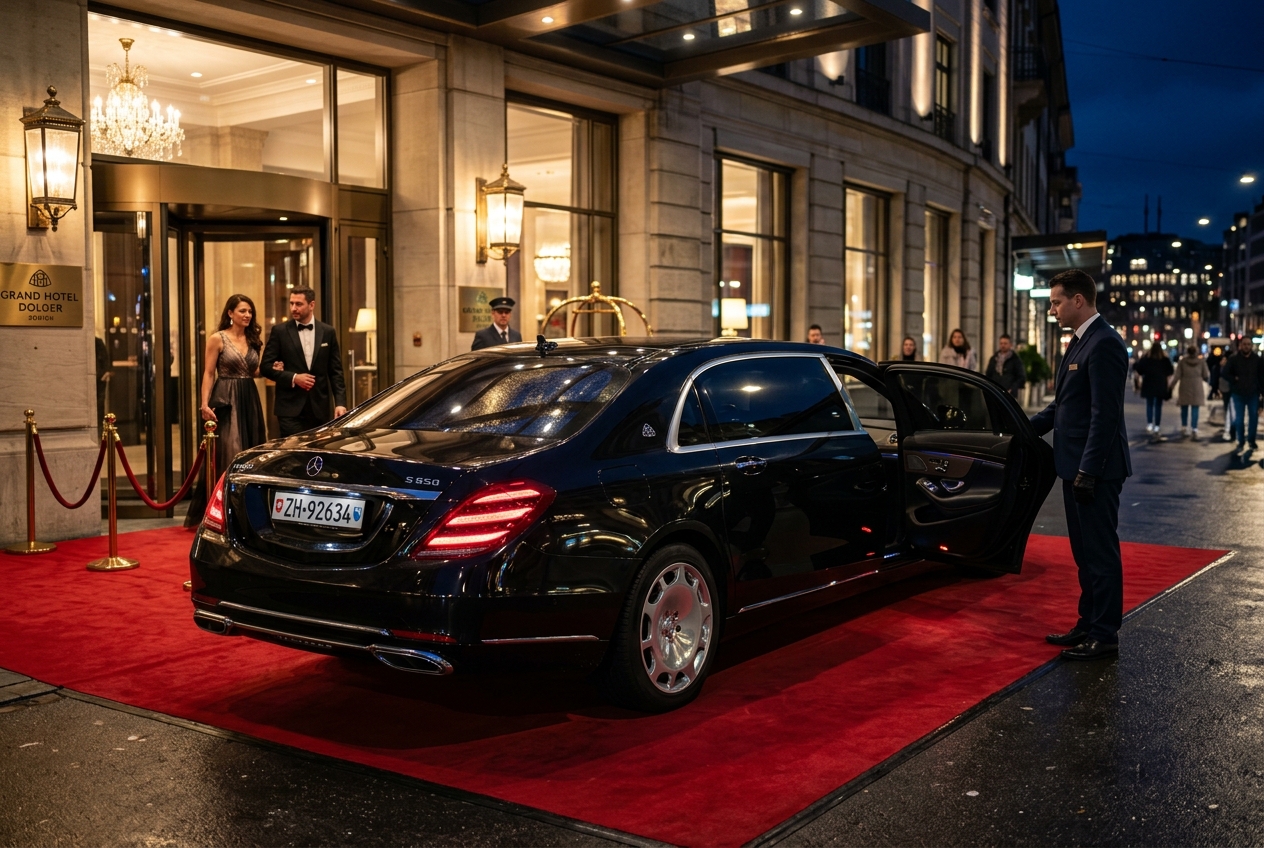
Every vehicle in the fleet carries Swiss ZH (Zürich canton) plates. For cross-border journeys—which form a significant proportion of Arabic-speaking travel itineraries, whether heading to Geneva for the UN or WEF connections, to Basel for Art Basel, to the French Alps, or into northern Italy via the Bernina or Maloja passes—Swiss registration confers a practical advantage at border crossings and in international contexts.
Swiss-registered vehicles are subject to Swiss regulatory standards, which are among the most rigorous in Europe for commercial transport. Insurance documentation, roadworthiness certification, and operator licensing are all issued under Swiss law, which provides a clear and enforceable framework for clients who have had experiences in other markets with vehicles of uncertain legal status. For corporate travel managers and personal assistants arranging travel for a principal, this is a detail that simplifies compliance paperwork and provides confidence that the vehicle's documentation is in order before the journey begins.
For travellers who have arranged multi-country itineraries—arriving at Zurich Airport, proceeding to meetings in Zug, attending a dinner in Geneva, and crossing into France or Italy at the end of the week—the consistency of the Swiss plate throughout the journey means the same operator, the same standards, and the same accountability at every point on the route.
Cultural Etiquette, Privacy and Discretion in Swiss Transfers
Swiss professional chauffeurs operating at the luxury end of the market are, by training and disposition, discreet. Discretion is practically a national character trait — the same cultural instinct that protects numbered bank accounts and keeps Alpine hotel guest lists confidential also shapes how a VIP driver behaves from the moment a client steps off the aircraft. Yet there is a meaningful difference between generic discretion and culturally informed discretion. For Arabic-speaking guests — whether travelling for business, medical care, leisure, or private family reasons — the expectations around privacy, gender, faith and etiquette carry specific weight. Understanding those expectations, and communicating them clearly to a chauffeur service before travel, makes the difference between a merely comfortable transfer and one that genuinely respects the guest's values.
Privacy: Far Beyond the Standard NDA
High-net-worth Arabic-speaking travellers, and particularly those from Gulf Cooperative Council (GCC) states, frequently travel with a level of public profile that makes privacy not a preference but a practical necessity. A ruling-family member, a senior minister, a prominent business figure or simply a private family that values its anonymity will arrive in Zurich with the reasonable expectation that their movements, associations and vehicle details remain entirely confidential.
Swiss chauffeurs working in VIP transport understand several foundational rules:
- No photography, under any circumstances. The vehicle interior, the client's face, luggage, companions, destination address — none of these are ever photographed. The same applies to screenshots of booking communications.
- No discussion of previous or current passengers. Professional chauffeurs do not mention other clients by name or implication, even in casual conversation. A driver who drops a famous name to seem impressive is disqualifying himself from any future VIP engagement.
- Discreet parking and pick-up points. Experienced operators know which hotel side entrances, private terminal zones and underground garage approaches avoid the public gaze. At the Zurich Airport VIP terminal (the dedicated FBO facility at Kloten), arrivals can be handled almost entirely away from commercial passenger areas.
- No social media. The vehicle licence plate, a glimpse of a passenger in the wing mirror, a detail about a destination — all of these are entirely off-limits. Any chauffeur company working with Gulf clients should have explicit written policies prohibiting social media posts relating to any journey, and staff should be briefed regularly.
When booking with a service such as BLACKTRANSFER, it is entirely appropriate — and strongly advisable — to note high-profile or privacy-sensitive travel in the booking instructions. Professional operators treat such notes as operational parameters, not unusual demands.
Gender Sensitivity: Practical Considerations for Female Passengers
Expectations around gender etiquette vary considerably within the Arabic-speaking world, and a good chauffeur service does not presume to know where any individual guest sits on that spectrum. The practical principle is to follow the guest's lead while offering appropriate default conduct.
Default professional conduct for female passengers travelling alone or with family:
- The chauffeur greets politely, handles luggage efficiently, and does not initiate physical contact (no handshakes unless the guest extends a hand first).
- Conversation is professional and purposeful — destination confirmation, journey time, any route preferences — rather than personal or casual.
- The chauffeur does not make personal observations about appearance, attire or travel companions.
- If a female guest wishes to sit in the rear and the privacy partition (where fitted) is closed, the driver respects that entirely and communicates via the intercom or waits for the guest to initiate.
For guests who specifically request a female chauffeur: This is a reasonable request and, where possible, should be made at the time of booking. Availability of female drivers varies between operators and is not universally guaranteed in the Swiss market, but reputable services will make every effort to accommodate the request or advise honestly if it cannot be met. Giving as much advance notice as possible — ideally several days — significantly improves the likelihood of a successful match.
Mixed-group travel involving both male and female members of a family or delegation does not require special protocol beyond what professional conduct already dictates: respectful, neutral, attentive service directed towards whoever is the lead contact for the booking.
Halal Considerations for In-Vehicle Refreshments
Standard luxury chauffeur provision in Switzerland typically includes chilled still and sparkling mineral water, and occasionally small confectionery. For Arabic-speaking Muslim guests, the question of whether any food or beverage items comply with Islamic dietary principles (ḥalāl) is a legitimate one.
| Item | Typical Status | What to Request |
|---|---|---|
| Still mineral water (e.g., Henniez, Evian) | Universally permissible | No action needed |
| Sparkling mineral water | Universally permissible | No action needed |
| Dark chocolates / pralines | May contain alcohol | Request alcohol-free confectionery |
| Fruit sweets / gummies | May contain pork-derived gelatine | Request clearly labelled halal sweets or avoid entirely |
| Soft drinks / juices | Usually permissible; check labels | Specify preferred brands at booking |
| Mints / breath strips | Usually permissible; verify ingredients | Check for alcohol-based flavouring |
The practical approach is straightforward: note in the booking that refreshments should be alcohol-free and free from pork derivatives. A professional operator will source appropriate alternatives without difficulty — Switzerland's major supermarket and specialty chains stock a wide range of certified products. If the journey is long (for example, Zurich to St. Moritz or Zurich to Davos, each of which can take well over two hours), it is worth specifying preferred drinks and snacks explicitly. This is not an unusual request; it is part of attentive VIP service.
Prayer Time Awareness on Long Journeys
For observant Muslim travellers, the five daily prayers (ṣalāt) are not optional interruptions to a schedule — they are a structural part of the day. On a long transfer through Switzerland, one or more prayer times may fall during the journey. A culturally aware chauffeur, or booking coordinator, will have considered this in advance.
Practical planning suggestions:
- Know the prayer schedule for the travel date. Prayer times in Zurich and across Switzerland can be looked up through any standard Islamic prayer time application. They shift daily with the calendar.
- Identify suitable stopping points. Switzerland's motorway service areas (Raststätten) are clean and well-maintained. Some private residences, hotels and corporate locations along the route may offer prayer rooms. The chauffeur should know — or be told — which stop is preferred.
- Allow adequate time. Wuḍūʾ (ritual ablution) and the prayer itself require a modest amount of time. A chauffeur who is accustomed to point-to-point timing should be briefed that a stop of fifteen to twenty minutes may be needed and that this is planned, not an emergency.
- Direction of qibla. The passenger will manage this independently, but if a knowledgeable chauffeur can advise on which end of a car park faces roughly south-east (towards Mecca from Switzerland), this small gesture is likely to be appreciated.
None of this requires the chauffeur to have theological knowledge. It requires only awareness, flexibility and the professional judgment to treat a faith-based need with the same practical respect as any other specific client requirement.
Ramadan Travel: Adjustments Worth Knowing
Ramadan travel has its own texture. Fasting guests will decline food and drink from dawn to sunset, and this is not a matter requiring comment or explanation from the driver. The chauffeur simply ensures that any standard refreshments are discreetly set aside rather than prominently offered.
Other considerations for Ramadan journeys:
- Iftar timing. If a journey is scheduled to conclude around sunset, a Muslim guest may be eager to reach the destination by iftar (the fast-breaking meal). Punctuality carries additional meaning in this context. If traffic or delays threaten the schedule, prompt communication from the chauffeur allows the guest to manage expectations.
- Suhur transfers. Very early-morning airport runs — for pre-dawn suhur — are not uncommon during Ramadan. A 24/7 chauffeur service should handle these without any indication that the hour is unusual.
- Reduced energy levels. Fasting guests, particularly in the later hours of the day, may prefer a quieter environment: subdued lighting, low or no music, minimal conversation. The professional instinct here is simply to be attentive without being intrusive.
- Heightened generosity and social warmth. Ramadan is also a month of heightened social generosity. Guests may be travelling with larger family groups, may wish to stop at a specific location for iftar, or may be transporting gifts. The chauffeur should be prepared for these possibilities and respond with the same warm professionalism that the occasion calls for.
Briefing Your Chauffeur: The Coordinator's Role
In practice, the most reliable way to ensure cultural requirements are met is to communicate them clearly at the booking stage — not assumed, not guessed. Luxury transfer services operate on information. A booking that specifies "female passenger travelling alone, please send female driver if possible; no alcohol or pork products in vehicle; prayer stop required approximately ninety minutes into Zurich–Davos transfer" gives the operator everything needed to deliver a genuinely tailored service.
The best operators do not need to be educated on cultural sensitivity in the abstract — they need the specific operational parameters for each journey. Swiss professional chauffeurs working with international VIP clients are accustomed to tailoring every detail of a transfer. Cultural and religious requirements are simply another set of well-defined needs that professional service exists to meet.
Pricing, Booking and Practical Logistics
Transparency about cost and a frictionless booking experience matter to any discerning traveller, but they matter especially when you are arriving from a long-haul flight, coordinating across time zones, or managing a large family or executive group. The practical details below cover everything from indicative fares to the fastest way to confirm a vehicle, all in one place.
Indicative Fares for the Most-Travelled Routes
BLACKTRANSFER publishes fixed, all-inclusive prices: the figure quoted covers VAT, Swiss motorway vignette costs, tolls, and the complimentary sixty-minute waiting period at the airport. There are no fuel surcharges added at the end, no "airport facilitation fees" buried in the small print, and no dynamic pricing that spikes when demand is high. For guests travelling from the Gulf states, Egypt, or the Levant, this fixed-price model mirrors the best practice of pre-booked private aviation handling — a single number, agreed in advance.
The table below shows indicative one-way fares from Zurich Airport (ZRH) for the routes most frequently requested by Arabic-speaking visitors. All figures are in Swiss francs (CHF). Because currency rates fluctuate and the company's own pricing may be updated, treat these as planning benchmarks rather than binding quotes — always confirm with BLACKTRANSFER directly.
| Route (from Zurich Airport ZRH) | Mercedes E-Class | Mercedes S-Class | Mercedes V-Class (up to 7) | Mercedes-Maybach S-Class |
|---|---|---|---|---|
| Zurich City centre | CHF 120 | CHF 160 | CHF 150 | CHF 290 |
| Zug | CHF 190 | — | — | — |
| Lucerne | CHF 290 | — | — | — |
| Basel | CHF 390 | — | — | — |
| Bern | CHF 420 | — | — | — |
| Davos / WEF | CHF 690 | — | — | — |
| St. Moritz | CHF 890 | — | — | — |
| Zermatt | CHF 990 | — | — | — |
| Geneva | CHF 1,150 | — | — | — |
For multi-vehicle bookings, hourly chauffeur hire, or routes not listed — including cross-border runs into France, Italy, Liechtenstein, or Austria — contact the team for a bespoke quotation. Hourly engagements start at CHF 95 per hour for the E-Class and CHF 220 per hour for the Maybach, with a three-hour minimum across all vehicle classes, making them well-suited to city days, business meetings in multiple locations, or private shopping itineraries along Zurich's Bahnhofstrasse.
Understanding What the Price Includes
A point worth spelling out clearly, because it surprises many first-time clients: the fixed fare from Zurich Airport already absorbs the cost of the chauffeur tracking your inbound flight in real time. If your Emirates, Etihad, Qatar Airways, or flydubai service arrives early or is delayed by two hours, the driver adjusts without any additional charge being applied. The complimentary waiting window is sixty minutes from the moment your flight lands, giving ample time to clear Swiss immigration, collect luggage, and walk through arrivals to meet your chauffeur — who will be standing with a name sign at the designated meeting point.
For long-distance routes such as St. Moritz or Zermatt — both of which can take anywhere from ninety minutes to over two hours depending on the season and mountain road conditions — the fixed-fare structure is especially valuable. There is no meter running, and no anxiety about an extended journey pushing the bill into unpredictable territory.
Booking via WhatsApp: The Preferred Method for Many Arabic-Speaking Guests
WhatsApp has become the de facto communication platform across the Arab world, and BLACKTRANSFER has adapted accordingly. You can reach the team directly on +41 79 177 24 24 via WhatsApp at any hour of the day or night — the service operates around the clock, every day of the year. This channel is useful not just for the initial booking but for the entire journey lifecycle:
- Sending your flight details — forward a screenshot of your booking confirmation and the team will extract the flight number for tracking purposes.
- Communicating last-minute changes — a gate delay, a decision to add a second vehicle, or an updated drop-off address can all be handled quickly by message.
- Sharing special requirements — child seat configurations, requests for a specific pick-up location within the airport, or instructions for discretion at a hotel entrance are all easily relayed in writing, creating a clear record for both parties.
- Receiving confirmation — written WhatsApp confirmation gives you something tangible to reference if there is any confusion on the day.
For guests who prefer Arabic for the initial enquiry, this channel removes any hesitation about language barriers — a message in Arabic can convey nuance and specific requirements far more precisely than trying to spell out details over a noisy phone line.
Booking Online and by Telephone
The company's website at blacktransfers.ch provides an online booking pathway for those who prefer to arrange transfers in advance and in their own time, particularly useful when coordinating across different time zones before departure from Riyadh, Dubai, Cairo, or Beirut. The form accepts all standard journey details, and confirmation is returned promptly.
For those who prefer voice contact, three lines are available:
- +41 79 177 24 24
- +41 76 389 64 52
- +41 78 739 12 21
All three numbers connect to the same professional dispatch team. Calling from a GCC mobile number or an international SIM is straightforward — Switzerland uses the country code +41, and the numbers listed are Swiss mobile numbers that can receive international calls without issue.
For corporate clients managing multiple trips across a Swiss roadshow or an extended business visit, email at info@blacktransfers.ch provides a useful paper trail for travel managers and executive assistants coordinating on behalf of a principal.
Payment Methods and Corporate Accounts
BLACKTRANSFER accepts a broad range of payment methods that cover the preferences of both individual and corporate travellers:
- Credit and debit cards: Visa and Mastercard
- Digital wallets: Apple Pay and Google Pay
- Online payment: PayPal
- Corporate invoice: available for registered business accounts
The corporate invoice option is particularly relevant for private family offices, investment funds, and businesses that regularly bring senior personnel through Switzerland for meetings, board sessions, or due diligence visits. Establishing an account means travel managers can book directly without requiring a personal card at each transaction, and monthly invoices can be reconciled against travel budgets in a single step. To discuss setting up a corporate account, contact the team by email or phone.
The Cancellation Policy in Plain Terms
Circumstances change — flight itineraries are rerouted, meetings are rescheduled, or a family decision shifts the departure day by twenty-four hours. The cancellation terms are structured to be fair:
- Free cancellation: up to twenty-four hours before the scheduled pick-up time, at no cost.
- Fifty per cent charge: if the cancellation is made within twenty-four hours but more than three hours before pick-up.
- Full fare charged: for cancellations within three hours of pick-up, or for no-shows where the driver has been deployed.
- WEF Davos and major events: individual terms apply and will be communicated at the time of booking, reflecting the dedicated resources committed well in advance for high-demand periods.
The twenty-four-hour free window is generous by the standards of Swiss ground transport and gives reasonable flexibility for business travellers whose agendas shift at short notice. The key practical advice is to cancel or amend as early as possible the moment you know plans have changed — a WhatsApp message at midnight costs nothing if it is sent more than a day ahead.
Communicating Special Requirements in Advance
This is the step that separates a smooth journey from a stressful one. A few minutes spent detailing requirements at the time of booking eliminates any uncertainty on arrival day.
Child seats: Switzerland's road traffic legislation requires appropriate child restraints for young passengers. Specify the age and approximate weight of each child when booking so the correct seat type — infant carrier, forward-facing seat, or booster — can be fitted before pick-up. Last-minute requests cannot always be accommodated.
Extended luggage for long Swiss stays: Arabic-speaking families visiting Switzerland for two or three weeks in summer or during ski season typically travel with substantial luggage. If your group is bringing more than one large suitcase per person, mention it when booking so that a V-Class, GLS, or Escalade can be allocated rather than a saloon that may not have adequate boot space.
Multiple stops: A journey that includes a stop at a private clinic on the outskirts of Zurich before continuing to a hotel in the city centre, or a hotel drop-off followed by a delivery to a business address, can almost always be accommodated — but must be detailed in advance so that timing and any additional fare adjustment can be agreed clearly.
Meet-and-greet preferences: Whether you would like the chauffeur to wait inside the terminal, at a specific exit, or to make contact by phone as you approach the luggage hall — all of these can be specified in your booking notes.
For a personalised quotation, to establish a corporate account, or to book a vehicle for any journey across Switzerland or into neighbouring countries, reach the BLACKTRANSFER team at any hour via WhatsApp on +41 79 177 24 24, by telephone, or through the enquiry form at blacktransfers.ch.
Frequently Asked Questions
Is an Arabic-Speaking Chauffeur Available Around the Clock?
Yes. Transfers to and from Zurich Airport (ZRH) operate at all hours, including late-night arrivals on flights from the Gulf, overnight departures, and early-morning connections. The availability window is genuinely 24/7, 365 days a year, which matters when Emirates, Qatar Airways and Etihad routinely schedule arrivals into Zurich between midnight and 06:00. When you book, confirm the Arabic-language preference at the time of reservation so the dispatcher can match the correct driver to your journey from the outset.
Which Arabic Dialects Are Typically Spoken?
The most commonly available dialects among professional Zurich chauffeurs serving Arabic-speaking clientele are Gulf Arabic (خليجي), particularly familiar with Saudi, Emirati, Kuwaiti and Qatari speech patterns, and Levantine Arabic (شامي), spoken across Lebanon, Syria, Jordan and Palestine. Modern Standard Arabic (فصحى) is generally understood for written or formal communication, including WhatsApp messages and booking confirmations. Egyptian Arabic also appears, given the size of the Egyptian diaspora in Switzerland.
When you make your reservation, note the specific country or dialect you prefer. A brief line in the booking notes—"Gulf Arabic preferred" or "Lebanese dialect comfortable"—allows the team to allocate the best-matched driver available for that date and time.
How Do I Request an Arabic-Speaking Driver Specifically?
State the requirement explicitly at the booking stage, not afterwards. The most practical method is to send a WhatsApp message in Arabic or English to +41 79 177 24 24 alongside the standard booking details (date, time, pickup point, destination and vehicle class). You can also email info@blacktransfers.ch or book via blacktransfers.ch and add the dialect preference in the notes or special requests field.
BLACKTRANSFER operates as a premium chauffeur service and allocates drivers based on the full brief provided, so an early, detailed request yields the best result. Requests made a few hours before pickup on a busy date—WEF week in Davos, the Art Basel period, Formula 1 hospitality weekends—cannot always be fulfilled. For guaranteed dialect matching, a 48-hour or longer lead time is advisable.
Can Female Passengers Request a Female Chauffeur?
This is a reasonable and frequently asked question from Gulf travellers. The availability of a female chauffeur depends on scheduling and cannot always be guaranteed, but the request can be noted and the service will attempt to fulfil it. Submit the request in writing at the time of booking, marked clearly as essential rather than optional if it is a firm requirement for your travel party.
If a female chauffeur cannot be confirmed for the specific date requested, the service will communicate this honestly in advance, giving you the opportunity to adjust your plans. For families travelling with conservative preferences, the Mercedes-Benz V-Class offers a large, private cabin that allows women passengers to travel comfortably with a partition of personal space from the driver.
How Does Meet-and-Greet Work at ZRH, Including the Private Aviation Terminal?
At Zurich Airport's commercial terminals (the main arrivals hall in Terminal E and the Schengen/non-Schengen arrivals areas), the chauffeur meets passengers at the designated arrival point holding a name board. The service includes free flight tracking, meaning the driver monitors the actual landing time—not the scheduled time—and adjusts accordingly. Sixty minutes of complimentary waiting time is included after the flight lands, allowing time for passport control and baggage collection without any rush.
For private aviation, Zurich has a dedicated FBO (Fixed-Base Operator) facility at the airport serving private jets. The protocol here differs from commercial arrivals: the chauffeur can in most cases meet passengers airside or at the specific FBO lounge, and the vehicle is positioned to minimise the walk from aircraft stairs to car door. When booking for a private jet arrival, provide the tail number or at least the estimated arrival time and the FBO name so logistics can be arranged accordingly. This detail is particularly relevant for Gulf-based clients flying in on private or charter aircraft, which is common during the summer and WEF periods.
Is WhatsApp Booking Available in Arabic?
Yes. You can communicate in Arabic directly via WhatsApp on +41 79 177 24 24. Booking confirmations, vehicle details and driver contact information can be shared through WhatsApp. Many Gulf clients find this more convenient than web forms, and it also allows quick amendments to pickup times, additional stops or changes in passenger numbers.
Can I Request Halal Refreshments or Specific In-Car Provisions?
Standard vehicle amenities include still and sparkling mineral water. Requests for Halal snacks, dates, Arabic coffee (قهوة عربية), or specific non-alcoholic beverages can be accommodated with advance notice—typically 24 hours or more. Be specific in the request: "a box of Medjool dates" or "Volvic still water only, no sparkling" is easier to fulfil accurately than a vague note. Alcohol is never automatically placed in any vehicle; if other passengers in your group want wine or Champagne and you would prefer the vehicle remains alcohol-free, simply state this when booking.
What Is the Tipping Culture in Switzerland?
Switzerland does not have the same tipping conventions as the Gulf or the United States. Service charges are not added to chauffeur invoices, and drivers do not expect a tip as a matter of cultural norm. That said, tipping is appreciated and entirely welcome if the service has been exceptional—a smooth night transfer, assistance with heavy luggage, or professional conduct over a multi-day roadshow.
A practical guide for those who wish to tip:
| Journey Type | Typical Voluntary Tip Range |
|---|---|
| Single airport transfer | CHF 10–20 |
| Half-day hire (3–4 hours) | CHF 20–40 |
| Full-day hire or roadshow | CHF 50–100 |
| Multi-day engagement | Per-day discretion |
Cash in Swiss Francs is appreciated, though a verbal acknowledgement of good service is equally meaningful in Swiss culture.
How Long Will the Chauffeur Wait If My Flight Is Delayed?
For all airport pickups, 60 minutes of complimentary waiting time is included, measured from the actual landing time (tracked in real time), not the scheduled arrival. If your flight is delayed by three hours due to a diversion or air traffic disruption—which occasionally happens on long-haul routes from the Gulf—the driver will be updated automatically. Extended waiting beyond the complimentary period is billed at a modest hourly rate, and you will not be charged the full journey cost if you miss the pickup entirely due to a cancellation or major delay; consult the terms at the time of booking for specifics.
What Paperwork Is Required for Cross-Border Transfers?
Switzerland is not an EU member and operates its own customs and immigration controls. Passengers travelling by road from Zurich to destinations in Germany (Munich, Stuttgart), Austria (Vorarlberg, Innsbruck), Italy (Milan, Como, Lugano is Swiss) or France (Alsace, Geneva airport connections) must carry a valid passport or EU identity card. Swiss residents with a valid residence permit travel on that document.
The chauffeur's vehicle holds a Swiss commercial transport licence; no special documentation is required of the passenger beyond standard cross-border identification. For clients carrying significant amounts of cash, jewellery or business samples, Swiss customs (EZV/OEZV) regulations require declaration of cash amounts over CHF 10,000. This is not the chauffeur's responsibility but it is worth knowing before departure.
Are Child Seats Available, and What Does Swiss Law Require?
Child seats are available on request and must be specified at booking with the child's approximate age and weight. Swiss road law requires children under 12 years of age and under 150 cm in height to use an approved restraint system. This applies in chauffeur vehicles exactly as it does in private cars. Infant carriers, forward-facing child seats and booster cushions can all be arranged; state clearly which type you need and for how many children.
How Does Multi-Day Hire and Roadshow Logistics Work?
For corporate clients conducting investor roadshows, board meetings across multiple Swiss cities, or extended family tours, BLACKTRANSFER can assign a dedicated driver for consecutive days. A typical two-day roadshow might involve:
- Day 1: Zurich Airport arrival → Zurich city meetings → Zug → Basel, overnight hotel collection at 07:00 the following morning
- Day 2: Basel → Bern → Zurich, return to airport
The driver remains on standby between appointments, available for impromptu stops, document handovers or rerouting as schedules shift. Pricing for multi-day hire is structured around hourly rates with a daily minimum, and corporate accounts can be invoiced monthly rather than per journey. Itineraries should be shared in advance and updated via WhatsApp as plans evolve.
What Should First-Time Visitors from the Gulf Know About Arriving in Summer Versus Winter?
Summer arrivals (June–September): Zurich in summer is warm and occasionally humid, with temperatures regularly reaching 28–33 °C in July and August. The city is busy with tourism, and traffic around Zurich Airport and on the A1 motorway can be congested, particularly on Friday afternoons and Sunday evenings. Alpine resorts such as Grindelwald, Zermatt and Engadin are popular for cooler highland temperatures—a deliberate preference for many Gulf visitors seeking relief from 45 °C at home. Journey times to mountain destinations should include a 15–20% buffer for summer traffic.
Winter arrivals (December–March): Snow is common on Alpine routes from November through April. Roads to Davos, St. Moritz, Zermatt and Verbier require vehicles with winter tyres (mandatory in Swiss mountain conditions) or snow chains. All BLACKTRANSFER vehicles are equipped for Swiss winter driving. Arrival clothing from Gulf destinations is often insufficient for Swiss mountain temperatures of −10 °C to −15 °C; it is worth packing or purchasing warm outerwear in Zurich before heading to altitude. Flight schedules from the Gulf to Switzerland are unaffected by Alpine snow, but the onward mountain drive adds meaningful time—plan for 1.5 to 2 hours from Zurich Airport to Davos under normal winter conditions, and longer after heavy snowfall.