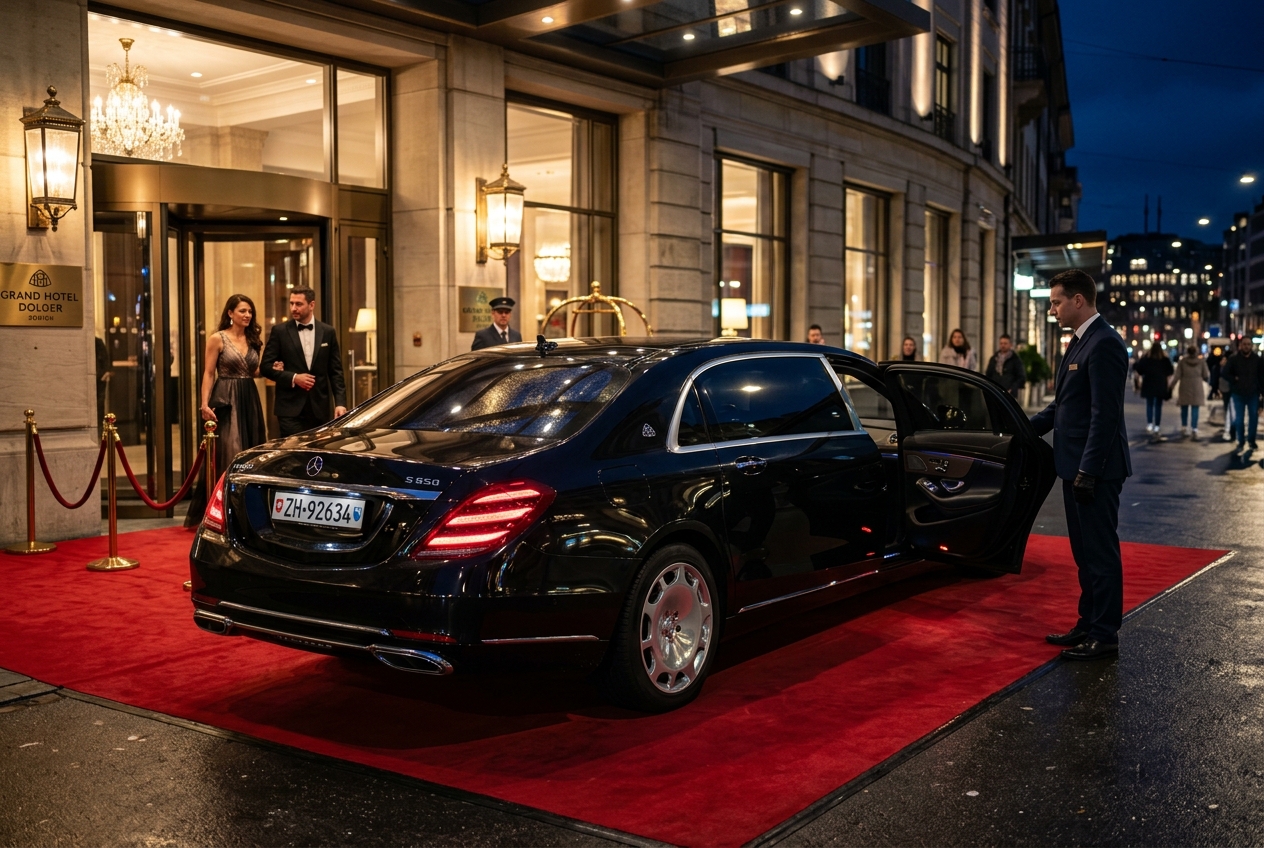
Book Limousine Online Zurich: The Smart Traveller's 2026 Guide
57 min read · 13,183 words
Booking a limousine online in Zurich looks straightforward until you realise how many variables separate a seamless ride from an expensive disappointment. This guide cuts through the noise with concrete, locally grounded advice for every step of the process.
Why Online Booking Has Changed Zurich's Limousine Market
A decade ago, arranging a limousine in Zurich meant a phone call — often to a number held in a Rolodex, passed along by a concierge at the Baur au Lac or whispered between colleagues before a roadshow. The chauffeur industry in Switzerland ran largely on personal relationships, repeat accounts, and word of mouth. Pricing was opaque, availability was communicated verbally, and the traveller had little option but to trust the voice on the other end of the line. That model still exists at the very top of the market, but for the vast majority of journeys booked today — airport transfers to Kloten, conference runs to the Dolder Grand, ski-season shuttles to Davos — the process begins not with a call but with a browser tab.
The shift is not merely cosmetic. It has restructured competition, raised the floor on service expectations, and changed what it means to be a credible provider in one of Europe's most demanding mobility markets.
From Rolodex to Real-Time: The Mechanics of the Change
The acceleration began roughly between 2020 and 2022. Several forces converged simultaneously. International travel resumed after a prolonged pause and business travellers returned to Zurich with habits formed during that interval — habits built around frictionless digital transactions, instant confirmations, and the ability to compare options without speaking to anyone. At the same time, smartphone penetration among frequent travellers reached the point where expecting to manage every logistical detail from a single device became entirely reasonable, not just aspirational.
Swiss corporate travel managers, who control a significant share of premium ground-transport spend in the Zurich corridor, began requiring suppliers to integrate with online booking tools or risk being dropped from preferred-vendor lists. This created a structural incentive for chauffeur companies to invest in digital infrastructure — or at minimum, to offer a credible online presence with a bookable interface — that had simply not existed in the same form before.
The result is a market that now rewards visibility and process as much as it rewards reputation. A company that cannot be found, compared, and booked online before midnight on a Sunday is, for a large category of international business travellers, functionally invisible.
What Side-by-Side Comparison Actually Looks Like
When a passenger arriving at Zurich Airport (ZRH) in 2026 types "limousine transfer Zurich" into a search engine, they typically encounter a layered landscape:
- Aggregator platforms that pull prices from multiple operators and display them in a grid
- Ride-hailing apps that stretch their definitions of "premium" to cover any vehicle that happens to have leather seats
- Dedicated chauffeur company websites with their own booking forms or integrated reservation systems
- Hotel concierge portals that white-label a preferred supplier's inventory
Each of these surfaces price information, and that is the most consequential change of all. A traveller comparing the transfer from Zurich Airport to the city centre can, within two minutes, see figures ranging from around CHF 80 for a basic saloon to CHF 290 or more for a Maybach-class vehicle. They can filter by vehicle type, passenger capacity, and luggage allowance. They can read policies on waiting time, flight tracking, and cancellation.
This transparency has done two things simultaneously. It has made the market more competitive on price for commodity transfers, and it has made it easier for well-run premium operators to justify and defend higher pricing by making their inclusions visible. When a provider clearly states that the price covers meet-and-greet with a name sign, 60 minutes of complimentary waiting time keyed to the live flight arrival, and free flight tracking — and a competitor's "lower" price offers none of those — the comparison becomes qualitative, not just numerical.
The Transparency Gap: What Passengers Can Now See That They Couldn't Before
Consider what the online environment has made legible that was previously obscured:
| What passengers can now check online | Why it matters for a Zurich transfer |
|---|---|
| Whether the price is fixed or meter-based | Zurich traffic on the A1 or around Escher-Wyss-Platz is unpredictable; a metered fare carries genuine cost uncertainty |
| Fleet composition and vehicle age | An "S-Class" can mean anything from a current W223 to a vehicle several generations old |
| Waiting-time policy at Zurich Airport (ZRH) | International arrivals through terminals E and D involve passport control and baggage retrieval — waiting periods of 45–90 minutes are routine |
| Cancellation and amendment terms | Corporate travellers particularly need clarity; a no-cost cancellation window of 24 hours is now a near-standard expectation |
| Whether the operator carries Swiss-registered vehicles | ZH-plated vehicles signal local registration, local liability insurance, and compliance with cantonal commercial transport rules |
| Driver language capability | In Zurich's multilingual business environment, English, German, and French are all regularly required |
Each of these data points was either unavailable or required a direct conversation to obtain before the online booking era. Their routine availability online has raised the baseline expectation: a provider that cannot answer these questions on its website is now at a disadvantage before the first word is exchanged.
Why Zurich Is a Particularly Demanding Market for 'Instant Booking' Promises
Not every city tests a limousine platform equally. Zurich presents a specific combination of factors that make the gap between a confident "instant booking confirmed" message and a reliably executed journey larger than it would be in, say, a mid-sized regional hub.
Airport complexity. Zurich Airport handles a high volume of intercontinental flights on tight turnaround schedules. Arrivals are distributed across terminals, and the specific gate a passenger uses affects the walking distance and time to the kerbside pickup zone. A chauffeur service operating without live flight tracking and a process for communicating gate information to the driver is structurally unable to meet the standard the airport environment demands. Online confirmation is easy; operational follow-through is not.
Traffic variability. The road network between the airport and the city — primarily the A51 and then city routes — is subject to congestion that varies dramatically by time of day, day of week, and season. A departure from Zurich Airport at 08:15 on a Tuesday in October is a categorically different logistical challenge from the same journey at 14:30 on a Sunday. Platforms that treat all Zurich transfers as interchangeable are building in a risk that passengers, particularly first-timers, may not recognise until they are standing at the kerb.
Event-driven demand spikes. Zurich's calendar includes the World Economic Forum in Davos (though the journey originates in Zurich), Art Basel's satellite events, the Zurich Film Festival in September, Swiss Finance Day, and a dense schedule of corporate roadshows concentrated in the banking district on Bahnhofstrasse and Paradeplatz. During these periods, the difference between a provider with a properly managed fleet and driver capacity, and one that has over-sold availability on a booking platform, is the difference between a car at the kerb and an apology message.
Cross-border complexity. A meaningful proportion of Zurich limousine journeys cross into neighbouring countries — to Basel for EuroAirport (BSL), to Germany for corporate visits, to Geneva, Bern, or the Ticino. Some journeys involve mountain-road driving to ski resorts with seasonal road conditions. These are not transfers that a driver unfamiliar with Swiss geography, Alpine pass rules, or cross-border commercial transport requirements can navigate reliably, regardless of how clean the booking interface was.
The Reliability Premium: Why It Exists and Why Passengers Are Learning to Pay It
The effect of all this transparency is nuanced. Some passengers, once they can compare providers side by side, default to the lowest visible price. This is rational behaviour, and for a short, low-stakes transfer it may be entirely defensible. But a growing segment — particularly frequent business travellers, corporate travel managers, and international visitors coordinating complex multi-day itineraries — is drawing a different conclusion.
They are using the same information environment to qualify providers more rigorously than they ever could over the phone. They are looking for consistency between what is promised online and what is operationally realistic. They are asking whether a company has the fleet depth to cover a vehicle substitution at short notice, whether a human is reachable at 04:30 when a flight diverts, and whether the cancellation terms are stated clearly enough to be enforceable.
BLACKTRANSFER, for instance, publishes its fleet, its pricing, its waiting-time and cancellation policies, and its contact options — including WhatsApp — in a form that allows a prospective passenger to assess all of these parameters before committing. That kind of structured transparency is what the online booking era has made both possible and, for sophisticated travellers, expected.
The Zurich limousine market has not simply moved online. It has been remade by the move. The providers who have thrived are those who understood that digital visibility was not a substitute for operational quality, but a means of making operational quality legible — and that passengers, once they could see the difference, would act on it.
Mapping Zurich's Limousine Landscape: Who Operates and Where
Zurich's limousine and chauffeur market looks, at first glance, deceptively simple: type a few words into a search engine, compare prices on a grid of results, and click. But behind that clean interface sits a genuinely complex supply chain, shaped by Swiss cantonal law, EU cross-border rules, VAT obligations and wildly varying standards of accountability. Understanding who actually operates in this market — and how the structural differences between providers affect what happens on the day — is the most useful piece of research you can do before you book.
The Three Broad Categories of Provider
Broadly speaking, every company offering to put a car and driver in front of you in Zurich falls into one of three categories. They often look identical online. They rarely deliver an identical experience.
1. Locally registered, Zurich-based operators
These are companies — sometimes family-owned, sometimes structured as mid-sized fleets — that are physically based in the canton of Zurich, hold a Swiss passenger-transport licence, register their vehicles with ZH plates under Swiss law, and pay Swiss VAT. Their drivers are employed or contracted under Swiss labour regulations, and their vehicles must pass Swiss road-worthiness inspections (MFK). When something goes wrong, the complaint stays within Swiss jurisdiction.
2. Aggregator platforms and booking portals
These range from global giants — platforms that aggregate ground transport across dozens of countries — down to regional comparison sites. They take your booking, process your payment, and then assign the job to whichever affiliated operator is available. The underlying operator could be registered in Switzerland, in Germany, in the EU, or somewhere less straightforward. The platform acts as a commercial intermediary, not as a carrier.
3. Grey-market intermediaries
This category is harder to define because it overlaps with the others. A grey-market intermediary might present itself as a Zurich limousine company while actually being a foreign-registered entity subcontracting to drivers who hold neither a Swiss passenger-transport licence nor the correct cantonal authorisation. Some operate entirely through informal channels: WhatsApp groups, cash payments, vehicles registered abroad. The price is often attractive. The accountability is often absent.
Swiss Cantonal Licensing and Why It Matters
Switzerland does not operate a single national taxi or limousine licence. Ground passenger transport is regulated at cantonal level, meaning the rules in Zurich differ in some specifics from those in Geneva or Bern. In the canton of Zurich, operators carrying passengers commercially must hold a cantonal authorisation under the relevant provisions of Swiss transport law (broadly, the Personenbeförderungsgesetz and related cantonal ordinances). Drivers must meet professional competency requirements.
This matters for two practical reasons.
First, it creates a paper trail. A licensed Zurich operator is known to the cantonal authorities. Their vehicles are on Swiss registers. If there is an accident, a dispute about a charge, or a question about insurance, you are operating within a coherent legal framework with identifiable parties.
Second, it filters out the least capable operators — not perfectly, but meaningfully. The process of obtaining and maintaining cantonal authorisation requires documentation, compliance and a physical presence in Switzerland. An operator running vehicles registered in Slovakia and drivers who cross the border for the day does not meet this bar.
When you look at a provider's website, ask yourself: do they display a Swiss business address (not just a P.O. box)? Do they list Swiss phone numbers? Do their vehicles carry Swiss plates? None of these individually is a guarantee of quality, but collectively they indicate an operator that is genuinely embedded in the Swiss system rather than piggybacking on it.
Vehicle Registration: The ZH Plate Signal
Swiss vehicle registration is canton-specific and public. A car registered in Zurich carries ZH plates. This is not merely cosmetic — it means the vehicle was inspected and registered by Swiss authorities, insured under Swiss law (mandatory third-party liability is set at a minimum of CHF 100 million per incident, one of the highest statutory minimums in Europe), and is subject to Swiss periodic technical inspections.
A vehicle registered in Germany (plates beginning with letters like M, B, F, etc.) or elsewhere in the EU is subject to different insurance frameworks, different inspection regimes and — critically — may not be legally permitted to carry passengers commercially within Switzerland on a regular basis without specific bilateral authorisations. Cross-border rules for commercial passenger transport between Switzerland and EU states exist but are complex and are not universally observed by informal operators.
The practical implication: if you are being collected from Zurich Airport by a vehicle with foreign plates driven by someone who is not operating under a Swiss cantonal authorisation, you may have limited legal recourse in Switzerland if things go wrong, and the insurance position may be ambiguous.
VAT Registration and What It Tells You
Switzerland's VAT threshold for mandatory registration is currently CHF 100,000 of annual domestic turnover. Any legitimate, professionally active limousine company operating in Zurich should be above this threshold and therefore VAT-registered. Swiss VAT on passenger transport services is charged at the reduced rate.
When a provider quotes you a price and cannot tell you whether it includes VAT, or quotes a price that seems to imply they are not VAT-registered, treat that as a signal. It may indicate a very small informal operator who has not crossed the threshold (possible but unusual for a company marketing itself prominently), or it may indicate a foreign operator who is not charging Swiss VAT because they are not registered in Switzerland — which creates its own complications if you are a business seeking to reclaim input tax.
Reputable Swiss operators quote all-inclusive prices that explicitly state VAT is included, or they provide a proper VAT invoice on request for corporate clients.
How Aggregator Platforms Change the Accountability Chain
Large aggregator platforms have made it genuinely easier to compare ground transport options across cities, and the best of them do enforce minimum standards on their affiliate operators. The problem is structural rather than motivational.
When you book through a platform, the contract for carriage is often between you and the platform, not between you and the driver or the vehicle operator. If the platform then subcontracts to a local company, and that company further subcontracts to a freelance driver, the accountability chain has three or four links before it reaches the person actually responsible for your safety. Consider the table below:
| Provider Type | Your Contract With | Driver Accountability | Vehicle Inspection | Jurisdiction for Disputes |
|---|---|---|---|---|
| Swiss-registered, ZH-based operator | The operator directly | Swiss labour/commercial law | Swiss MFK standard | Swiss cantonal courts |
| Global aggregator (Swiss affiliate) | The platform | Platform's affiliate rules | Variable | Platform's T&Cs (often non-CH) |
| Global aggregator (non-Swiss affiliate) | The platform | Varies by country | Varies by country | Likely non-Swiss |
| Grey-market intermediary | Often unclear | Unclear or none | Unknown | Very limited |
The table simplifies a complex reality, but the directional point is sound: the shorter and more transparent the chain between your booking and the entity responsible for the vehicle and driver, the stronger your position as a passenger.
The Geography of Where Zurich's Chauffeur Market Actually Operates
Zurich itself is not an enormous city by area — the city limits take about twenty minutes to cross by car at off-peak times. But the limousine and chauffeur market that uses Zurich as its hub serves a much larger catchment. Routes regularly run south to Zug, Lucerne and the Gotthard corridor; east to Winterthur, St. Gallen and the Austrian border; west towards Baden and Aarau; and northeast towards Schaffhausen. Longer transfers reach Davos and the Engadin valley, Basel, Bern and Geneva.
Zurich Airport (ZRH), located in Kloten roughly 13 kilometres north of the city centre, is the single largest origin and destination point for chauffeur bookings in the region. Geneva Airport (GVA) and Basel EuroAirport (BSL/MLH/EAP — the three-country terminal shared by Switzerland, France and Germany) are also served by companies based in Zurich, typically on fixed-price transfer tariffs.
The operators who handle these longer routes well are almost always the locally registered ones. They know which approach roads to Davos close in bad winter weather, which hotels in St. Moritz have underground drop-off restrictions, and where to position the car at ZRH's Terminal 1 arrivals hall to avoid the taxi queue entirely. That local operational knowledge does not appear on a price-comparison grid.
What 'Premium' Actually Means in the Zurich Context
The word premium is used freely across all three categories of operator. In Zurich's specific context, a provider that genuinely earns the label will typically demonstrate several overlapping characteristics: vehicles in the current or previous model generation from a recognised luxury marque; drivers in professional dress who speak at least German and English; compliance with all Swiss licensing and insurance requirements; and a 24/7 contact point that can actually resolve a problem in real time.
BLACKTRANSFER, for example, operates exclusively from Zurich with ZH-registered vehicles — including models such as the Mercedes-Maybach S-Class, Mercedes-Benz S-Class and V-Class, and Bentley Flying Spur — and handles bookings around the clock. That operational structure, with a fixed Swiss address and verifiable registration, is the baseline the market should be judged against, not the exception.
Understanding this landscape before you search is what separates a smart booking from an expensive gamble.
Choosing the Right Vehicle Before You Click 'Book'
Picking the wrong vehicle is one of the most common—and most avoidable—mistakes in premium ground transport. It rarely surfaces as a dramatic incident; instead it materialises as a cramped rear seat when you expected legroom, a boot that physically cannot accept a ski bag, or an awkward moment when a seventh guest discovers there is no seventh seat. Solving that problem begins well before you reach the booking form.
Start With Journey Purpose, Not Badge Prestige
The instinct to book the most impressive-sounding vehicle is understandable, but purpose is a more reliable guide than prestige. A solo consultant flying into Zurich Airport (ZRH) for a full day of client meetings and an evening flight out has fundamentally different requirements from a family of five arriving with ski equipment for a week in Verbier. Both journeys deserve excellence; they do not both require the same car.
Think first about the number of passengers travelling together, then about luggage volume, then about any particular comfort or accessibility requirements. Only after those three filters does brand or model become relevant.
Solo and Small-Party Executive Travel: E-Class and S-Class
For one or two travellers with standard business luggage—a carry-on, a laptop bag, perhaps a suit carrier—the Mercedes-Benz E-Class is the rational choice for most point-to-point routes. It is a large saloon by any normal measure, offers genuine rear-seat comfort, and carries Wi-Fi, chilled water and charging cables as standard. On the Zurich Airport–city-centre run it is also the most economical option at around CHF 120, making it the sensible default when the priority is reliable, quiet transit rather than ceremony.
Move up to the Mercedes-Benz S-Class when the context changes: a first meeting with a new client, airport pickup for a senior executive visiting your company, or a journey long enough that rear-seat space genuinely matters—say, the two-hour drive from Zurich Airport to Lucerne or the roughly three-and-a-half-hour transfer to Davos. The S-Class rear cabin is perceptibly larger. The acoustic insulation is noticeably better. If you will be making calls or reviewing presentations during a ninety-minute drive through the Swiss Mittelland, the difference is not cosmetic.
Key practical points for E-Class and S-Class saloons:
- Boot capacity is generous for two standard suitcases but ask specifically if you are travelling with a rigid large suitcase plus cabin bags. Experienced operators can usually load more than the nominal figure suggests, but it is always worth confirming.
- Suit carriers can often be hung inside the cabin rather than folded into the boot—confirm this when booking.
- Neither class is the right choice when a third adult with full luggage joins the party. At that point you are looking at a V-Class or rethinking the configuration entirely.
Ultra-Premium and Diplomatic Requirements: Maybach, Bentley Flying Spur and S-Class
There is a category of journey where comfort and discretion are table stakes but where the vehicle itself communicates something specific: a visiting principal, a diplomatic delegation, a closing dinner for a major transaction, a wedding arrival. In these situations the Mercedes-Maybach S-Class and the Bentley Flying Spur earn their place.
The Maybach variant extends the standard S-Class wheelbase substantially, creating a rear compartment that is closer in philosophy to a first-class aircraft cabin than to a conventional car. The rear seats recline, the legroom is exceptional, and the ambient environment—materials, acoustics, lighting—is calibrated for extended, stress-free travel. For the 90-minute drive from Zurich to Geneva by car or the four-plus hours to St. Moritz in winter, the Maybach is not an indulgence; it is a rational tool for arriving rested.
The Bentley Flying Spur sits in a slightly different register. Where the Maybach is architectural and deliberate, the Flying Spur is characterful—hand-stitched leather, a distinctive exhaust note at low speed, a silhouette that is immediately recognisable. Whether that suits your guest or context is a genuine question worth asking before you book. Some principals prefer to arrive without drawing attention; others consider the Bentley appropriate to the occasion.
Practical considerations for this tier:
- Passenger capacity is two in genuine comfort in the Maybach, with a possible third in the front. The rear cabin is not designed for three adults abreast.
- Lead time: Maybachs and Bentleys are limited-fleet assets. For WEF Davos, major Zurich trade fairs (Baselworld, Art Basel, Zürich Film Festival), or New Year's Eve, book weeks—not days—in advance.
- Discretion: good operators in this segment will not, as a matter of course, display tracking information, confirm passenger identity to third parties, or accept ad hoc additions to the route without authorisation from the account holder. If discretion is a specific requirement, state it when booking, not on the day.
Families and Groups With Luggage: V-Class and GLS
The Mercedes-Benz V-Class is arguably the most versatile vehicle in any premium chauffeur fleet. Configured for up to seven passengers, it is the default solution for families travelling with children, groups combining several colleagues for a shared airport run, or any journey where luggage volume is genuinely substantial.
Where families are concerned, the V-Class matters because:
- Child seats can be installed in the V-Class more practically than in any saloon. If you are travelling with an infant or toddler, confirm the child seat type and age range when booking—a reputable operator will ask for the child's age and weight and fit the appropriate restraint. In Switzerland, children under 12 and under 150 cm must travel in an approved child restraint; this is not optional and a professional operator will enforce it.
- Luggage capacity is genuinely different in scale from a saloon. A family of four with a week of ski equipment, including boot bags and helmet bags, can often be accommodated in a single V-Class rather than requiring two vehicles.
- Configuration flexibility means that seats can be folded or removed to prioritise cargo space—useful for group airport transfers where one or two passengers are travelling with oversized equipment.
The Mercedes-Benz GLS serves a slightly different function. As a large premium SUV, it combines higher ground clearance with comfortable seating for up to six and a properly sized boot. For Alpine transfers in winter—particularly routes where conditions can be variable, such as Zurich to Zermatt or the approach roads to ski resorts above 1,500 metres—some clients prefer the psychological reassurance of an SUV silhouette, even though all vehicles in a properly operated Swiss fleet carry winter tyres as a matter of course from November onwards.
Larger Delegations: Escalade and V-Class for Up to Seven
When a group exceeds five comfortably-seated adults with luggage, the options narrow. The Cadillac Escalade is a large-format American SUV with genuine third-row seating and a boot that, with careful packing, can handle the luggage of a small delegation. Its dimensions are notably larger than European vehicles, which is relevant on some of Zurich's narrower hotel approach roads and underground car parks—worth mentioning if your arrival or departure point involves restricted access.
For seven passengers where legroom and refinement matter more than the SUV format, the V-Class is often the more logical choice. Its sliding side doors make entry and exit on a busy kerbside considerably more practical than the wide-opening doors of an SUV. Zurich Airport's arrivals kerb, Zurich Hauptbahnhof, and the drop-off zones of many five-star hotels on Bahnhofstrasse or the lake promenade all reward a vehicle with a smaller physical footprint.
| Vehicle | Max passengers (practical) | Luggage (large suitcases approx.) | Best suited for |
|---|---|---|---|
| E-Class | 3 | 2–3 | Solo / duo executive transfers |
| S-Class | 3 | 2–3 | Executive, client reception, longer routes |
| Maybach S-Class | 2–3 | 2 | Ultra-premium, diplomatic, celebratory |
| Bentley Flying Spur | 3 | 2 | Prestige occasions, brand-sensitive arrivals |
| V-Class | 6–7 | 5–7 | Families, groups, ski transfers, large luggage |
| GLS | 5–6 | 4–5 | Alpine routes, SUV preference, small groups |
| Cadillac Escalade | 6–7 | 4–5 | Larger delegations, SUV format required |
Wheelchair Accessibility: What to Ask and Why
None of the standard saloon or SUV formats in a premium fleet is automatically wheelchair accessible in the way a purpose-adapted vehicle would be. This is not a criticism—it reflects engineering reality. If a member of your party uses a manual wheelchair that folds, it can often be accommodated in a V-Class boot with pre-arrangement. A power wheelchair is a different matter entirely.
Before booking, provide the operator with:
- Whether the wheelchair folds and its approximate dimensions when folded
- Whether the passenger transfers independently or requires assistance
- Whether any additional mobility equipment (walker, portable oxygen) travels alongside
A professional operator will give you an honest answer about whether their fleet can serve your specific need rather than giving an optimistic non-answer. If the answer is no, the right response is a referral—not a booking that creates a problem at kerbside.
Vehicle Photos on Booking Pages: A Note on Realism
Almost every chauffeur company, including those at the premium end of the market, uses manufacturer press photography or studio imagery on their booking pages. These images are accurate representations of the vehicle model but not of the specific car that will collect you. Colour, interior trim, optional equipment and specification level may vary between the photo and the actual vehicle.
What matters more than the photo:
- Model year: ask whether the fleet is current-generation. In 2026, a current S-Class or V-Class is a very recent vehicle; an older generation is not necessarily inferior, but it is worth knowing.
- Confirmed specification: Wi-Fi, water, charging points, and privacy glass are standard expectations in the premium segment. Confirm them rather than assuming.
- Fleet registration: Swiss-registered vehicles (in Zurich, ZH plates) are subject to Swiss roadworthiness standards and inspection regimes. This is a meaningful data point when evaluating an operator you have not used before.
The vehicle photo is a signal, not a promise. The confirmation email, operator reputation and—if relevant—a direct pre-booking conversation are where the real guarantees live.
Reading a Limousine Quote: What the Price Actually Includes
When you request a limousine quote online in Zurich, you are rarely looking at a single number. You are looking at a starting point for a calculation that the provider completes on your behalf — and the quality of that calculation determines whether the figure on your confirmation matches the figure on your invoice. Understanding the architecture of a Swiss limousine quote takes about five minutes and can save you considerably more than that in surprises.
Fixed Pricing vs Metered Pricing: Two Very Different Promises
The most fundamental question to ask about any Zurich limousine quote is simple: is this a fixed price, or does the meter run?
Fixed-price quotes lock in a single sum at the moment of booking, regardless of traffic on the A1 motorway, road works on the Westumfahrung ring road, or the time it takes to clear customs after a long-haul flight from Singapore. The number you see at checkout is the number that appears on the receipt. Premium chauffeur operators in Switzerland tend to use fixed pricing as a signal of quality, because it transfers route risk from the passenger to the operator and eliminates the anxiety of watching a meter climb during a congested crossing of the city.
Metered or time-plus-distance quotes work differently. You are quoted a base rate, a per-kilometre charge, and often a per-minute waiting fee. On a routine run from Zurich Airport (ZRH) to the city centre — roughly 14 kilometres along the A51 — the estimate might look competitive. But add 25 minutes of motorway tailback at the Zürich-Nord interchange, a detour to the Hauptbahnhof car park, and a brief stop at a second address, and the final sum can be materially higher than expected.
Neither model is inherently dishonest, but they carry very different risk profiles for the traveller. For airport transfers and long-distance routes across Switzerland, fixed pricing is almost always the more transparent choice.
Decoding 'All-Inclusive': What Should Be in the Price
The phrase all-inclusive appears frequently in Swiss chauffeur marketing. When it is genuine, it means the quoted figure already absorbs every cost the journey will generate. Here is what a properly all-inclusive Zurich limousine quote should cover:
- Swiss VAT (MWST) at the current rate. This is not optional or negotiable — it is a legal obligation for any operator above the turnover threshold, and a quote that excludes it is presenting a materially lower headline number.
- Road tolls and motorway vignette costs. Switzerland's annual motorway vignette is a flat fee, and long-distance routes such as Zurich to Davos or Zurich to St. Moritz may also pass through cantonal tunnel tolls. These should be absorbed, not itemised on arrival.
- Airport surcharges. Zurich Airport charges commercial vehicles for access to the terminal zones. A credible operator builds this into the quote rather than adding it as a line item after the fact.
- Meet-and-greet. This means a uniformed chauffeur waiting in the arrivals hall — not the car park — holding a name sign. It is a service that takes time and involves parking fees. If your quote includes it, those costs should already be embedded.
- Flight monitoring and waiting time. If your Lufthansa connection from Frankfurt lands 40 minutes late, or your Swiss International flight from London Heathrow is held on the taxiway, you should not be penalised. Reputable providers track flights in real time and offer a standard complimentary waiting window — typically 60 minutes from the confirmed landing time at ZRH — before any additional charge applies.
Operators like BLACKTRANSFER include all of the above in their published fixed prices, so a quoted CHF 120 for an E-Class from Zurich Airport to the city centre, or CHF 690 for the same category to Davos, is the amount you pay — tolls, VAT, waiting and meet-and-greet already folded in.
Common Add-On Traps to Read for Before You Confirm
The gap between a compelling headline quote and a higher final invoice is rarely caused by outright dishonesty. It is usually caused by costs that were disclosed in the small print but not foregrounded in the checkout flow. These are the most common ones in the Zurich market.
Late-night and early-morning surcharges. Many operators apply a premium for journeys that depart or arrive between, say, 22:00 and 06:00. Given that a significant proportion of long-haul flights to Zurich Airport arrive outside business hours, this surcharge can affect a large share of real-world bookings. Always check whether the time of your pickup triggers a multiplier.
Return-journey minimums. If you book a one-way transfer from Zurich to a resort such as Zermatt or St. Moritz — routes of roughly 230 km and 200 km respectively — some operators build a partial return-leg cost into the fare on the basis that the vehicle deadheads back empty. This is a legitimate cost-recovery mechanism, but it should be visible in the quote, not added during billing. At the upper end of the market, fixed pricing absorbs this implicitly.
Fuel supplements. These were introduced by several operators during periods of exceptional diesel price volatility and sometimes remain embedded in booking systems long after fuel costs normalise. A reputable fixed-price operator does not charge a fuel supplement on top of a confirmed fare; the fare should already account for operating costs.
Credit-card and payment processing fees. Swiss consumer expectations are that card payment is standard and free. Some online booking platforms — particularly aggregators that front multiple operators — add a processing fee of 2–4 % at the final checkout screen. This is not illegal, but it is worth reading the payment page carefully before confirming.
Additional stops. A point-to-point fixed quote is exactly that: one origin, one destination. If you need to collect a colleague in Enge before continuing to the airport, or drop luggage at a hotel before the final drop-off, that may be priced as a separate stop charge. Ask before booking if your itinerary is anything other than A-to-B.
Child seat and special equipment charges. Swiss law requires appropriate child restraints. Some operators include one standard child seat at no extra cost; others charge per seat. Worth confirming at the time of booking if relevant.
Route Examples: What a Transparent Quote Looks Like in Practice
The table below illustrates what a genuine all-inclusive fixed quote for an E-Class saloon — a typical choice for solo travellers or couples — should cover on three commonly booked Zurich routes.
| Route | Distance (approx.) | Journey time (typical, no delays) | What the fixed price covers |
|---|---|---|---|
| Zurich Airport → Zurich City Centre | ~14 km | 20–35 min | VAT, airport access fee, meet-and-greet, 60 min flight monitoring, motorway vignette share |
| Zurich Airport → Davos | ~155 km | ~1 hr 45 min | All of the above plus A3/A13 motorway, Landquart approach, no tunnel tolls on this route |
| Zurich Airport → St. Moritz | ~200 km | ~2 hrs 15 min | All of the above plus Julier or Maloja pass routing (seasonal), Engadin approach |
At BLACKTRANSFER, published indicative fares for the E-Class on these routes are CHF 120, CHF 690 and CHF 890 respectively — and those figures include everything listed in the right-hand column. The value of knowing that in advance is not just financial; it removes the administrative friction that follows an unexpected invoice and undermines the experience of an otherwise excellent journey.
Why the Cheapest Quote Is Often the Most Expensive Journey
Aggregator platforms and comparison sites make it genuinely easy to find low headline numbers for Zurich limousine bookings. The problem is that these platforms frequently display the pre-tax, pre-surcharge fare and construct the complete price only when you reach the confirmation screen — or, in the worst cases, only when the invoice arrives.
A quote of CHF 85 for an airport-to-city transfer that adds 8.1% VAT, a CHF 15 airport access fee, and a CHF 12 late-night supplement arrives at CHF 110 — less competitive relative to a fully transparent CHF 120 fixed fare than it first appeared, and delivered with considerably less clarity.
On longer routes the divergence is more significant. The Zurich-to-St. Moritz corridor is among the most price-sensitive in the Swiss chauffeur market because the route is long and the clientele is discerning. A quoted CHF 750 that adds fuel supplement, return-leg contribution and VAT can land closer to CHF 950 — at which point the transparent CHF 890 fixed fare represents not only better value but better trust.
The practical discipline for any smart traveller booking a limousine online in Zurich is to read the quote as a checklist rather than a number. VAT included? Waiting time policy stated? Meet-and-greet confirmed or optional? Late-night premium applicable at your pickup time? Payment method fees? A provider that answers all of those questions within the initial quote — without requiring you to excavate the FAQ section — is demonstrating the kind of operational transparency that tends to carry through to the journey itself.
The Online Booking Process Step by Step: From Search to Confirmation
Booking a limousine online should feel straightforward, but the process contains more decision points than most travellers realise. Each field you fill in carries operational weight: an incorrectly entered flight number can mean a driver waiting at the wrong terminal, while a vague pickup address can turn a seamless arrival into a frantic phone call on the pavement. Understanding each stage of a well-built booking flow — and knowing what a poorly designed one looks like — is the single most effective way to protect both your time and your money.
Step 1: The Initial Search and Landing on a Booking Form
Before you reach any form, pay attention to where you land. A trustworthy provider's booking page will load over a secure HTTPS connection, display a clearly named legal entity alongside the booking widget, and show a telephone number that answers — not just a chatbot. If you find yourself on a page that resells trips through an aggregator platform, note that your contract may be with a subcontractor rather than the company whose logo appears at the top.
Once on the form itself, the first legitimate signal of quality is what the operator asks you for. A well-built form will not let you proceed past the route stage without capturing:
- Journey type (one-way, return, hourly hire)
- Pickup date and time, ideally with a note clarifying whether the time refers to your landing time or your requested vehicle-on-ground time
- Origin and destination, with enough granularity to distinguish between, say, Zurich Airport and Zurich city, rather than treating "Zurich" as a single point
Red flag: A form that shows you a price after entering only a city-to-city pairing, without asking whether you are flying or meeting from a street address, is almost certainly using flat-rate logic that does not account for operational complexity. You will likely discover hidden supplements at checkout or, worse, in an invoice sent days later.
Step 2: Entering Flight Details for Automatic Tracking
This is arguably the most consequential field in the entire form, and it is the one most travellers rush through.
Enter your flight number — not the airline name, not a booking reference — in the exact IATA format: two letters followed by up to four digits (for example, LX 38 or OS 571). A reliable operator's system will immediately cross-reference that number against live flight data feeds (most use FlightAware, FlightRadar24 or a direct airline API). Within seconds, the form should surface your scheduled arrival time and, importantly, flag whether the flight is a codeshare, since codeshare duplications occasionally route arriving passengers to unexpected terminal positions.
At Zurich Airport (IATA: ZRH), this distinction matters in practice:
| Arrival category | Physical location | What the driver monitors |
|---|---|---|
| Schengen flight | Terminal 1, Arrivals Level 1 | Belt number from airport display |
| Non-Schengen / intercontinental | Terminal 2 / Gate areas E/B | Extended customs buffer added to wait |
| Private jet via Zurich Business Aviation | FBO building, separate landside access | Separate contact protocol, no public arrivals board |
If your inbound flight is a private jet arriving at Zurich Business Aviation (ZBA) — located on the north-east perimeter of Kloten — you must flag this explicitly, either through a dedicated field or a free-text notes box. The FBO uses a different access road, has no public arrivals display, and requires the driver to coordinate with the handling agent rather than monitoring a departures board. Operators who lack a specific field for private aviation arrivals and expect you to handle this nuance in a generic "notes" field are a minor warning sign; operators whose form does not ask the question at all are a significant one.
Red flag: If the booking form accepts any string of characters in the flight number field — including obvious nonsense — without validation, the system is not connected to live flight tracking. This means that if your flight is delayed by two hours, your driver will appear on time for the original slot and begin accruing waiting charges rather than adjusting dynamically.
Step 3: Specifying the Precise Pickup Point
Zurich Airport has multiple pickup and drop-off positions that are not interchangeable. The public arrivals hall (Ground Level, Exit West and Exit East) is where meet-and-greet drivers stand with name signs. The multi-storey car parks have designated chauffeur holding bays. The train station is a separate building accessible via an underground walkway. These are not trivial distinctions at 06:00 on a January morning with luggage in tow.
A good booking form will offer a dropdown or structured field for pickup point within the airport, not simply "Zurich Airport." At minimum, it should ask whether you want:
- Kerbside pickup (driver waits in the vehicle)
- Arrivals hall meet-and-greet (driver stands inside with a name sign at the exit of the baggage reclaim)
- VIP or FBO coordination (private aviation only)
For city pickups — hotels, offices, private residences — the address field should accept full Swiss postal addresses including four-digit postcode. An operator matching international standards will also permit the entry of GPS coordinates or Plus Codes for unusual locations such as event venues without visible street numbers.
Red flag: A form that offers only "Zurich City Centre" as a destination category, with no capacity to enter a specific street address, is a logistical problem waiting to happen. Your driver will need to call you on arrival, negating the seamlessness you are paying for.
Step 4: Meet-and-Greet, Name Board and Passenger Preferences
The meet-and-greet option is more than a comfort feature. In a busy international arrivals hall — particularly after a long-haul flight — being able to walk out of customs and immediately see your name held by a uniformed chauffeur reduces decision fatigue considerably.
When selecting this option, verify that the form captures:
- The exact name or company name to appear on the sign (some passengers prefer initials only for discretion)
- Your mobile number, so the driver can send a WhatsApp message or SMS with their location the moment you clear customs
- Number of passengers, which affects which vehicle class is dispatched
- Luggage count and type — ski bags, golf bags and oversized luggage require specific vehicles or roof storage, and selecting an E-Class when you have six skis will cause a rebooking on the day
This is also the stage at which to declare child seats. Reputable operators carry an inventory of Group 0+, Group 1 and Group 2/3 seats and will confirm availability at the booking stage. Confirming a child seat after you have paid — or assuming it can be sourced on the day — is not a risk worth taking. The booking form should offer a tickbox or dropdown; if it does not, use the notes field and follow up by phone or email to obtain written confirmation.
Similarly, if any passenger has mobility requirements — a wheelchair, walking frame, or a preference for a vehicle with easier ingress — declare this before selecting a vehicle class. The V-Class and GLS platforms offer meaningfully different ingress heights from the S-Class saloon, and a professional operator will guide you to the correct choice before confirming.
Step 5: Reviewing the Cancellation Policy Before Paying
Every reputable operator displays cancellation terms on the payment page, not buried in a terms-and-conditions PDF linked in the footer. Read them before entering card details.
Standard industry structure in Switzerland at this level looks like this:
- Free cancellation up to 24 hours before pickup
- 50% charge for cancellations within 24 hours
- Full charge for cancellations within 3 hours, or for no-shows
Special bookings — WEF Davos transfers, wedding days, multi-vehicle corporate roadshows — typically carry individual terms with longer cancellation windows, sometimes 48 to 72 hours. If you are booking anything that qualifies as an event rather than a standard transfer, ask for the specific policy in writing before you pay.
Red flag: A booking page that shows no cancellation policy at all, or states simply "no refunds," falls outside standard Swiss consumer practice. Equally suspect is a policy that claims cancellations are always free — this occasionally signals that the operator is re-brokering your journey and will simply pass the cancellation downstream, meaning that your "guaranteed" booking may not be as firm as it appears.
Step 6: Payment, Confirmation and Documentation
Once you have reviewed the route, vehicle, meeting details and cancellation policy, the payment stage should offer established, verifiable methods. Cards (Visa, Mastercard), digital wallets (Apple Pay, Google Pay) and PayPal are standard. Operators with corporate accounts may offer invoice payment with net-30 terms.
After payment processes, you should receive — within minutes, not hours — a confirmation email containing:
- Booking reference number
- Journey details (date, time, origin, destination, vehicle class)
- Driver assignment or a note confirming this will follow 24 hours before pickup
- Emergency contact number active at the time of the transfer
- Cancellation policy reiterated in plain text
- Receipt or VAT invoice if applicable (Swiss operators will show the CHF amount inclusive of Swiss VAT)
For airport pickups, a follow-up message — often via WhatsApp — on the day of travel with the driver's name, mobile number and vehicle registration is standard practice among premium operators. If you reach your pickup time without having received this, call the company's published number before assuming everything is in order.
Red flag: A confirmation that arrives as a plain-text email with no booking reference, no named contact and no vehicle information is not a confirmation in any meaningful operational sense. It is an acknowledgement that money has changed hands. These are not the same thing, and distinguishing between them before you board your flight will save you significant stress on arrival.
Timing Your Booking: When to Book and What Affects Availability
Zurich's limousine market is not a flat, always-available commodity. Demand spikes sharply around a handful of predictable events, softens in the quiet weeks between them, and then spikes again — sometimes within the same fortnight. Understanding this rhythm before you open a booking form is the single most valuable piece of advance planning a traveller can do, because the vehicle class you want and the driver slot you need can disappear weeks before you even begin searching.
The Seasonal Architecture of Demand
Switzerland's business and cultural calendar is unusually dense for a country of its size. Events that draw global audiences — corporate delegations, high-net-worth private travellers, media crews — converge on the same narrow geography: Zurich, Zug, Basel, Davos, and a handful of ski resorts. Limousine and chauffeur fleets are finite, and when three or four events overlap even loosely, availability tightens faster than hotel rooms.
The broad seasonal pattern looks like this:
- January–February: Peak corporate demand driven by WEF and the conference season that surrounds it.
- March–May: A secondary corporate wave tied to pharmaceutical and banking forums, plus Geneva Motor Show. Moderate but consistent demand.
- June: Art Basel lifts demand across northern Switzerland and spills northward into Zurich as collectors and dealers move between cities.
- July–August: Mixed. August's Swiss National Day creates a short spike; otherwise, leisure travellers partly replace corporate clients, and overall volume is somewhat lower.
- September–October: Zurich Film Festival, several major fintech and asset-management conferences, and the start of the autumn corporate roadshow season combine to make this arguably the most complex period for booking.
- November–December: Corporate year-end events, Christmas concerts, private party hire, and ski-season transfers to Verbier, St. Moritz and Zermatt converge.
The Events That Genuinely Sell Out Vehicles
World Economic Forum, Davos (January) The WEF is the clearest example of demand that outstrips supply by a large margin. Davos itself is a small mountain town, and the transfer routes — Zurich Airport to Davos, Kloten to Klosters, Geneva Airport to Davos — are long, time-consuming drives that remove vehicles from rotation for hours at a time. Simultaneously, Zurich hosts satellite meetings, dinners and media briefings that require their own fleet of city cars. Premium vehicles (Mercedes-Benz S-Class, Maybach, Bentley) are typically reserved weeks, sometimes months, in advance by returning corporate clients and security-conscious delegations. BLACKTRANSFER, like other reputable providers, applies individual booking terms for WEF period precisely because of this.
Practical guidance: if you are travelling to or from Davos, or even just transiting through Zurich during the forum's five days, treat a six-to-eight-week advance booking as the minimum for a guaranteed vehicle class. If your travel dates fall in the week after the forum, book four weeks out — a secondary ripple of departures and decompression meetings keeps demand elevated.
Art Basel, Basel (June) Art Basel draws approximately 90,000 visitors over its core public days, plus several days of private previews. Many collectors and gallery directors base themselves in Basel but travel to Zurich for private viewings, dealer dinners and bank meetings. The transfer corridor between Zurich and Basel — roughly 85 km on the A3 motorway — becomes heavily contested. The V-Class and larger SUV formats (Mercedes GLS, Cadillac Escalade) are particularly sought after for group travel or when collectors need to move between multiple venues with discretion. Expect meaningful availability pressure on Mercedes S-Class and larger formats from ten days before the first preview day.
Practical guidance: book three to four weeks before the Art Basel opening for the best vehicle selection. For the preview days specifically, the earlier the better.
Geneva Motor Show (typically March) Although the show is physically in Geneva, its attendee base — automotive executives, technology investors, automotive media — moves through both Geneva Airport and Zurich Airport. Many executives combine a Geneva show visit with Zurich meetings. This creates a quiet but real uplift in Zurich limousine demand during the show week. Availability is rarely as tight as WEF, but premium vehicles can be committed earlier than usual.
Practical guidance: two to three weeks in advance for this period is advisable if you want S-Class or above.
Swiss National Day, 1 August This is primarily a leisure and private-hire spike rather than a corporate one. Families, event hosts and hotel-based tourists book vehicles for firework viewings, lake tours and private dinners. Day-hire and evening transfers fill up from local residents as much as inbound travellers. The practical implication for travellers arriving at or departing from Zurich Airport on 1 August is that late-evening airport runs can be harder to fill at short notice.
Practical guidance: one to two weeks ahead for most needs, but if you want a specific vehicle for an evening event, book two to three weeks out.
Zurich Film Festival (late September / early October) The ZFF is ten to eleven days of screenings, parties, red-carpet events and industry meetings centred on the Zurich Bellevue and Zurich city centre. It runs in parallel with the beginning of the autumn corporate conference circuit, which means the fleet is being pulled in two directions simultaneously — informal creative-industry hires on one side, formal executive roadshows on the other. This combination makes late September one of the most unpredictable periods for last-minute limousine availability in Zurich.
Practical guidance: book three to four weeks in advance for any ZFF-adjacent travel. If your corporate calendar puts you in Zurich during this period regardless of the festival, assume vehicle choice will be limited unless you have a standing account or have confirmed early.
Major Banking and Pharmaceutical Conferences Zurich is home to several global financial institutions and is the operating base for some of the world's largest pharmaceutical companies. The conference and roadshow calendar — events tied to UBS, Julius Bär, Novartis, Roche and their peers — runs almost year-round but peaks in March–May and again in September–November. These events rarely generate public coverage, but they absorb significant limousine capacity because attendees are high-value clients who book premium vehicles, often on standing corporate accounts, weeks or months ahead.
For an independent traveller arriving without a corporate account during these periods, the effective available fleet is smaller than the nominal one. This is worth factoring into your planning even if you have no connection to the events themselves.
A Practical Advance-Booking Reference
The table below summarises recommended booking windows for common Zurich scenarios. These are practical minimums, not ideals — booking earlier than the window shown is always better.
| Scenario | Recommended Advance Booking |
|---|---|
| WEF Davos period (January) — any route | 6–8 weeks minimum |
| Art Basel week — Zurich or Basel routes | 3–4 weeks |
| Zurich Film Festival period | 3–4 weeks |
| Geneva Motor Show week | 2–3 weeks |
| Swiss National Day evening hire | 2–3 weeks |
| Major banking / pharma conference weeks | 2–4 weeks |
| Standard business transfer, off-peak | 3–7 days |
| Same-day / next-day (off-peak, standard vehicle) | Possible, subject to availability |
| Same-day / next-day (peak period, premium vehicle) | Not recommended — high risk of unavailability |
Airport Transfers: Early Morning and Late-Night Specifics
Zurich Airport (ZRH) operates between approximately 06:00 and 23:30 local time for commercial departures, though cargo and some charter traffic runs outside those windows. The timing of your flight within that range changes your booking calculus considerably.
Early morning departures (flights before 08:00) These require pickups from Zurich city hotels typically between 04:30 and 06:00. Drivers working these slots begin their day before public transport is fully operational and before most of the city is awake. During peak periods, these early slots are allocated first because they fit neatly into a driver's full working day. During WEF or Film Festival weeks, 05:00 city-centre pickups can be committed by competitors or standing accounts up to two weeks in advance. Book as early as possible; do not assume early-morning availability on the day before, let alone the morning itself.
Late-night arrivals (landing after 21:00) Late evening arrivals at ZRH are statistically among the most time-sensitive limousine scenarios. Delays cascade — a flight from London that lands at 21:45 instead of 20:50 can push arrival to the kerb past 22:30, particularly if terminal queues are long. Reputable providers include free flight tracking and a waiting period in their quoted price precisely because of this variability. BLACKTRANSFER, for instance, includes 60 minutes of complimentary waiting at the airport, which absorbs most realistic delay scenarios.
The risk for late arrivals is less about availability on the night (a confirmed booking is a confirmed booking) and more about what happens if you try to book last-minute for a late pickup during peak periods. At 19:00, attempting to organise a 22:30 ZRH pickup for a premium vehicle during a conference week is genuinely likely to fail.
Multi-stop day hire in the city Booking a vehicle by the hour for a full or half day of Zurich city meetings is a different logistical proposition. The vehicle is off the rotation for three to eight hours, which means providers are careful about committing long blocks during busy periods. The three-hour minimum common to most hourly hire arrangements (BLACKTRANSFER's minimum is three hours) reflects this operational reality.
For multi-stop day hire, consider:
- What day of the week matters. Tuesday through Thursday are the heaviest corporate-hire days in Zurich. Monday and Friday are lighter. Midweek booking of a full business day in hourly hire during October will feel tighter than the same arrangement on a Friday in August.
- How specific your vehicle requirement is. If you need a Maybach or Bentley for a specific meeting impression, the narrower your acceptable fleet, the earlier you need to commit. If an E-Class or S-Class serves equally well, your flexibility is greater.
- Whether your schedule is confirmed. Providing a detailed itinerary — specific pickup address, each stop, approximate dwell times, final drop-off — at the time of booking gives the provider the information needed to plan the driver's day correctly. Vague bookings are harder to honour precisely during busy periods.
Last-Minute Booking: When It Works and When It Does Not
Last-minute booking (within 24 hours, or on the day) is entirely possible for standard vehicles during off-peak periods. Zurich is a large, well-serviced market, and providers with adequate fleets can often accommodate standard E-Class or V-Class requests on relatively short notice outside of the event calendar.
The calculus reverses quickly under two conditions: when you need a specific premium vehicle, or when you are booking during any of the event periods described above. Under those conditions, treating your transport as a confirmed, advance-booked service — the same way you would treat a hotel room at the Dolder Grand or a first-class rail ticket — is the only reliable strategy.
Safety, Discretion and Verifying Your Provider Before You Travel
Booking a limousine online takes seconds; verifying that the company behind the booking form is genuinely trustworthy takes a little longer but is time well spent, particularly in a city like Zurich where the standards expected by corporate clients, diplomats and high-net-worth travellers are correspondingly high. The digital convenience that online platforms offer has also made it easier for loosely regulated operators to present themselves with the same visual polish as properly licensed, insured and locally rooted companies. Knowing what to look for before you click "confirm" is the practical equivalent of reading the small print on any significant contract.
Verify the Business Behind the Booking Form
Switzerland maintains a publicly searchable commercial register — the Handelsregister — which records every legitimately incorporated company, its registered address, its stated business activity and its responsible officers. Any chauffeur or limousine provider operating commercially in Zurich should appear in this register or, if structured as a sole trader, be registered with the relevant cantonal tax authority.
A few practical steps:
- Search the company name or UID (Unternehmens-Identifikationsnummer) at zefix.ch, the federal commercial register portal. A genuine result will list a registered address, date of incorporation and the names of authorised signatories.
- Cross-check the address shown on the website with the registered address. Discrepancies — a website showing a prestigious Zurich street address while the register shows a distant PO box or nothing at all — are a warning sign.
- Check the VAT registration if the company charges Swiss VAT. MWST/TVA registration can be confirmed through the federal tax administration portal. A company charging VAT without being registered to collect it is acting improperly.
- Look for a physical Swiss telephone number, ideally a mobile number with a Swiss prefix (+41 76, +41 78, +41 79 and similar), not a call-forwarding service that routes to an overseas call centre.
BLACKTRANSFER, for example, lists a concrete address at Blumenfeldstrasse 1, 8046 Zürich, which is a real street in the Höngg-area of Zurich, and three Swiss mobile numbers for direct contact. That kind of transparency — verifiable within minutes — is what a trustworthy operator looks like.
Chauffeur Licensing: The Swiss Professional Passenger-Transport Permit
Switzerland's requirements for commercial passenger transport are governed at federal level by the Personenbeförderungsgesetz (PBG) and at cantonal level by specific licensing rules. A chauffeur driving passengers for commercial gain is not permitted simply to hold a standard Category B driving licence; they must hold a Category D or, in the case of vehicles up to nine seats, a Category D1 licence or the professional passenger-transport authorisation known in German-speaking cantons as the Personentransportbewilligung (sometimes described informally as the commercial transport permit).
What this means in practice:
- Ask directly whether the company's drivers hold the relevant professional transport authorisation for the canton of Zurich. A reputable operator will answer promptly and clearly.
- Understand the vehicle-capacity distinction. For a limousine or saloon carrying fewer than nine passengers, Swiss law typically requires the Chauffeur-Dienstleistungsausweis or equivalent cantonal permit alongside a clean criminal-record certificate. For larger vehicles such as a V-Class or minivan carrying up to seven or eight passengers commercially, the requirements are stricter.
- Beware of "peer-to-peer" grey areas. Some online platforms that appear to offer limousine services are actually marketplaces connecting private individuals who may not hold any commercial transport authorisation. If an incident occurs, insurance cover can be void.
Asking a prospective provider "Do your chauffeurs hold the Swiss professional passenger-transport permit?" before booking is entirely reasonable, and a confident, specific answer is itself a trust signal.
Insurance and Vehicle Roadworthiness
Swiss law mandates third-party liability insurance (Haftpflichtversicherung) for all motor vehicles, but the minimum statutory cover for private vehicles is materially different from the cover required for vehicles used in commercial passenger transport. Professional passenger-carrying vehicles must carry higher liability limits and, typically, additional passenger accident insurance.
Before confirming a booking for a significant journey or for a group:
| What to check | Why it matters | How to verify |
|---|---|---|
| Commercial passenger liability insurance | Standard private motor insurance does not cover commercial hire; a claim following an incident could be refused | Ask for a written confirmation or summary; a reputable operator will provide it |
| Current roadworthiness certificate (MFK) | Swiss vehicles undergo periodic mandatory inspections by the cantonal road traffic office | Legitimate operators maintain current certificates; you can ask when the vehicle was last inspected |
| Vehicle registration (Zurich ZH plates) | Confirms the vehicle is taxed, registered and inspected in Switzerland | Visible on the vehicle when it arrives; can be cross-referenced if needed |
| Driver identity confirmation | Confirms the person who arrives matches the licensed, insured driver | Reputable companies confirm driver name and vehicle registration prior to pickup |
BLACKTRANSFER's fleet — which includes Mercedes-Benz and Mercedes-Maybach models as well as the Bentley Flying Spur and the Cadillac Escalade — carries Zurich ZH registration plates, meaning each vehicle is subject to Swiss cantonal roadworthiness inspection cycles and registered under Swiss law. That is a meaningful, verifiable detail, not a marketing claim.
Data Privacy and Discretion for High-Profile Passengers
For corporate executives, public figures, legal professionals and anyone travelling with commercially or personally sensitive information, data privacy is not a secondary concern. It begins at the moment you enter your name, itinerary and payment details into a booking form.
What a responsible operator does with your data:
- Processes personal data in compliance with the revised Swiss Federal Act on Data Protection (nDSG), which came into full force in September 2023 and is broadly aligned with GDPR principles.
- Does not share passenger itineraries, pickup addresses or travel patterns with third parties for commercial purposes.
- Stores payment data either through a PCI-DSS-compliant payment gateway (which means the operator itself never sees full card details) or via well-established processors such as PayPal, Apple Pay or Google Pay.
- Retains booking records only as long as required for legal and accounting purposes, not indefinitely.
Operational discretion is equally important. A chauffeur who discusses previous passengers, mentions the names of other clients or describes notable journeys they have undertaken is, however unintentionally, demonstrating that your own itinerary might be discussed similarly. Reputable operators train their chauffeurs explicitly on confidentiality. When evaluating a company, note whether their website or social media posts contain photographs or descriptions of identifiable clients or private journeys — this is a meaningful signal of how seriously they take discretion.
For roadshows, board meetings, WEF transfers or any journey where the passenger's movements are commercially sensitive, it is worth discussing data handling directly with the provider before booking. A company that welcomes that conversation and answers it substantively is one that has thought seriously about the issue.
Direct Communication as a Trust Signal
One of the clearest and most underused ways to assess a limousine provider before booking is simply to call or message them. The quality of that interaction tells you a great deal.
A trustworthy Zurich-based operator will:
- Answer calls in real time or return missed calls promptly, with someone who knows the operation rather than a generic call-centre script.
- Respond to WhatsApp messages in a reasonable timeframe with specific, accurate information — not templated responses copied from a FAQ.
- Confirm details without being asked twice — driver name, vehicle registration, pickup point, the fact that they are tracking your flight number — without the passenger needing to chase.
- Handle changes calmly and competently. A late-night flight delay, a change of meeting venue at short notice, a request for a different vehicle class: how a company responds to these situations before travel is a reliable predictor of how they will respond during it.
The availability of a WhatsApp contact number, in particular, has become an important practical signal in the premium transfer market. It means you can reach a real person with a written message at any hour, receive confirmation in the same channel, and have a documented record of what was agreed. A company that offers only a web form with a 24–48 hour response promise is, in practical terms, not available 24/7 regardless of what their homepage says.
Putting It Together: A Pre-Booking Checklist
Before confirming any limousine booking in Zurich with an unfamiliar provider, run through these points:
- Company appears in the Swiss commercial register (zefix.ch) with a verifiable Zurich address
- Swiss VAT registration confirmed if VAT is being charged
- Chauffeurs hold the relevant Swiss professional passenger-transport permit
- Commercial passenger liability insurance in place (not standard private motor cover)
- Vehicles carry Swiss (ZH) registration plates and are subject to Swiss roadworthiness inspections
- Driver name and vehicle details confirmed prior to travel
- Data privacy practices align with nDSG / GDPR principles; no identifiable client information shared publicly
- Direct Swiss phone and/or WhatsApp contact answered promptly by a knowledgeable person
- Written booking confirmation issued with fixed price, cancellation terms and vehicle class
None of these checks requires specialist legal knowledge or significant time. Together they take perhaps fifteen minutes, and they meaningfully reduce the risk of arriving at Zurich Airport at midnight, after a long international flight, to find that your driver is unlicensed, uninsured, or simply does not appear.
If you would like to discuss any of these points directly — vehicle options, driver credentials, data handling for a sensitive corporate itinerary, or anything else — the team at BLACKTRANSFER is available around the clock by phone, WhatsApp (+41 79 177 24 24) or email at info@blacktransfers.ch.
Frequently Asked Questions About Booking a Limousine Online in Zurich
How far in advance should I book a limousine in Zurich?
For standard point-to-point transfers — say, Zurich Airport to the city centre or Zurich to Zug — 24 to 48 hours' notice is usually sufficient during quieter periods. That said, same-day bookings are sometimes possible if you call directly rather than relying solely on an online form, because a dispatcher can immediately check real-time fleet availability.
Where advance booking becomes genuinely important:
- Peak conference season (January–February, September–October): Major forums, trade fairs and roadshows compress demand sharply. During WEF in Davos, for example, the entire premium chauffeur market across the Zurich–Graubünden corridor tightens weeks in advance.
- Ski season weekends (December–March): Transfers to St. Moritz, Verbier, Zermatt or Klosters fill quickly, especially on Friday evenings and Sunday afternoons.
- Weddings and private events: Book at least four to six weeks ahead; specific vehicles (Bentley Flying Spur, Mercedes-Maybach S-Class) are limited in number and tend to be reserved early.
- Swiss public holidays and long weekends: See the dedicated FAQ below.
As a rule of thumb: the more specific your vehicle requirement, the earlier you should book.
What happens if my flight is delayed?
A reputable Zurich limousine provider will track your flight automatically using the flight number you supply at booking. BLACKTRANSFER, for instance, monitors inbound flights and adjusts the driver's arrival time accordingly — the clock on your complimentary 60-minute airport waiting period does not start until your actual wheels-down time, not the scheduled one.
If your flight is diverted to a different Swiss airport or cancelled entirely, contact your provider as soon as possible — by phone or WhatsApp is fastest. Most companies will hold your booking or reassign a vehicle if they are given reasonable notice. Keep your provider's number saved before you travel; airport Wi-Fi at ZRH is reliable, but having the number ready saves time.
How does meet-and-greet work at Zurich Airport (ZRH)?
Zurich Airport has a clearly designated meeters-and-greeters area in the Arrivals hall of Terminal 1 (the main terminal). After clearing customs and baggage reclaim, passengers exit into the public arrivals zone where drivers wait with name boards.
What to expect in practice:
- Your driver will be holding a sign with your name (or your company name if you have booked on behalf of a colleague).
- They will assist with luggage and lead you to the vehicle, which is parked in one of the short-stay car parks adjacent to the terminal.
- If you cannot locate your driver, call or WhatsApp the number on your booking confirmation — response times are typically under two minutes.
- Drivers are briefed on passenger privacy; they will not approach you loudly or draw unnecessary attention in public spaces.
Note that ZRH is a single-terminal airport for arriving international and Schengen flights, so there is no ambiguity about which building to use.
Can I book a limousine for someone else — a client, a guest or a family member?
Yes, and this is very common in corporate travel. When booking online, you simply enter the passenger's details (name, phone number, flight number) separately from the billing details. The driver will greet the traveller by name regardless of who paid.
Useful practicalities:
- Provide the passenger's mobile number so the driver can send an "I'm here" message directly.
- If the passenger does not speak English or German, note their preferred language in the special requests field — some operators have multilingual drivers or can accommodate this with prior notice.
- For corporate accounts, billing can typically be consolidated to a monthly invoice rather than per-trip card payments.
What payment methods are accepted, and are online transactions secure?
BLACKTRANSFER accepts Visa, Mastercard, Apple Pay, Google Pay and PayPal for individual bookings. Established corporate clients can arrange invoicing, which is billed per trip or monthly depending on volume.
Online booking forms that handle card data should be running on HTTPS with a recognised payment gateway (Stripe and similar processors are standard in Switzerland). If in doubt, look for the padlock icon in your browser's address bar before entering any card details. You can also choose to pay by WhatsApp-linked invoice if you prefer not to enter card data online.
What is the cancellation policy, and will I receive a refund?
Policies vary by provider, but a transparent premium operator will publish clear terms. As a reference:
| Notice given before pickup | Typical charge |
|---|---|
| More than 24 hours | No charge (full refund) |
| Between 3 and 24 hours | 50% of the trip fare |
| Less than 3 hours or no-show | 100% of the trip fare |
| WEF, events, weddings | Individual terms apply — check at booking |
Always read the specific terms before confirming, especially for high-demand periods when operators may apply stricter conditions. If you cancel due to a flight cancellation by your airline, keep your airline's cancellation confirmation — some providers will waive or reduce the fee in documented cases of force majeure.
Can I travel with a pet?
This depends on the provider and must be requested explicitly at booking — do not assume it is permitted by default. When contacting your chauffeur company:
- State the animal's species, size and whether it will be in a carrier or loose.
- Dogs are generally more accommodated than cats; very large dogs may require the Mercedes-Benz V-Class or GLS for practical reasons.
- A small cleaning surcharge may apply.
- Guide dogs and assistance animals are a separate matter: by Swiss law, they must be accepted in taxis and hire cars, and no surcharge may be levied.
How do I book for a wedding or special event?
Wedding and event bookings differ from standard transfers in several ways. You are often booking a vehicle for a defined window of time (hourly hire) rather than a single journey, and exact timings may shift on the day. Key steps:
- Confirm the hourly rate and minimum duration — typically three hours minimum for chauffeur-by-the-hour service.
- Discuss decoration preferences — ribbons, flowers or specific presentation requirements need advance agreement.
- Share the event schedule — ceremony location, photo venue, reception address — so the driver can plan routing and parking.
- Clarify the vehicle: for weddings, the Bentley Flying Spur or Mercedes-Maybach S-Class is popular, but availability is limited; book as early as practicable.
- Confirm a point of contact on the day — someone the driver can reach if timings change during the reception.
Is billing different for multi-stop journeys versus point-to-point?
For a simple A-to-B transfer, you pay a fixed fare. For itineraries involving several stops — a roadshow visiting multiple Swiss cities, a private tour through the wine regions of the Zürichsee, or a succession of client meetings — hourly billing is typically applied.
Under hourly billing, the meter runs from the moment the driver arrives at your first address and ends when they drop you at your final destination. Waiting time between stops is included. Fuel, motorway tolls (Switzerland's vignette system) and parking are normally wrapped into the hourly rate with a premium provider. Confirm this explicitly before booking to avoid surprises.
Can I book a cross-border transfer to Germany, Austria, Italy or France?
Yes. Swiss premium chauffeur companies regularly operate transfers to:
- Germany: Munich (approx. 3.5 hours from Zurich), Stuttgart, Frankfurt
- Austria: Bregenz, Innsbruck, Vienna (long-distance)
- Italy: Milan (approx. 3.5–4 hours via the Gotthard or San Bernardino), Como, Lugano to Milan Malpensa or Linate
- France: Basel to Strasbourg, Geneva to Lyon or Annecy
Cross-border journeys are quoted as fixed fares and are fully legal — Swiss-registered vehicles operating in neighbouring EU countries must comply with bilateral road transport agreements. Drivers carry all necessary documentation. Note that Zermatt (within Switzerland) requires a transfer to the village by electric taxi from Täsch, as privately registered petrol and diesel vehicles are not permitted in the village centre; your chauffeur will organise the handover seamlessly if you discuss this at booking.
Are online prices fixed or just estimates?
With a properly structured premium chauffeur service, the price quoted online for a defined route and vehicle class is a fixed, all-inclusive fare — meaning it will not change at the end of the journey because of traffic, a longer route or a longer wait at the airport (within the complimentary waiting window). VAT, motorway tolls, and standard airport waiting time should all be absorbed into the quoted price.
The situations where an additional charge may legitimately apply:
- Waiting beyond the complimentary period (typically 60 minutes at airports, 15 minutes at non-airport addresses)
- Significant route changes requested by the passenger during the journey
- Additional stops not declared at booking
Always look for the phrase "all-inclusive" or "fixed price" on the booking page, and check whether VAT is included or added on top.
Are limousines available on Swiss public holidays?
Professional chauffeur services operating in Zurich are available 24 hours a day, seven days a week, including all Swiss federal holidays (New Year's Day, Good Friday, Easter Monday, Ascension, Whit Monday, National Day on 1 August, Christmas Day and St Stephen's Day). The canton of Zurich also observes several additional cantonal holidays.
What changes on public holidays:
- Demand is higher than a typical weekday, particularly for airport transfers (many people travel on the days immediately before and after a holiday).
- Some providers apply a public holiday surcharge — ask when booking.
- Booking in advance (at least 48 hours) is more important than usual, as fleet resources may be partially committed to existing bookings.
How do I communicate special requests?
Most online booking forms include a free-text "notes" or "special requests" field. Use it specifically and concisely. Examples of requests that can typically be accommodated with notice:
- Child seats (specify age and weight of child, as seat types differ)
- A particular bottled water brand or soft drink in the vehicle
- Temperature preference for the cabin
- Preferred language for the driver
- Quiet journey (no conversation unless initiated by passenger)
- Specific music or silence
- Privacy screen in S-Class or V-Class
- Accessibility requirements (step-free boarding, luggage handling assistance)
For anything sensitive — medical equipment, high-value cargo, security concerns — call or WhatsApp rather than using the online form, so you can discuss requirements directly with a dispatcher.
What should I do if my driver does not appear?
First, do not leave the designated meeting point. Then:
- Check your confirmation email for the driver's direct mobile number — most premium companies provide this 30 to 60 minutes before pickup.
- Call the company's main line — a 24/7 dispatch line should connect you within seconds.
- Send a WhatsApp message if calling does not connect immediately (useful if you are in a noisy arrivals hall).
- Do not book an alternative transport until you have spoken to a dispatcher — mismatches sometimes occur because a passenger has exited through a different door or is waiting in the wrong section of the arrivals hall.
Genuine no-shows by the driver are rare with established operators, but network issues, sudden vehicle breakdowns or miscommunication about arrival doors do occasionally happen. A professional company will either reach you within minutes or send a replacement vehicle and compensate any additional costs incurred.