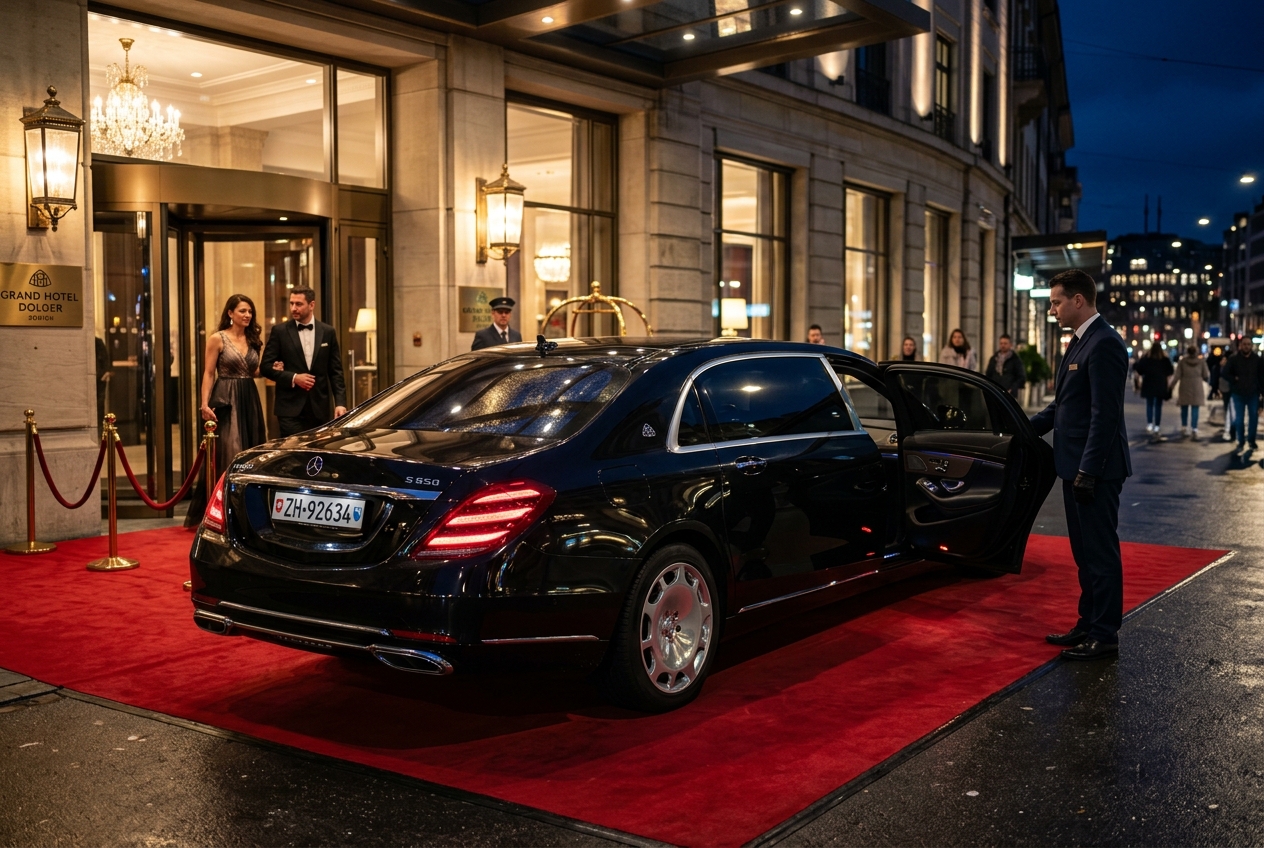
Bespoke Chauffeur Service Zurich: The Definitive 2026 Guide
58 min read · 13,350 words
A bespoke chauffeur service goes far beyond a standard transfer — it is built around your schedule, preferences and privacy rather than a fixed menu of options. This guide unpacks exactly what genuine personalisation looks like in Zurich, how to specify it, and what separates a truly tailored ride from one that merely claims to be.
What 'Bespoke' Actually Means in Premium Ground Transport
The word bespoke entered the English language through Savile Row, where a suit was said to be "bespoken" when the cloth had been set aside exclusively for one customer. Nothing about it was off-the-peg. The pattern was drawn for that person's shoulders, that person's posture, that person's preferences in lapel width and button stance. Transposing that idea into ground transport sounds straightforward, but in practice the industry uses the word so loosely that it has lost almost all meaning. A chauffeur company that lets you choose between a black saloon and a black SUV is not offering bespoke service — it is offering a menu. Understanding the genuine distinction matters, especially in Zurich, where the gap between a polished transfer product and truly tailored mobility is wide, consequential and immediately apparent to anyone who travels at a certain level.
Beyond the Vehicle: Why 'Bespoke' Is Not Synonymous With 'Luxury'
The most common misuse of the word occurs when it is applied exclusively to the car. A Mercedes-Maybach S-Class or a Bentley Flying Spur is undeniably a luxury vehicle, but placing a client in one without knowing anything about how they work, rest, communicate or prefer to be treated is simply expensive standardisation. The vehicle is the canvas, not the painting.
Genuine bespoke ground transport is better understood as a service architecture built around a specific individual or group for a specific journey or programme. It encompasses at least five distinct layers, each of which can be calibrated independently:
- Route and routing logic — the path taken, the sequence of stops, the contingency if something changes
- Timing and scheduling — when the car appears, how much buffer is built in, how the timetable flexes around live events
- In-cabin environment — temperature, music (or silence), reading material, refreshments, device charging, connectivity
- Communication style and protocols — how and when the chauffeur speaks, which channels are used for updates, whether a travel coordinator rather than the passenger is the primary contact
- Discretion and security parameters — what information is shared with third parties, how the vehicle is positioned at pickup, whether a secondary vehicle is required
A standardised transfer product, even a premium one, typically fixes most of these variables. You book a car class, you provide an address, a driver arrives. That model works perfectly well for millions of journeys. It becomes inadequate the moment a client's needs diverge meaningfully from the template — and in Zurich, they often do.
What Standardised Transfer Products Actually Deliver
To understand what bespoke replaces, it helps to be precise about what standardised services offer. Airport transfer platforms and ride-hailing applications have made enormous progress in reliability, app experience and pricing transparency. For a solo business traveller flying into Zurich Airport (ZRH) for a single meeting at Bahnhofstrasse and returning the same evening, a well-run fixed-price transfer is entirely adequate. The journey is predictable, the requirements are generic, and the value of customisation would be minimal.
The limitations surface in scenarios like these:
- A chief executive travelling with two assistants, sensitive documents and a need to conduct a phone call in privacy during the 25-minute drive to the city
- A family of five arriving from an intercontinental flight with significant jet lag, children who need the cabin at a specific temperature, and a stop at a pharmacy before the hotel
- A private equity team running a two-day roadshow with eight meetings across Zurich, Zug and Basel, where scheduling is live and will change in real time
- A principal who requires that their itinerary not be logged in any shared platform or communicated to hotel concierge staff
None of these situations is exotic. All of them expose the seams in a standardised service, because the product was not designed to absorb that kind of variability.
The Five Calibration Layers in Practice
Route and Routing Logic
In Zurich, even a short transfer involves genuine decisions. The direct route from the airport to the Dolder Grand, for instance, passes through Schwamendingen and up Adlisberg — beautiful in clear weather, slower in ice or mist. An alternative via Milchbuck and Zürichberg is marginally longer but more predictable in winter mornings. A bespoke provider knows the client's priority: scenic arrival, time certainty or fuel efficiency for a long onward journey. They also know that the client may want to stop at the Globus on Bahnhofstrasse without announcing this in advance.
Route customisation also includes sequencing when multiple passengers are collected from different addresses — a common scenario during WEF transfers between Davos hotels, or when a group is gathered from different parts of the city for an early Zurich Airport departure.
Timing and Scheduling Flexibility
Standard transfer products work from a fixed pickup time. Bespoke scheduling works from a fixed outcome — the client must be at a specific place by a specific time — and builds backwards with appropriate margins. Those margins are not arbitrary; they account for the specific terminal at ZRH (the Airside Centre connection to Dock E adds time), the security queue profile at a given hour, the client's mobility pace, and whether there is a meet-and-greet element that requires the chauffeur to be positioned landside before the flight lands.
The flexibility also operates in the other direction. A business dinner at Kronenhalle that runs long should not leave the client anxious about a fixed pickup window. In bespoke scheduling, the driver is on standby, not on a clock that runs against the client's interests.
In-Cabin Environment
| Element | Standardised Product | Bespoke Calibration |
|---|---|---|
| Temperature | Vehicle default | Client preference noted at booking and applied from the moment of boarding |
| Music | Driver's choice or silence | Specific genre, playlist or complete silence as specified |
| Refreshments | Bottled water, possibly | Still or sparkling, specific brands, dietary-appropriate snacks, coffee from a preferred source |
| Connectivity | Wi-Fi if available | Confirmed high-speed connection tested before pickup, device-specific chargers ready |
| Reading material | None | Specific newspapers (NZZ, FT, Le Monde), briefing documents printed if requested |
| Seating configuration | Fixed | Adjusted for working, resting, video call backdrop, or group conversation |
These details sound minor in isolation. Cumulatively, they represent the difference between a cabin that serves the client's next two hours and one that merely transports them.
Communication Style and Protocols
This is perhaps the most underappreciated dimension. Some clients want a brief, cordial greeting followed by silence and no further interaction unless they initiate it. Others prefer to be briefed on the route, the weather, or anticipated road conditions. Corporate travel managers may want all communications routed through them rather than to the executive directly. Some clients communicate exclusively via WhatsApp voice notes; others expect a formal email confirmation trail.
A bespoke provider establishes these preferences before the first journey and applies them consistently. The chauffeur who knows not to use the client's first name, not to offer unsolicited commentary and not to take calls in the vehicle is performing a communication protocol — one that was specified, learned and followed.
Discretion and Security Parameters
This layer receives its own dedicated treatment later in this guide, but it belongs here in the definitional framework because it fundamentally shapes how a bespoke service is constructed. A standardised transfer sends confirmation emails, stores booking history on shared platforms, dispatches a vehicle with company branding, and may have the driver confirm the booking verbally at pickup in a hotel lobby. Each of those steps is a potential disclosure of the client's itinerary, identity or routine.
Bespoke discretion protocols might include: unmarked vehicles, confirmation sent only to a personal assistant, chauffeur instructed not to confirm the passenger's name when asked, and no data retained after journey completion. These are not exotic requests in Zurich — they are routine requirements for a significant portion of the city's business and private client base.
Why the Distinction Matters Specifically in Zurich
Zurich is not a city where ground transport is an afterthought. It hosts the headquarters of major financial institutions, global commodities trading operations, pharmaceutical companies and international organisations. It is the gateway to Alpine ski resorts where discretion is currency. It receives delegations for the World Economic Forum and corporate roadshows that cross cantonal borders multiple times in a single day. Its hotels — the Baur au Lac, the Park Hyatt, The Dolder Grand — attract guests whose expectations were formed in cities where bespoke mobility is the norm.
In this environment, the gap between a well-maintained transfer vehicle and a genuinely tailored service is not invisible. It is felt immediately: in the temperature of the cabin on a January morning, in the absence of a conversation nobody wanted to have, in the route that avoids the precise bottleneck the client feared, in the confirmation that arrived through the right channel and contained exactly the information needed and nothing more.
Bespoke, properly understood, is not a premium tier on a dropdown menu. It is a methodology: a commitment to understanding the specific person, the specific journey and the specific outcome before a single variable is decided. That methodology begins long before the vehicle moves — and its quality is most visible in the moments that never required the client's attention at all.
Zurich as a Stage for Bespoke Travel: Geography, Venues and Logistics
Zurich occupies a geographically privileged but logistically demanding position at the heart of Central Europe. It sits at the north-western corner of Lake Zurich, roughly 400 metres above sea level, with the Alps visible on clear days from the upper city. That physical setting is not merely scenic — it is the single most important factor shaping how a bespoke chauffeur brief gets written, routed and executed here.
The Airport Corridor: ZRH to the City and Beyond
Zurich Airport (ZRH), located at Kloten, lies approximately 12–14 kilometres north of the city centre. On paper that suggests a short transfer. In practice, the corridor behaves very differently depending on time of day, day of the week and season.
The A1 motorway approach from Kloten feeds into the Milchbuck tunnel, where northbound city traffic regularly congests from 07:30 to 09:30 and again from 17:00 to 19:30 on weekdays. A professional chauffeur service working a bespoke brief will not quote "25 minutes" as a flat figure; it will distinguish between an 06:15 early-morning run — which can genuinely take 20 minutes in clear conditions — and a 17:45 arrival on a Tuesday in November, which may take 45 to 55 minutes door to door, particularly if the guest is arriving at Terminal 1 (the older domestic and Schengen satellite) versus the main Terminal 2 departure levels.
Key airport-corridor benchmarks under normal conditions:
| Route | Off-Peak (approx.) | Peak / Adverse (approx.) |
|---|---|---|
| ZRH Airport → Zurich City Centre | 20–25 min | 40–55 min |
| ZRH Airport → Zug | 30–40 min | 55–70 min |
| ZRH Airport → Lucerne | 45–55 min | 70–90 min |
| ZRH Airport → Basel | 60–70 min | 85–100 min |
| ZRH Airport → Bern | 85–100 min | 110–130 min |
| ZRH Airport → Davos | 130–150 min | 160–180 min (winter) |
| ZRH Airport → St. Moritz | 165–185 min | 195–220 min (winter) |
| ZRH Airport → Zermatt (road to Täsch) | 195–220 min | 240–270 min (winter/weekend) |
All figures assume Swiss motorway conditions. Winter benchmarks include the possibility of snow chains, reduced speed limits and occasional temporary closures on alpine passes. Zermatt itself is a car-free village; luggage transfer from Täsch is by mountain railway or authorised electric vehicle.
The Bahnhofstrasse and Paradeplatz Axis: Business Zurich at Ground Level
The strip between Zurich Hauptbahnhof (HB) and Paradeplatz — roughly 1.2 kilometres of pedestrianised and tram-served Bahnhofstrasse — is Switzerland's most concentrated financial address. The major clearing banks cluster on and immediately around Paradeplatz; law firms, asset managers and family offices occupy the streets radiating north and south. For a bespoke chauffeur service, this axis presents a specific logistical challenge: vehicles cannot stop freely on Bahnhofstrasse itself, and Paradeplatz is a tram interchange where parking is prohibited.
A bespoke brief for a Paradeplatz meeting, therefore, does not simply specify "collect at UBS" or "drop at Credit Suisse" — it specifies the secondary street, the exact entrance (most private banking buildings have a discreet lateral door rather than the public lobby), and whether the client requires the vehicle to wait nearby or to perform a loop and return on confirmation. Streets such as Bahnhofquai, Börsenstrasse and Pelikanstrasse are the practical staging grounds, all within 200–400 metres of the financial addresses but accessible to a waiting saloon or van.
The broader Innenstadt (City 1) grid — extending from HB south to Bürkliplatz and east toward the Niederdorf quarter on the right bank of the Limmat — has its own access constraints. Several streets operate restricted-access or pedestrian zones between 07:00 and 22:00. An experienced local chauffeur will know, for example, that Rämistrasse on the hill toward the university is a reliable northbound escape from the lakeshore tangle, and that Theaterstrasse offers cleaner access to the Opera House and the five-star hotels on the right bank.
The Seefeld and Enge Corridors: Hotels, Residences and Cultural Venues
Zurich's two most coveted residential and hospitality corridors each present different choreography for a chauffeur.
Seefeld (District 8) stretches along the eastern lakeshore from Bellevue toward Tiefenbrunnen. This is the address of the Zürichhorn park, several embassy residences and a concentration of internationally oriented dining. The road along the lake — Seefeldstrasse and Utoquai — carries light but fast-moving traffic and offers limited stopping opportunities directly on the water. Hotels and private residences here tend to have small forecourts or require drop-off via a side lane. A chauffeur working a bespoke Seefeld brief must know exactly which entrance to approach and whether a turnaround is feasible without reversing into tram tracks.
Enge (District 2) on the western lakeshore is home to the Zürichhorn-facing Hotel Baur au Lac — arguably Switzerland's most prestigious address — along with several embassies, the convention facilities of Kongresshaus and the Bürkliplatz tram hub. The Baur au Lac's private forecourt on Talstrasse is accessible but narrow; early-morning or late-night drop-offs for guests returning from alpine transfers benefit from pre-coordination with the hotel concierge, a relationship that a bespoke service maintains proactively rather than managing on the fly.
Further south in Enge and into the suburb of Wollishofen, private client residences require precise addressing — the district is compact but its streets loop inland from the lake, and GPS routing will occasionally suggest approaches that are impractical for larger vehicles such as a V-Class or a Cadillac Escalade. A bespoke chauffeur service holds this local address intelligence as part of its operational foundation.
Onward Alpine Routes: Planning for Altitude and Season
The three principal alpine destinations from Zurich — Davos in Graubünden, St. Moritz in the Engadin valley, and Zermatt in the Mattertal — each require a distinctly different routing and preparation logic.
Davos is reached via the A3 motorway to Chur, then the Landquart valley road north and the Flüelastrasse or Prättigau approach through Klosters. In winter — the season when demand spikes dramatically, particularly around the World Economic Forum in January — the Flüela Pass (2,383 m) is typically closed between November and May. The alternative via Landquart and Klosters adds no meaningful journey time but does mean navigating the narrow Prättigau corridor, which can experience convoy traffic during WEF week. A bespoke brief for WEF must account for official security perimeters, credentialed vehicle access zones and the reality that certain Davos streets are temporarily closed to non-accredited vehicles.
St. Moritz is accessed via Chur and then the Julier Pass (2,284 m), which remains open year-round but requires winter tyres from November through March and occasionally snow chains after heavy snowfall. The alternative route via the Maloja Pass or the Albula valley rail car-ferry (Vereina tunnel) adds flexibility but needs pre-booking in high season. Journey time from Zurich to St. Moritz in summer is approximately two hours fifty minutes in relaxed conditions; in January weekend traffic, particularly on Saturday changeover days when ski resorts peak, three and a half hours is a realistic working estimate.
Zermatt is Switzerland's most logistically particular destination because the village itself has been car-free since 1988. Guests travel by road to Täsch (the last authorised car park and drop-off point at roughly 1,450 m), then board the Matterhorn Gotthard Bahn shuttle up to Zermatt village (additional 12 minutes). A bespoke chauffeur brief for Zermatt must coordinate luggage handling at Täsch, confirm train departure times and — if the guest has significant luggage — arrange for the hotel in Zermatt to meet the train. The road from Visp to Täsch through the Mattertal is narrow, and in winter the drive from Zurich to Täsch realistically takes between three and three and a half hours, longer on the first weekend of February when the valley road sees heavy leisure traffic.
Cantonal Rules, Altitude Factors and Seasonal Logistics
Swiss cantons differ in their traffic and environmental regulations in ways that affect route planning. The Canton of Zurich enforces strict 30 km/h zones in residential streets, which are expanding progressively across the city. The Canton of Graubünden mandates winter tyres from a practical rather than fixed calendar date — snow chains must be carried on alpine routes from October through April. Several mountain approach roads operate one-way convoy systems at certain times (the Simplon and certain Gotthard alternative routes), with waiting times of up to 20 minutes at controlled sections.
Altitude itself affects journey comfort and vehicle performance. A client arriving from a long-haul flight and transferring immediately to St. Moritz at 1,856 metres may experience mild altitude effects; a bespoke chauffeur service operating in this environment keeps the cabin at a comfortable temperature, ensures still water is available and maintains a calm pace on serpentine climbs — details that are the quiet difference between a taxicab and a genuinely curated experience.
Finally, Swiss driving law imposes a 0.05% blood-alcohol limit (lower than the UK's 0.08%), and the country's road tunnel regulations — particularly fire safety rules governing tandem vehicle spacing inside the Gotthard, San Bernardino and Belchen tunnels — are actively enforced. A chauffeur who treats a Zurich-to-Lugano run as a simple distance calculation, rather than a route with convoy protocols, regulatory checkpoints and seasonal variables, is not operating at bespoke level. Understanding the full geography — urban, suburban and alpine — is the baseline from which genuinely tailored service in Zurich begins.
The Art of the Client Brief: How to Specify What You Need
Most people book a premium chauffeur the same way they order a taxi: a pickup address, a destination, a time. That is the bare minimum, and for an ordinary journey it is enough. For a genuinely bespoke experience, it is roughly equivalent to walking into a bespoke tailor and asking for "a suit." The result depends entirely on what you choose to communicate before the first stitch is made.
A well-constructed client brief is not a luxury affectation. It is a practical document — or conversation — that allows a professional chauffeur company to calibrate every variable under its control. The five minutes you invest in specifying your preferences can eliminate twenty minutes of awkward in-car adjustment and ensure that every subsequent journey with the same company feels effortless from the moment the door is opened.
Why the Brief Matters More Than the Vehicle
There is a temptation, particularly among first-time users of premium ground transport, to focus almost entirely on the car. Which model? What colour? Does it have massage seats? These are legitimate questions, but they are answered in a few seconds. The brief, by contrast, governs the entire experience: the temperature of the cabin, whether the chauffeur greets you by name or by title, whether your preferred newspaper is folded on the seat or waiting in digital form on the in-car tablet, whether your phone will be charged on arrival, whether silence or soft background music fills the journey.
A vehicle is hardware. The brief is the software that makes it run the way you need it to.
The Eight Domains of a Comprehensive Brief
Think of your preferences as falling into eight distinct domains. Covering each one — even briefly — gives a professional chauffeur company enough to work with.
1. Sensory environment
This covers sound, temperature and scent. It is also the area most clients skip entirely, assuming the default will be acceptable. It rarely is for everyone.
- Music: Do you want silence? Classical? Jazz? A specific Spotify playlist you can share in advance? Some clients find any music intrusive during early-morning transfers when they are mentally preparing for a meeting; others find complete silence uncomfortable on long motorway runs to Geneva or Bern. Neither preference is unusual — but neither can be guessed.
- Temperature: Swiss weather changes quickly between seasons and between the lake floor and the lower Alps. A chauffeur travelling from Zurich to Davos in February may cross a temperature differential of fifteen degrees Celsius in ninety minutes. Specify whether you prefer a consistently warm cabin, a cooler setting for alertness, or a graduated adjustment.
- Scent: This is easily overlooked but significant. Some clients have sensitivities to air fresheners, leather conditioning products or even the cleaning agents used on upholstery. If you fall into this category, say so.
2. Refreshments and consumables
Still or sparkling water? A specific mineral water brand? Coffee from a flask? A cold brew? Tea with milk or without? Some chauffeur companies, including those offering higher-tier vehicles, can accommodate pre-loaded refreshments for longer journeys if given adequate notice.
Newspapers and periodicals deserve a separate note. The Financial Times, the NZZ am Sonntag, The Economist — if a particular title signals the start of your working day, include it in your brief. Digital alternatives are increasingly common; if you use a press aggregator or a specific app, note that too. Snacks for long runs (Zurich to St. Moritz is roughly two and a half hours under normal winter conditions) or for clients travelling with children are worth specifying in advance.
3. Luggage handling and loading order
This is more nuanced than it appears. Do you carry a laptop bag that should never go into the boot? Do you have photographic or medical equipment that requires careful placement? Do you travel with multiple cases and expect the chauffeur to assist with all of them, or do you prefer to manage a carry-on yourself? On return transfers from the airport, do you want the chauffeur to proceed directly to the boot, or do you prefer a greeting first?
Specify loading priority — what goes in first, what stays within reach, what must not be stacked.
4. Mobile-phone and connectivity etiquette
Some clients use every minute of a transfer for calls. In that case, the chauffeur should understand that conversation with them is unwelcome unless initiated. Others use the car as a decompression space between meetings and prefer not to be disturbed even by polite enquiries about the route. Still others actively enjoy a brief, professional exchange with a knowledgeable local driver and would welcome a recommendation for dinner in the neighbourhood they are visiting.
None of these positions is right or wrong. All of them need to be stated.
If you regularly conduct confidential calls in the car, it is worth stating that explicitly. A professional chauffeur will already observe strict confidentiality as a matter of course, but articulating it in your brief signals the level of discretion you expect and reinforces the professional boundary.
5. Language preference
Switzerland's linguistic geography means this is genuinely relevant. A chauffeur company based in Zurich will routinely operate in Swiss German, High German, English and French, with many drivers covering Italian or other languages. If you prefer all communication to be in English, or if a non-native-English speaker in your party would be more comfortable in French, note this. For delegations or groups with a primary language that sits outside the company's default, advance notice allows appropriate matching.
6. Punctuality and buffer expectations
How much time do you habitually build in before a flight or a meeting? Do you prefer to arrive eight minutes early or thirty? Do you want the chauffeur to call ahead if traffic suggests a delay, or do you find interruptions during work calls irritating and prefer a text? These seem like small operational details, but they define whether a chauffeur feels proactive or intrusive.
7. Physical and access considerations
Height, mobility requirements, assistance with door handles, step-up height for larger vehicles — these are practical matters that affect which vehicle is appropriate and how the chauffeur should assist. This applies equally to elderly clients, guests recovering from an injury, or clients travelling with young children who require a specific type of car seat (which must be requested and confirmed well in advance).
8. Confidentiality scope
Beyond the general expectation of professional discretion, some clients need to specify what should not be acknowledged. Certain executives do not want their travel schedules confirmed to third parties, even casually. Some clients travelling for personal rather than business reasons may prefer that the company not contact their registered corporate account after the trip. Public figures may have preferences about pickup and drop-off positioning to avoid visibility. These are legitimate requirements that a professional operation can accommodate — but only if they are stated clearly and in advance.
Standing Brief vs. Single-Trip Preference Sheet
Once you have worked through the eight domains above, consider how you want to maintain that information.
A single-trip preference sheet is appropriate when you are travelling with guests whose preferences differ from your own, when you are using a chauffeur service for the first time, or when the nature of a trip is genuinely unusual (a wedding, a site visit, an airport run for an overseas delegation). It is produced once, shared with the company before the journey, and does not need to persist.
A standing brief — also called a passenger profile or client card in the industry — is a living document held on file by the chauffeur company and applied automatically to every booking under your name or account. Once established, it means you never have to re-specify that you want silence, still Henniez water and the cabin at twenty degrees. The company delivers it without prompting.
The standing brief is particularly valuable for frequent travellers and corporate accounts, where different members of staff may book on behalf of the same senior executive. The EA who arranges the transfer may not know that their director prefers to sit behind the passenger seat rather than the driver, but the brief does.
| Feature | Single-Trip Sheet | Standing Brief |
|---|---|---|
| Created for | One journey or group | Ongoing relationship |
| Held by | Client or booker | Chauffeur company's system |
| Applied | Manually, per trip | Automatically on all bookings |
| Updated by | Client before each trip | Client, as preferences evolve |
| Best for | First-time use, guests, events | Corporate accounts, frequent travellers |
| Effort after setup | Moderate (repeat each time) | Minimal (update only when preferences change) |
A Practical Brief Checklist
Adapt the following before your next booking. You can send it as a plain-text email, complete it in a booking form, or communicate it by phone — the format matters less than the content.
Sensory
- Music preference (genre, specific playlist, silence)
- Preferred cabin temperature (°C, or relative: warm / cool / no preference)
- Sensitivity to fragrances or cleaning products
Refreshments
- Water type (still / sparkling / brand preference)
- Hot beverage preference and timing (pre-journey flask, etc.)
- Newspaper or periodical (print / digital / title)
- Snacks or dietary requirements for longer journeys
Luggage
- Number and type of bags
- Items requiring special handling
- Loading and unloading preferences
In-Car Conduct
- Conversation welcome / not welcome unless initiated
- Call privacy requirement
- Preferred form of update if delayed (call / text / no contact)
Logistics
- Language preference for all communication
- Arrival buffer preference (minutes before meeting / flight)
- Seating position preference
- Mobility or access requirements
- Child seat requirement (age, weight, type)
Confidentiality
- Third-party disclosure restrictions
- Visibility preferences at pickup / drop-off locations
- Account separation (personal vs. corporate)
This checklist is deliberately comprehensive. In practice, many clients will have no preference on several items — "no preference" is itself a valid and useful answer that requires no further action. The point is to address each category deliberately rather than leaving it to chance, assumption, or a chauffeur's best guess.
A chauffeur service that receives a brief this thorough will, in return, be able to offer something genuinely bespoke: not a premium car driven competently, but a calibrated environment that serves your specific working style, health, schedule and professional standing. That is the difference between a luxury product and a luxury experience.
Fleet Decisions: Matching Vehicle to Purpose in Zurich
The first question a good chauffeur company asks is not "which vehicle would you like?" but "what are you actually trying to accomplish?" Vehicle selection in bespoke ground transport is a functional decision before it is an aesthetic one. Getting it wrong — arriving at a bilateral business meeting in an underpowered estate, or sending a solo traveller to a hotel in a seven-seat van — signals exactly the opposite of the considered judgement that bespoke service is supposed to project.
What follows is an honest account of when each vehicle class makes sense in a Zurich context, including the practical trade-offs that brochures rarely mention.
The Mercedes-Benz E-Class: The Underrated Workhorse
There is a persistent assumption that booking an E-Class represents a compromise. It does not. For a single executive or a couple travelling between Zurich Airport and a city-centre hotel, an E-Class is, in many respects, the ideal instrument: nimble enough to navigate Zurich's one-way systems around Niederdorf and Langstrasse, compact enough to stop cleanly in the drop-off bay of a Bahnhofstrasse property, and refined enough that the ride quality and interior finish cause no embarrassment whatsoever.
The practical case for an E-Class:
- Passenger capacity: up to three passengers comfortably; four at a push for short distances
- Luggage: two large suitcases plus cabin bags in the standard boot — adequate for most business trips
- Urban agility: width and turning radius matter on Zurich's older streets, particularly in Altstadt and around the Limmatquai; the E-Class handles these more gracefully than the S-Class or larger SUVs
- Mountain transfers: on routes such as Zurich Airport to Lucerne or to Andermatt, the E-Class performs perfectly well; it is not underpowered on Alpine gradients
Where the E-Class is the wrong choice: groups of more than three, clients travelling with substantial ski equipment or multiple large cases, and occasions where the vehicle's exterior presence is itself part of the brief — a first meeting with a sovereign wealth fund representative, for instance, where arriving in an S-Class or above is simply part of the professional vocabulary.
At BLACKTRANSFER, the E-Class transfer from Zurich Airport to the city is priced at CHF 120 (all-inclusive), which is the most cost-efficient option in the fleet. For frequent travellers with straightforward logistics, it is often the most intelligent choice.
The Mercedes-Benz S-Class: The Standard of Bespoke
The S-Class is the reference point against which everything else in premium chauffeur work is measured, and for good reason. Its rear cabin is genuinely spacious — not merely "comfortable" — and the insulation from road and wind noise is sufficient for confidential telephone conversations at motorway speed. The massaging seats, ambient lighting and panoramic roof are not marketing features; they reduce genuine fatigue on longer Swiss transfers.
The S-Class works well across the full range of Zurich-adjacent routes:
- City transfers: slightly wider than an E-Class but still manageable at the Airport's Terminal 1 and Terminal 2 drop-off areas and at hotels on Talstrasse or General-Guisan-Quai
- Intercity transfers: for routes such as Zurich to Zug (approximately 25 minutes), Zurich to Basel (around 65 minutes on the A3/A2) or Zurich Airport to Bern (roughly 1 hour 40 minutes), the S-Class is the natural default for solo executives or pairs
- Mountain routes: the S-Class handles the A13 San Bernardino corridor, the approach to Davos via Landquart and Klosters, and the Julier Pass road toward St. Moritz (when open in winter) competently; it is, however, a long, low-slung saloon, and on genuinely tight or steeply graded mountain roads it requires a skilled, unhurried driver
Privacy glass on current S-Class models significantly reduces visibility into the rear cabin, which matters for clients conducting video calls or travelling with sensitive documents during transfers.
The Mercedes-Benz V-Class: Undervalued for Small Delegations
The V-Class is consistently underestimated. It is configured here as a premium people-carrier — not a minibus — with leather seating for up to seven passengers, individual rear seats that can be arranged conference-style or facing forward, and significantly more luggage capacity than any saloon. For a delegation of three to six people arriving at Zurich Airport for a roadshow or board meeting, a single V-Class is almost always a more coherent solution than two separate S-Classes.
Why the V-Class beats two saloons for groups:
- One vehicle, one briefing: the group travels together, which allows pre-meeting alignment, avoids the coordination problem of two vehicles arriving at different moments and eliminates the slightly awkward question of who rides in the "better" car
- Luggage: the V-Class can accommodate the full luggage of a small delegation without compromise, including ski bags if relevant
- Cost: a V-Class at CHF 150 (Zurich Airport to city) is considerably less expensive than two S-Class bookings
- Mountain roads: this is where the V-Class surprises people; as a taller, four-wheel-drive-capable vehicle with Mercedes-Benz's AMG Line suspension options, it handles the road to Davos or the approach to Zermatt (as far as Täsch, where private vehicles are not permitted) more capably than a low-riding saloon in adverse conditions
The V-Class is the right call when privacy within the vehicle is less important than group cohesion, or when luggage volume is the binding constraint.
The Mercedes-Benz GLS and Cadillac Escalade: Presence and Alpine Capability
Both the GLS and the Escalade occupy a distinct position: they offer genuine SUV ground clearance and all-weather traction combined with executive-level cabin appointments. On Swiss mountain transfers in winter — the Engadine in January, the Verbier approaches in February — this combination is not a luxury but a practical necessity. Snow chains fit both vehicles, and neither struggles with the gradient changes on roads such as the Flüela Pass route to Davos (when open) or the Maloja Pass descent toward Chiavenna.
The Escalade is worth particular attention for clients from North American markets: the cabin dimensions, headroom and overall proportions align with expectations that European saloons simply do not meet. It is also the correct vehicle when a physical security escort requires an imposing, high-visibility presence.
The GLS, by contrast, integrates more naturally into the Swiss urban environment — it is a recognisable executive SUV rather than an American-market statement — and its MBUX interior matches the S-Class in technological sophistication.
The Mercedes-Maybach S-Class and Bentley Flying Spur: Protocol and Impression Management
These two vehicles exist in a different register. They are not simply "better" versions of the S-Class; they are instruments of protocol, and the decision to deploy them should be made consciously rather than reflexively.
Mercedes-Maybach S-Class: The Maybach's extended wheelbase gives rear-seat passengers a genuinely unusual amount of space — both for limb comfort and for the psychological effect of space itself. The Nappa leather, the fold-down footrests, the refrigerated compartment and the Burmester audio system are not incidental; they constitute a deliberate environment. For a client whose status requires that the vehicle itself communicate something — a state-adjacent meeting at the Dolder Grand, the arrival of a principal investor at the Baur au Lac, or a WEF participant transfer in Davos — the Maybach is the appropriate selection.
Bentley Flying Spur: The Flying Spur introduces a different vocabulary: British craftsmanship, open-pore wood veneers, hand-stitched leather and a powertrain that, whatever speed limit applies, communicates effortless reserve. Where the Maybach signals scale and formality, the Flying Spur signals connoisseurship. It is a more personal choice, and it works particularly well when the client has a relationship with the Bentley brand or where the cultural context prizes heritage over corporate scale.
Practical trade-offs to understand before choosing either:
| Factor | Maybach S-Class | Bentley Flying Spur |
|---|---|---|
| Rear-seat space | Exceptional (extended wheelbase) | Generous but slightly less than Maybach |
| Urban manoeuvrability | Moderate — length is a factor | Moderate — similar length constraints |
| Mountain road handling | S-Class platform — capable but low | GT platform — composed but road-dependent |
| Luggage capacity | Saloon boot — adequate for two | Saloon boot — similar |
| Visual signal | Corporate authority | Refined personal taste |
| Appropriate context | Protocol, state-adjacent, WEF | High-net-worth personal, brand-aligned |
Both vehicles carry privacy glass as standard in the BLACKTRANSFER fleet, and both are available for hourly hire (minimum three hours) as well as fixed transfers.
Matching Vehicle to Route: A Practical Summary
Swiss geography imposes constraints that no amount of vehicle prestige can override. The table below maps vehicle suitability to the transfer types most commonly booked from Zurich.
| Route type | Recommended vehicle | Notes |
|---|---|---|
| ZRH → Zurich city, 1–2 passengers | E-Class or S-Class | E-Class sufficient; S-Class if impression matters |
| ZRH → Zurich city, 3–6 passengers | V-Class | Single vehicle, full luggage, lower cost |
| Zurich → Davos or St. Moritz, winter | GLS, Escalade or V-Class | Higher clearance, chain compatibility |
| Zurich → Davos or St. Moritz, summer | Any class | Saloons handle summer Alpine roads well |
| Roadshow, multi-stop urban | S-Class (hourly) | Consistent presence across stops |
| Protocol arrival, state-adjacent | Maybach or Flying Spur | Vehicle as part of the brief itself |
| Small delegation, group cohesion | V-Class | Travel together, align en route |
| Ski resort (Zermatt direction, to Täsch) | GLS or Escalade | Road terminates at Täsch; luggage transfer to train or rack railway onward |
The honest answer to "which vehicle?" is almost always: the one that solves the actual problem without creating new ones. Bespoke selection means starting from requirements and working outward — not starting from the most impressive option and working backward to justify it.
Bespoke Scheduling and Timing: Beyond the Fixed Pickup Window
A fixed pickup time printed on a booking confirmation is, at best, an educated guess. Real bespoke scheduling treats that number as a starting point rather than a constraint, building enough intelligence and flexibility around it that the client's day survives contact with the unexpected — a delayed inbound flight, a meeting that overruns by forty minutes, or a lorry incident on the A1 that backs traffic from Härdwald to Zürich-West. The difference between a premium chauffeur service and a competent one is largely visible in how each handles those forty unplanned minutes.
Flight Tracking: Why Passive Waiting Is Not Good Enough
Every commercial flight arriving at Zurich Airport (ZRH) carries a publicly visible IATA status string, but that string tells only part of the story. An operator who monitors only the gate-arrival figure will often send a driver too early and charge for dead time, or dispatch too late after a diversion hold and leave the client stranded at baggage reclaim. Experienced providers use live feeds that distinguish between wheels-down, gate-docking and actual deplaning, then cross-reference against the relevant terminal — A for Schengen, B and E for non-Schengen, D for some charter and private movements — because each corridor has materially different walking distances to baggage carousels and customs channels.
BLACKTRANSFER tracks every inbound flight in real time and adjusts chauffeur positioning accordingly, without requiring the passenger to send a single update message. When a flight arrives early, the driver is already in position. When it arrives late, the vehicle is staged at an appropriate holding point rather than circling or incurring short-stay parking fees. The service includes sixty minutes of complimentary waiting at the airport from the time the flight lands — a policy that reflects how long baggage collection, customs clearance and corridor walks genuinely take on a busy Schengen morning versus a quiet midweek E-terminal arrival.
That sixty-minute buffer is not arbitrary. On a peak-season morning when Terminal E handles multiple intercontinental arrivals simultaneously, baggage carousels can run twenty-five to thirty-five minutes behind gate arrival. Adding a long-haul traveller carrying checked luggage through non-Schengen customs easily brings the real dwell time to fifty minutes. A bespoke service prices this reality into the base structure rather than punishing the client for a system delay they cannot control.
Corporate Roadshows: Scheduling Across a Moving Day
A corporate roadshow in Zurich is a masterclass in logistical compression. A fund manager might land at ZRH at 07:30, meet two asset managers on Bahnhofstrasse by 09:15, attend a luncheon at the Dolder Grand at 12:30, hold two afternoon sessions in the Zurich financial district, then catch a 19:05 departure to Geneva — all of which depends on a driver who understands not just the addresses but the rhythm of the day.
There are several practical layers to managing this well:
Buffer allocation between meetings. The default instinct is to insert the minimum transit time — say, eight minutes from Bahnhofstrasse to the Dolder Grand. A skilled operator adds a working buffer: fifteen to eighteen minutes for that segment to absorb a prolonged goodbye handshake, a pavement conversation that extends, or temporary lane narrowing on Rämistrasse during peak hours. If the meeting runs to time and the roads are clear, the client arrives a few minutes early and has a moment to collect their thoughts. If either variable degrades, the buffer absorbs it.
Sequencing meeting locations logically. When a client presents a list of addresses without a fixed order, an experienced chauffeur service will flag inefficiencies. Routing from Paradeplatz to Kloten and back to Seefeld before heading to the airport wastes forty minutes. Reordering the sequence to end the day closest to the highway corridor saves both time and fuel. This kind of advisory input — offered without overstepping — is a quiet marker of genuine bespoke service.
Real-time replanning during the day. If a morning meeting overruns by twenty minutes, the chauffeur should already know this before the client appears at the kerb. Communication between the operations desk and the driver allows the afternoon schedule to be compressed or adjusted while the client is still in the room. When the passenger gets in the car, the revised plan is already in place; the client does not need to manage the logistics.
Multi-Stop Itineraries Across Swiss Cities
Switzerland's compactness is deceptive. The distance from Zurich to Bern by road is roughly 130 kilometres, and on a clear midweek afternoon the A1 motorway will carry a car from the Sihlcity interchange to Bern Wankdorf in under ninety minutes. But "clear midweek afternoon" is not a guarantee — it is a condition that requires local knowledge to anticipate.
A typical multi-city business itinerary might cover:
| Leg | Route | Typical Duration | Key Risk |
|---|---|---|---|
| Zurich City → Lucerne | A14/A2 via Reppischtal | 50–65 min | A14 congestion near Zug after 17:00 |
| Zurich Airport → Bern | A1 via Härdwald | 80–100 min | Morning HGV convoys between Dietikon and Härkingen |
| Zurich City → Basel | A3/A2 via Pratteln | 65–85 min | Afternoon construction zones near Augst (2025–2026 roadworks) |
| Zurich → St. Moritz | A3/A13 via Chur | 2h 30–3h | Winter weekend ski traffic on the A13 south of Chur |
| Zurich → Davos | A3/A13 via Landquart | 2h–2h 30min | WEF week closures and convoy protocols in January |
The operator who simply puts these durations into a scheduling spreadsheet and adds fifteen minutes will eventually fail a client. The operator who understands that the A1 narrows from three to two lanes through the Härdwald tunnel, that the A3 through the Zürichsee corridor carries heavy HGV volumes from the Port of Basel overnight, and that a Europa League match at Letzigrund will cause the A3 on-ramp at Brunau to back up ninety minutes before kick-off — that operator has a materially different ability to protect the schedule.
Specific local patterns worth building into any multi-stop Zurich itinerary:
- A1 Westbound, 06:30–08:30: Significant commuter compression between Limmattal and Dietikon; add fifteen to twenty minutes against off-peak.
- A3 Northbound from Thalwil, 17:00–19:00: Lakeshore traffic after financial-district close; thirty-minute deviation is common.
- A4 through Winterthur: Functional but prone to incident delays on the Töss valley section; cross-country route via Bülach is sometimes faster for Schaffhausen-bound journeys.
- Zürich city core, Langstrasse and Escher-Wyss-Platz, all day: Light rail works and bike-lane reconfigurations ongoing through 2026 affect routing between Altstetten and the main station.
The Mechanics of Buffer Time: How It Should Be Calculated
Buffer time is not a flat percentage added to journey duration. Sophisticated scheduling treats buffers as variables with specific inputs:
Time-of-day sensitivity. A transfer from Zurich Airport to the Widder Hotel at 07:45 on a Tuesday carries a different risk profile than the same transfer at 10:30. The morning transfer needs a larger buffer for city-entry congestion; the mid-morning transfer can run tighter.
Event calendars. Zurich's annual schedule contains several predictable pressure points: the Street Parade in August, the Zurich Film Festival in late September, the Christmas market period from late November, and — relevant to clients using alpine routes — school half-term ski weekends in February and March when southbound motorway access to Graubünden and Valais slows measurably.
Client-specific factors. A passenger with mobility considerations needs more door-to-door time built in. A client travelling with several large cases after a three-week roadshow needs additional vehicle loading time. A group needing to make a collective decision about where to dine before confirming the next address adds soft time that a rigidly scheduled itinerary cannot absorb.
The recovery window. Any well-structured day includes at least one built-in moment where minor delays can be absorbed before they cascade. For a day that starts at Zurich Airport and ends at Geneva Airport, that recovery window might be the post-lunch transfer from the Widder to Paradeplatz — a four-minute journey that a good operator stretches to twelve without the client noticing, creating a reserve for the afternoon.
Coordination Infrastructure Behind the Scenes
Bespoke scheduling of this complexity requires more than a competent driver. It requires an operations layer: someone monitoring the live itinerary, watching traffic feeds, flagging diversions and maintaining communication between driver and client without becoming intrusive.
The best operators maintain 24/7 availability not because clients are calling at 03:00 most nights, but because the occasional 03:00 situation — a missed connection at GVA requiring a last-minute Zurich pickup, a client whose Basel evening meeting has just been rescheduled to Bern — demands a human being who can actually act. An automated booking platform cannot reroute a driver already en route, negotiate a parking extension at a closed venue or call a hotel concierge to hold the room while the schedule is reconstructed.
BLACKTRANSFER operates on this model: reachable by phone or WhatsApp around the clock, with drivers briefed not just on the address but on the purpose and sequence of the day, so that any disruption can be managed at the point where it occurs rather than escalated back to a client who is already sitting in a meeting.
Discretion, Privacy and Security: The Unspoken Dimension of Bespoke
Privacy in ground transport is rarely discussed openly — and that, in itself, is the point. For a significant proportion of the clients who commission bespoke chauffeur services in Zurich, discretion is not an amenity; it is a baseline condition without which no other element of the service has value. A perfectly timed arrival in a spotless S-Class means nothing if the passenger's schedule, identity or movements have been carelessly handled. Understanding how discretion actually works — operationally, legally and in terms of everyday etiquette — is essential before engaging any premium chauffeur provider in Switzerland.
The Privacy Expectations of Zurich's Most Demanding Clients
Zurich's position as a global financial centre, diplomatic hub and recurring venue for high-stakes events means the city regularly hosts individuals for whom privacy is a professional requirement, not a personal preference. Private equity partners conducting confidential roadshows, heads of state attending bilateral meetings at the Baur au Lac, technology executives negotiating acquisitions under NDA, and public figures whose personal security depends on movement opacity — all of them share a common expectation: that the people transporting them will behave as though they were invisible.
This expectation manifests in several distinct ways:
- Identity handling: The client's name should appear in as few internal systems as possible. Booking references, initials or corporate account codes are preferable to full names in dispatch records.
- Movement confidentiality: Route details, pickup locations, destination addresses and timing should be shared only with the driver directly assigned to that journey, and only on a need-to-know basis.
- Third-party silence: Hotel concierges, building reception staff and personal assistants who assist in coordinating the transfer should receive only the information they require to execute their specific role — nothing more.
- Digital hygiene: Confirmation emails, booking summaries and receipts should ideally be sent to a personal assistant or corporate account rather than a personal address that might generate data trails.
Swiss Legal Norms and How They Reinforce Discretion
Switzerland's approach to personal privacy is among the most robust in the world, and it shapes the operating environment for professional service providers in ways that visitors from other jurisdictions sometimes underestimate. The revised Federal Act on Data Protection (revFADP), which entered into force in September 2023, aligns Swiss standards broadly with the GDPR's principles of data minimisation, purpose limitation and storage limitation — but Switzerland's cultural and institutional tradition of confidentiality predates those regulations by generations.
For clients accustomed to other European markets, several Swiss-specific norms are worth noting:
- Proportionality of data collection: Swiss law and professional practice both favour collecting only the data strictly necessary for service delivery. A reputable Zurich chauffeur provider should not be storing granular journey histories, passenger photographs or biometric data beyond any operational necessity.
- Staff confidentiality obligations: Professional drivers working within a bespoke service framework operate under employment or contractor agreements that typically include explicit confidentiality clauses. In Switzerland, breach of professional secrecy carries genuine legal and reputational consequences.
- Cross-border considerations: Clients travelling between Switzerland and neighbouring countries — Germany, Austria, France, Italy, Liechtenstein — should be aware that data handling norms change at the border. A Swiss-based operator whose systems and staff are subject to Swiss law provides a consistent and well-understood privacy framework for the entire journey.
The practical effect of this legal environment is that working with a Zurich-registered, Swiss-operating provider is not merely a matter of convenience. It is a deliberate choice to operate within a jurisdiction whose professional culture and legal framework both incentivise restraint.
Non-Disclosure and the Etiquette of Anonymity
Beyond formal legal obligations, bespoke chauffeur service operates according to a set of unwritten professional conventions that experienced drivers understand instinctively and that less seasoned operators often get wrong.
The fundamental rule is that the chauffeur does not acknowledge the passenger in public. If a client is recognised on the street, approached by a journalist, or simply wishes to move through a hotel lobby without drawing attention, the driver's role is to facilitate movement — not to confirm identity, engage in conversation or react in any way that might draw the eye of bystanders. A discreet nod at the vehicle door; nothing more.
The meet-and-greet protocol for anonymity requires some nuance. Standard airport meet-and-greet involves a driver holding a name sign at arrivals — appropriate for most clients, but not for those who prefer not to have their name displayed in a public terminal. In such cases, the protocol shifts: the driver may use initials, a company name, a codename agreed in advance, or simply wait to be contacted via the number the client already holds. The driver knows what the passenger looks like; the sign, if used at all, is a convenience rather than a necessity.
In-vehicle behaviour follows equally well-understood conventions. The driver does not initiate conversation beyond what is necessary to confirm the destination or offer a preference (temperature, music, window). If the passenger takes a call, the partition remains closed or the driver behaves as though the conversation is inaudible. Notes are not taken. Observations are not made.
Route Confidentiality and Pre-Arrival Reconnaissance
For clients with active security concerns — whether personal, commercial or political — route management is as important as vehicle selection. Predictability is a vulnerability; the same route at the same time every day creates a pattern that can be identified and exploited.
A competent bespoke provider in Zurich will, for appropriate clients, undertake pre-arrival route reconnaissance: physically checking the proposed route, noting construction, events or other obstructions that could affect timing or introduce unwanted variables, and identifying alternative approaches to key destinations. Zurich's compact geography means that a driver with genuine local knowledge can often select from three or four viable route options between any two points in the city — a flexibility that becomes significant when discretion demands it.
Relevant considerations in a Zurich context:
| Situation | Typical Challenge | Bespoke Mitigation |
|---|---|---|
| WEF Davos transfers | Heavy traffic, media presence on mountain roads | Timing offset, convoy coordination, staged departures |
| Hotel arrivals (Baur au Lac, Dolder Grand, Park Hyatt) | Paparazzi or press at main entrance | Coordination with hotel security for service entrance use |
| Financial district meetings (Paradeplatz, Löwenstrasse) | No-stopping zones, high footfall | Pre-agreed drop point, driver on standby for immediate collection |
| Private aviation at ZRH (FBO/GA terminal) | Crossing apron access points | Advance coordination with FBO handler and customs if applicable |
| Zurich Airport public arrivals | Name visibility at meet-and-greet | Initials or code name on sign, or app-based contact only |
Pre-arrival reconnaissance is standard practice for transfers associated with major events — WEF in Davos, Art Basel, the World Health Assembly — where the concentration of high-profile individuals creates an elevated operational tempo and where the press presence is correspondingly intense.
Coordination with Hotel Security and Concierge Teams
Luxury hotels in Zurich maintain their own security and concierge infrastructure, and for clients travelling with personal protection officers or corporate security teams, the chauffeur provider functions as one node in a coordinated network rather than an independent operator. This requires a specific kind of professional maturity.
The driver or fleet coordinator should be capable of:
- Receiving and acting on a client's security team's advance brief, including timing protocols, communication channels and contingency instructions
- Coordinating arrival and departure logistics with the hotel concierge or duty manager without disclosing more information than the hotel strictly requires
- Adapting to last-minute changes in route, timing or pickup point without querying the reasons — changes of this kind are often themselves security measures
- Maintaining radio or phone silence at specified moments if instructed by a protection officer
Hotels such as the Baur au Lac, the Dolder Grand and the Park Hyatt Zurich have well-practised procedures for managing the arrivals and departures of guests who require discretion, and an experienced chauffeur provider will have an established working relationship with their concierge teams. This informal network — built over time, based on mutual trust — is one of the less visible but genuinely important assets of a Zurich-based premium operator.
The Signal Value of Swiss-Registered Vehicles
One element of discretion that is easily overlooked is the vehicle registration itself. In Zurich, a vehicle bearing ZH plates is unremarkable — it is simply a car registered in the canton, indistinguishable from thousands of others. A foreign-plated vehicle, by contrast, immediately signals a cross-border hire or a non-local operator, and in certain sensitive contexts — diplomatic venues, private clinics, residential areas where presence is noted — this distinction matters.
BLACKTRANSFER's entire fleet carries Swiss ZH plates, which serves both practical and reputational functions: vehicles pass through checkpoints and enter restricted zones without triggering the additional scrutiny that foreign registrations can attract, and clients can be confident that the operational base, insurance and regulatory compliance of the vehicle are subject to Swiss standards.
For security-conscious clients, this is not a trivial detail. It is the difference between a vehicle that belongs, visually and legally, to its environment — and one that does not.
A Note on Digital Footprint in the Booking Process
The booking process itself can generate a data trail that some clients prefer to minimise. Phone bookings — particularly via WhatsApp, where messages can be selectively deleted — leave a smaller persistent record than web-form submissions that are stored on servers. Corporate account structures, where the contracting entity is a company rather than an individual, further reduce the linkage between a specific person and a specific journey.
Clients with elevated privacy requirements should discuss their preferences explicitly at the point of engagement: how booking confirmations are transmitted, what identifying information appears on invoices, and how long journey records are retained. A professional provider will have considered these questions and will be able to give a clear, specific answer — not a vague assurance.
Pricing, Contracts and Corporate Accounts: Getting the Structure Right
Bespoke ground transport in Zurich rarely fails on the quality of the vehicle or the professionalism of the chauffeur. It fails on the commercial structure — the moment a client realises the quoted price did not include the Gotthard tunnel toll, the second hour of waiting at a board meeting, or the VAT that inflated the invoice by 8.1 per cent. Getting the pricing and contractual architecture right before a journey begins is, in many ways, the most practical expression of bespoke service: it removes friction precisely where friction is least welcome.
Fixed-Rate Logic: Certainty Over Calculation
The most common pricing model in premium ground transport is the fixed, all-inclusive transfer rate. The logic is straightforward: a client specifies an origin, a destination and a vehicle class, and receives a single price that does not change regardless of minor route adjustments, moderate traffic or standard waiting time at the destination.
For airport transfers — arguably the highest-stakes category of urban ground transport — fixed rates are especially valuable. BLACKTRANSFER, for example, prices a Mercedes-Benz E-Class from Zurich Airport (ZRH) to Zurich city at CHF 120 and the same journey in an S-Class at CHF 160, with the V-Class (for groups of up to seven) priced at CHF 150. These figures already absorb VAT, any applicable road tolls and up to 60 minutes of free waiting after landing — a buffer that accounts for immigration queues, baggage reclaim and the unpredictable rhythms of international arrivals.
The fixed-rate model extends to longer intercity and resort transfers. A journey from Zurich Airport to St. Moritz, for instance, is priced at CHF 890 in an E-Class — a figure that covers the considerable distance through the Engadin, the Julier or Maloja Pass depending on season and road conditions, plus any tunnel tolls en route. Reaching Zermatt, which requires a vehicle swap to the electric taxi system at Täsch, is priced at CHF 990, reflecting both the driving distance and the operational complexity of the handover. Geneva, at CHF 1,150, reflects the motorway distance of roughly 280 kilometres.
The discipline these rates impose is as much on the operator as on the client: the company must plan routes intelligently, absorb realistic wait times and build in contingency without padding invoices after the fact.
Hourly Arrangements: When Duration Matters More Than Distance
Not every bespoke engagement has a clear destination. A full-day roadshow across Zurich's financial district, an afternoon accompanying a principal between back-to-back private viewings, or a VIP arriving for the World Economic Forum who needs a vehicle on constant standby — all of these are better served by an hourly arrangement than a fixed-point transfer.
BLACKTRANSFER's hourly rates run across the fleet:
| Vehicle | Hourly Rate | Minimum Engagement |
|---|---|---|
| Mercedes-Benz E-Class | CHF 95 / hour | 3 hours |
| Mercedes-Benz V-Class | CHF 120 / hour | 3 hours |
| Mercedes-Benz S-Class | CHF 130 / hour | 3 hours |
| Mercedes-Maybach S-Class | CHF 220 / hour | 3 hours |
The three-hour minimum is standard practice in the industry and reflects genuine operational costs: a chauffeur cannot be productively redeployed for a one-hour engagement that requires 45 minutes of positioning on either side. Clients booking hourly arrangements should therefore assess whether a three-hour block is genuinely sufficient or whether extending to a half-day or full-day rate — where available — offers better value and fewer clock-watching interruptions.
For events such as WEF Davos, where demand is compressed into a narrow window and logistical complexity is extreme, hourly rates may be supplemented by positioning fees, overnight accommodation for the chauffeur and individual contractual terms negotiated in advance. This is not exploitation; it is an honest reflection of the resource commitment required.
Reading an All-Inclusive Quote: What Should — and Should Not — Be Itemised
A genuinely all-inclusive quote in Swiss chauffeur service covers four categories of cost that can otherwise appear as surprises on a final invoice:
1. VAT (MWST) Switzerland levied a standard VAT rate of 8.1 per cent on transport services. Reputable operators include VAT in the displayed price; if a quote is presented excluding tax, the difference on a CHF 890 transfer is over CHF 72 — not trivial. Always confirm whether the figure shown is the total you will pay.
2. Tolls and vignettes The Swiss motorway vignette (Autobahnvignette) costs CHF 40 annually and is valid for all motorways. Vehicles registered in Switzerland, including those on ZH plates operated by BLACKTRANSFER, carry this as a standing cost. Additional tolls apply for certain Alpine tunnels — the San Bernardino and Gotthard road tunnels both charge fees. A fixed all-inclusive quote should absorb these; an itemised surcharge appearing post-journey is a red flag.
3. Waiting time For airport transfers, the industry standard is 60 minutes of complimentary waiting after the flight lands — not from the scheduled arrival time, but from the actual touchdown, tracked in real time. Beyond that buffer, waiting is typically charged at a fraction of the hourly rate. Confirm the per-minute or per-15-minute rate in advance if your itinerary involves extended waits at non-airport locations.
4. Extras and add-ons Wi-Fi, bottled water, phone chargers, newspapers and child seats (where required by Swiss law for passengers under 12 weighing less than 36 kg) should be confirmed as included. Reputable operators provide these as standard; the invoice should not itemise them as extras.
Corporate Accounts: The Structural Advantage
Businesses that use chauffeur services more than a handful of times per year benefit materially from a corporate account rather than ad-hoc booking. The advantages are operational as much as financial:
- Centralised billing: A single monthly invoice replaces multiple individual card transactions, simplifying accounts-payable processes and VAT reclaim.
- Negotiated rates: Volume commitments — even modest ones — typically unlock preferential pricing, particularly on frequent routes such as Zurich Airport to Zug or Lucerne.
- Priority availability: During peak periods (WEF week, Art Basel, major Geneva auto show dates), corporate accounts with established operators tend to receive allocation priority over one-off bookings.
- Consistent chauffeur allocation: Some operators can assign a named chauffeur or a small pool of chauffeurs to a corporate account, which matters when discretion and familiarity with a principal's preferences are priorities.
- Simplified expense management: Many corporate platforms accept supplier invoices directly; a chauffeur company that issues structured invoices with job references, cost-centre codes and PO numbers integrates more cleanly into enterprise finance workflows.
BLACKTRANSFER accepts corporate account arrangements with invoice settlement, alongside card payments (Visa, Mastercard, Apple Pay, Google Pay) and PayPal for ad-hoc clients.
Roadshow Packages and Retainer Agreements
Investment bank roadshows, private equity deal tours and executive leadership travel across multiple Swiss cities have distinct requirements that neither a fixed-rate transfer nor a standard hourly arrangement captures fully. A roadshow package typically covers:
- Multiple daily pickup and drop-off points across one or more days
- Coordination with internal travel teams or PAs
- Real-time schedule adjustment as meetings overrun or compress
- Standby time between engagements without the clock-anxiety of per-minute billing
- Potentially multiple vehicles operating in parallel for larger delegations
The commercial structure for a roadshow is usually a negotiated daily rate or a block of hours spanning the engagement, with clearly defined rules for extensions. The key variable to specify in advance is standby time — the hours during which the vehicle and chauffeur are retained but not actively moving. A poorly drafted roadshow agreement that treats all standby as billable at the full hourly rate will produce unexpectedly high invoices; one that allocates a realistic number of standby hours within the day rate avoids this entirely.
Retainer agreements — where a company or UHNW individual secures a vehicle and chauffeur for a fixed period, typically monthly — are the most bespoke commercial arrangement available. They function analogously to a private aircraft time-share: guaranteed availability, known costs, consistent service. These arrangements are negotiated individually and fall outside standard rate-card pricing.
Cancellation Terms: Where the Contract Earns Its Keep
Cancellation policy is the clause that clients rarely read until they need it. In Swiss premium ground transport, the threshold structure is generally:
- More than 24 hours before pickup: Full refund, no penalty. This is the baseline that should appear in any reputable operator's terms.
- Within 24 hours of pickup: A 50 per cent cancellation fee is standard, reflecting that the vehicle and chauffeur have been blocked and redeployment at short notice is difficult.
- Within 3 hours of pickup, or no-show: 100 per cent of the fare is charged. At this point the chauffeur is en route or waiting, and the booking cannot realistically be filled.
For high-complexity engagements — WEF Davos transfers, weddings, multi-day events — individual cancellation terms apply and should be negotiated and documented in writing before any deposit is taken. The reason is structural: these engagements often require the operator to pre-position vehicles in Davos or secure specific vehicles weeks in advance, creating sunk costs that a standard 24-hour threshold does not cover.
One practical consideration for corporate travel managers: if your company's internal policy requires 48-hour notice for expense approval on discretionary travel, aligning that policy with a chauffeur supplier's 24-hour free-cancellation window prevents a situation where a cancelled booking incurs a penalty that the finance team then disputes.
Structuring the Conversation Before You Book
Before confirming any bespoke chauffeur engagement in Zurich, three questions resolve most commercial ambiguities:
- Is the quoted price the total amount that will appear on the invoice, including VAT and tolls?
- What is the waiting policy — how much is included, and what is the rate beyond that?
- What are the specific cancellation terms for this type of booking?
A provider who answers all three clearly and in writing, before taking payment, is demonstrating the same professionalism in the commercial relationship that they claim to offer in the vehicle. That alignment is what separates a bespoke service from a premium-branded one.
To discuss corporate accounts, roadshow packages or bespoke retainer arrangements, reach the BLACKTRANSFER team directly at +41 79 177 24 24 (also WhatsApp), by email at info@blacktransfers.ch, or through blacktransfers.ch — the team is available around the clock.
Frequently Asked Questions: Bespoke Chauffeur Service in Zurich
How far in advance should I book a bespoke chauffeur in Zurich?
For standard airport transfers and city journeys, 24 to 48 hours' notice is usually sufficient during normal periods. However, "bespoke" by definition involves more variables—specific vehicles, multi-stop itineraries, particular drivers, or specialist equipment—and each added layer requires more lead time to coordinate properly.
Practical benchmarks:
| Journey type | Minimum recommended notice |
|---|---|
| Standard airport transfer, single vehicle | 12–24 hours |
| Multi-vehicle group movement | 3–5 days |
| Roadshow with complex scheduling | 1–2 weeks |
| Alpine ski-season transfers (December–March) | 5–7 days minimum |
| WEF Davos week | 6–12 weeks (see dedicated entry below) |
| Weddings and private events | 4–8 weeks |
During Geneva Motor Show, Art Basel, Zurich Film Festival, and other high-demand periods, availability across all premium operators tightens sharply. Booking early is not a formality; it is the difference between securing the exact vehicle and driver combination you need and making do with whatever remains.
Does 'bespoke' automatically mean paying significantly more?
Not necessarily, and the distinction matters. Bespoke refers to the configuration of a service—itinerary flexibility, vehicle choice, privacy protocols, specific driver continuity—rather than to a premium markup applied to every line item. A well-structured bespoke relationship can actually reduce cost over time: negotiated corporate rates, consolidated invoicing, and fewer last-minute surcharges from scrambling to find alternatives.
What does attract higher cost is genuine customisation that requires resource commitment in advance: holding a specific vehicle exclusively, positioning a driver hours before pickup, or sourcing specialist equipment. Transparent operators will itemise these elements clearly so you understand what you are paying for. What should never inflate a bill is vague "bespoke service" language attached to an otherwise ordinary journey.
How are last-minute itinerary changes handled?
This is where the quality gap between premium and standard operators becomes most visible. A genuinely bespoke service maintains a live communication channel—WhatsApp, direct driver contact, and a dispatcher—so that changes can be relayed and confirmed in minutes rather than via an app with a 20-minute update lag.
Typical changes that should be handled without drama:
- Adding or removing a stop en route
- Adjusting pickup time by 30–60 minutes
- Swapping the drop-off address within the same city
- Extending an hourly booking by one or two hours (subject to driver availability)
Changes that require more lead time include switching to a larger vehicle class, adding a second car, or diverting to a different city entirely. For corporate travellers whose plans shift frequently, agreeing a clear change protocol before the first journey—ideally documented in an account agreement—removes ambiguity when time pressure is highest.
What languages do Zurich chauffeurs typically speak?
Zurich is one of Europe's most internationally minded cities, and its professional chauffeur community reflects that. German is the working language of German-speaking Switzerland, but English is widely spoken at a high level across the premium transport sector—you should expect fluent English as standard from any operator serving international clients.
Depending on the operator and driver roster, French, Italian, Spanish, Portuguese and Russian are also commonly available. Some services can accommodate requests for Mandarin or Arabic-speaking drivers with sufficient advance notice. If a specific language matters for client-facing journeys—a board member who prefers to conduct calls in French, for example—raise it explicitly during the booking process so the right driver can be assigned.
Can child seats be arranged, and which types are available?
Yes, and this is a request that any reputable operator should accommodate without difficulty, provided it is made at the time of booking. In Switzerland, children under 12 years old or shorter than 150 cm must be secured in an appropriate restraint system. The main seat categories are:
- Group 0/0+ – infant carriers (up to approx. 13 kg)
- Group 1 – forward or rear-facing seats (9–18 kg)
- Group 2/3 – booster seats with or without backrest (15–36 kg)
Specify the child's age and approximate weight when booking; this allows the correct seat to be fitted and tested before pickup. Seats should be provided clean and installed by the driver. It is reasonable to inspect the seat and its installation before departure.
How is ski and snowboard equipment transported on alpine routes?
Routes from Zurich to Davos, St. Moritz, Verbier, Zermatt, and other ski resorts are a staple of Swiss premium chauffeur work from December through March, and equipment handling is a standard part of the brief.
For a single traveller or couple with a ski bag and boots, a Mercedes-Benz E-Class or S-Class will generally suffice if luggage is moderate. For families or groups travelling with multiple sets of equipment, the Mercedes-Benz V-Class (up to 7 passengers) or a Cadillac Escalade provides significantly more boot space. For very large groups with significant kit, a second vehicle—sometimes a luggage van—runs alongside the passenger car.
Key practical points:
- Ski bags should be packed in protective sleeves to prevent damage to vehicle interiors
- Hard-shell snowboard bags are bulkier than soft ski bags; mention these specifically
- Roof boxes are rarely fitted to bespoke chauffeur vehicles; the solution is vehicle selection, not accessories
- Davos and St. Moritz routes involve mountain passes that are subject to seasonal closure; a competent operator will know alternative routing and carry snow chains as required by Swiss law
What happens if my flight lands much earlier or later than scheduled?
Flight tracking is a baseline competency for any professional airport transfer service, not a luxury add-on. BLACKTRANSFER, for example, monitors flight status from the point of booking and adjusts driver scheduling automatically when arrivals shift. The standard allowance for waiting at the airport is 60 minutes after the actual landing time at no extra charge—this accommodates normal baggage reclaim and customs clearance without the passenger feeling rushed.
For very early arrivals (diverted, tailwind, or schedule changes): a good operator will have the driver on standby and will make contact once you have cleared arrivals.
For significant delays (technical faults, weather, Air Traffic Control holds): the driver is rescheduled to match the revised arrival time. You should never land to find no car because the original slot passed three hours ago.
The critical assumption here is that the operator has your flight number. Always provide it—and if your flight changes, update the booking immediately.
Can I request the same driver for all my trips?
Yes, and this is one of the defining markers of a truly bespoke arrangement. Driver continuity matters for several practical reasons: a familiar driver knows your preferred temperature, your tendency to work in silence, which terminal you habitually use for departures, and how you prefer luggage handled. That institutional knowledge cannot be replicated by a new driver each time.
Request driver continuity explicitly when establishing your account. Operators who take this seriously will log the preference and default to that driver for all your bookings. Conflicts arise when the driver is unavailable—on leave, covering another booking, or ill—so a secondary preferred driver is worth identifying early. Some clients build a relationship with two or three drivers across a trusted fleet for exactly this reason.
Is pet transport possible?
It can be arranged, though it requires advance notice and the right vehicle configuration. The primary concerns are allergens, upholstery protection, and the comfort and safety of the animal.
Small dogs and cats travelling in approved carriers are generally the most straightforward to accommodate. Larger dogs or animals not in carriers require specific vehicle assignment and protective seat coverings. Operators may charge a cleaning supplement. It is not reasonable to arrive at pickup with an unannounced large dog and expect seamless service.
Raise the request at booking, specify the breed, size, and whether a carrier will be used, and confirm the operator's specific policy in writing before the journey.
How do payments work for international clients?
Major bespoke operators in Switzerland are set up for international clients as a matter of course. Card payments via Visa, Mastercard, Apple Pay, Google Pay and PayPal are standard. For corporate clients, invoice billing in Swiss Francs—with the option of EUR or GBP settlement by arrangement—is typically available once an account is established.
Key points for international clients:
- Prices for Swiss chauffeur services are quoted in CHF and include VAT at the applicable Swiss rate
- Currency conversion fees are applied by your own bank or card issuer, not by the operator
- Corporate accounts with consolidated monthly invoicing simplify expense reporting across multiple trips
- For large pre-planned programmes (roadshows, WEF, events), a deposit or pre-authorisation is standard practice and entirely normal
Ensure you receive a VAT-compliant receipt for every journey if expense reclaim is required.
What should I do if I leave luggage or belongings in the vehicle?
Contact the operator immediately—by phone, not email, which may not be monitored in real time. Any reputable operator logs every journey and knows exactly which driver and vehicle handled your transfer. Items found in vehicles should be held securely and returned to you at the next available opportunity, either on your next booking or by arrangement.
If you suspect luggage was lost at the airport or hotel rather than in the vehicle, the chauffeur service may be able to assist by confirming what was loaded and unloaded, which can support a formal lost-property report. A high-quality operator keeps notes on passenger luggage as a matter of course, particularly for high-value items.
For particularly valuable items—a laptop bag, a document case, jewellery—make it a habit to do a brief check of the seat and rear footwell before you exit.
How do WEF Davos bookings differ from standard arrangements?
The World Economic Forum in Davos, held in January, is the single most demanding logistical period in the Swiss premium chauffeur calendar. Several factors make it categorically different from ordinary bookings:
Demand and lead time: Nearly every competent operator at the premium end of the market is substantially committed weeks before the forum opens. Serious enquiries should begin no later than October for January travel, and November at the absolute latest.
Route complexity: The Zurich–Davos route (approximately 130–140 km via the A3/A13 motorway and the Prättigau valley, or alternatively via Landquart and the Davos Dorf approach) takes 1.5 to 2.5 hours depending on traffic and conditions. During WEF, traffic on approach roads to Davos is managed by Swiss security services, and access to certain zones requires verified credentials. Your chauffeur must be familiar with these access protocols.
Pricing and contract terms: Fixed-price WEF packages replace standard per-journey pricing for many operators. Cancellation terms during forum week are stricter—typically individual terms applying to the full engagement rather than the standard 24-hour policy.
Security environment: The Swiss federal and cantonal police maintain a substantial security presence throughout the forum. Vehicles are subject to inspection, and drivers must carry full documentation. An experienced operator will have completed this process in prior years and will brief clients accordingly.
How can I verify the legitimacy and quality of a bespoke operator before my first booking?
Due diligence before a first booking is entirely reasonable and any credible operator will welcome it. Here is a practical framework:
Registration and compliance:
- Swiss-registered chauffeur vehicles carry cantonal plates (ZH for Zurich) and must be properly licensed for commercial passenger transport
- Ask for the company's registered address and verify it against Swiss commercial register records (zefix.ch)
- Confirm that drivers hold the appropriate professional driving licence category
Fleet verification:
- Request specific details of the vehicle you will be assigned: make, model, year of registration, and plate number
- A reputable operator will provide this without hesitation; vagueness is a warning sign
Operational indicators:
- A 24/7 contact number that is actually answered
- A clear, itemised price quotation in CHF including VAT
- Written confirmation of booking terms, cancellation policy, and payment method
- A professional email domain rather than a generic address
References and track record:
- Corporate clients can ask for references from comparable clients (subject to confidentiality)
- Long-standing operators will have verifiable presence: a professional website, consistent contact details, and a physical business address
Your own instinct: If responses to straightforward questions are evasive, if pricing is vague, or if the operator resists providing vehicle details in advance, these are signals worth heeding before rather than after your first journey.